Kirchner Marion, Schneider Sabine
Center for Integrated Protein Science at the Department of Chemistry, Technische Universität München, 85748 Garching, Germany
RNA. 2017 May;23(5):762-769. doi: 10.1261/rna.058792.116. Epub 2017 Feb 16.
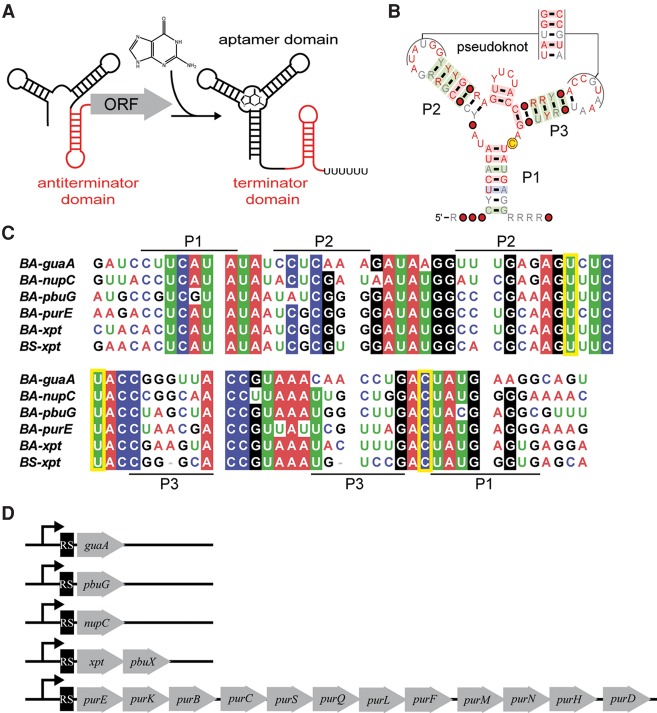
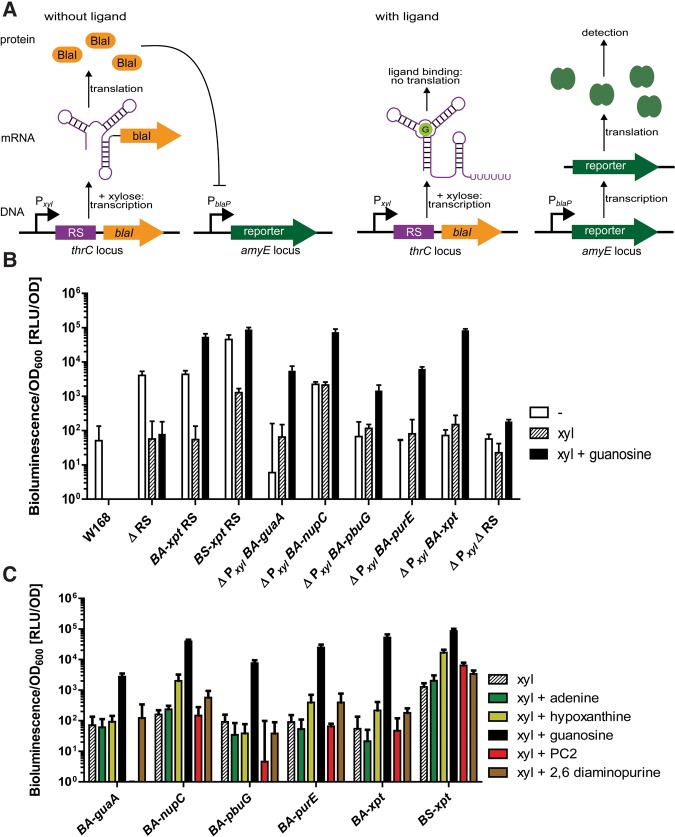
In all kingdoms of life, cellular replication relies on the presence of nucleosides and nucleotides, the building blocks of nucleic acids and the main source of energy. In bacteria, the availability of metabolites sometimes directly regulates the expression of enzymes and proteins involved in purine salvage, biosynthesis, and uptake through riboswitches. Riboswitches are located in bacterial mRNAs and can control gene expression by conformational changes in response to ligand binding. We have established an inverse reporter gene system in that allows us to monitor riboswitch-controlled gene expression. We used it to investigate the activity of five potential purine riboswitches from in response to different purines and pyrimidines. Furthermore, in vitro studies on the aptamer domains of the riboswitches reveal their variation in guanine binding affinity ranging from namomolar to micromolar. These data do not only provide insight into metabolite sensing but can also aid in engineering artificial cell regulatory systems.
在所有生命王国中,细胞复制依赖于核苷和核苷酸的存在,它们是核酸的组成成分以及主要的能量来源。在细菌中,代谢物的可利用性有时会通过核糖开关直接调节参与嘌呤补救、生物合成和摄取的酶和蛋白质的表达。核糖开关位于细菌mRNA中,可通过响应配体结合的构象变化来控制基因表达。我们建立了一个反向报告基因系统,使我们能够监测核糖开关控制的基因表达。我们用它来研究来自[具体来源未提及]的五个潜在嘌呤核糖开关对不同嘌呤和嘧啶的响应活性。此外,对核糖开关适配体结构域的体外研究揭示了它们在鸟嘌呤结合亲和力方面的变化,范围从纳摩尔到微摩尔。这些数据不仅有助于深入了解代谢物传感,还能辅助构建人工细胞调节系统。