Zhou Xianhui, Lv Wenkui, Zhang Wenhui, Ye Yuanzheng, Li Yaodong, Zhou Qina, Xing Qiang, Zhang Jianghua, Lu Yanmei, Zhang Ling, Wang Hongli, Qin Wen, Tang Baopeng
Pacing and Electrophysiological Department, the First Affiliated Hospital of Xinjiang Medical University; Urumqi, Xinjiang-P. R. China.
Anatol J Cardiol. 2017 Feb;17(2):82-91. doi: 10.14744/AnatolJCardiol.2016.7512.
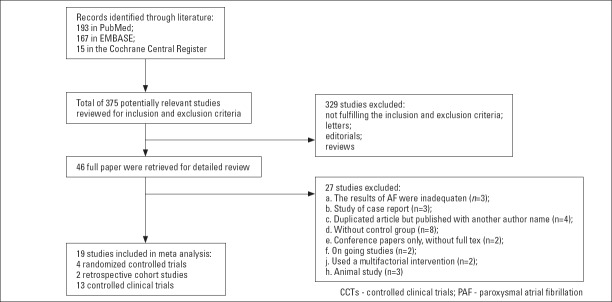
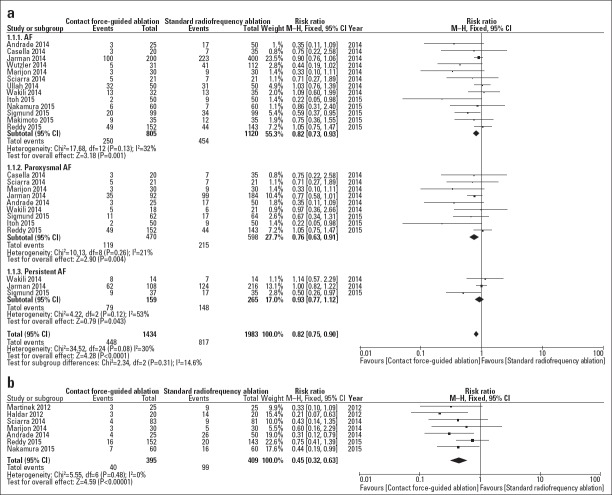
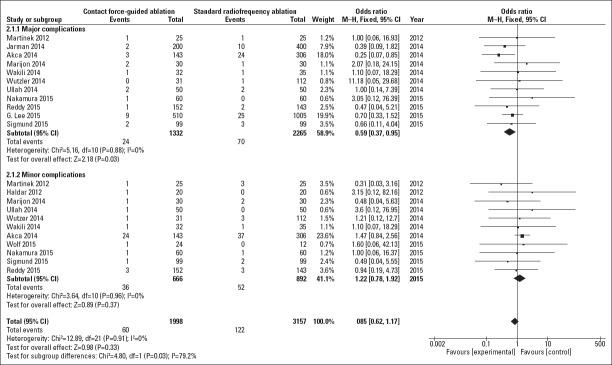
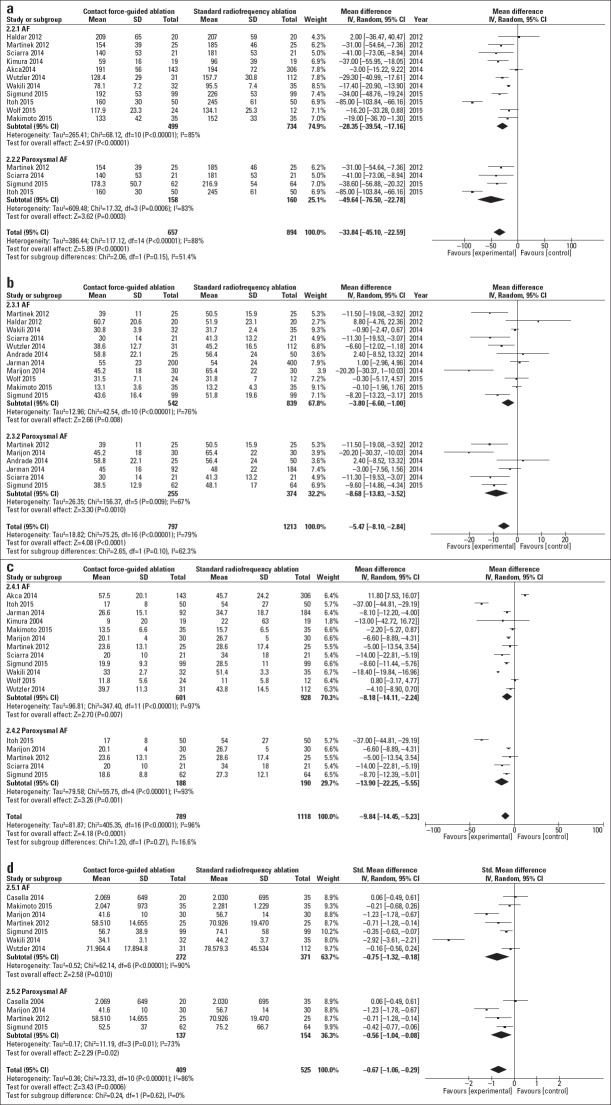
Contact force (CF) monitoring can be useful in accomplishing circumferential pulmonary vein (PV) isolation for atrial fibrillation (AF). This meta-analysis aimed to assess the efficacy and safety of a CF-sensing catheter in treating AF. Randomized controlled trials or non-randomized observational studies comparing AF ablation using CF-sensing or standard non-CF (NCF)-sensing catheters were identified from PubMed, EMBASE, Cochrane Library, Wanfang Data, and China National Knowledge Infrastructure (January 1, 1998-2016). A total of 19 studies were included. The primary efficacy endpoint was AF recurrence within 12 months, which significantly improved using CF-sensing catheters compared with using NCF-sensing catheters [31.1% vs. 40.5%; risk ratio (RR)=0.82; 95% confidence interval (CI), 0.73-0.93; p<0.05]. Further, the acute PV reconnection (10.1% vs. 24.2%; RR=0.45; 95% CI, 0.32-0.63; p<0.05) and incidence of major complications (1.8% vs. 3.1%; OR=0.59; 95% CI, 0.37-0.95; p<0.05) significantly improved using CF-sensing catheters compared with using NCF-sensing catheters. Procedure parameters such as procedure duration [mean difference (MD)=-28.35; 95% CI, -39.54 to -17.16; p<0.05], ablation time (MD=-3.8; 95% CI, -6.6 to -1.0; p<0.05), fluoroscopy duration (MD=-8.18; 95% CI, -14.11 to -2.24; p<0.05), and radiation dose (standard MD=-0.75; 95% CI, -1.32 to -0.18; p<0.05] significantly reduced using CF-sensing catheters. CF-sensing catheter ablation of AF can reduce the incidence of major complications and generate better outcomes compared with NCF-sensing catheters during the 12-month follow-up period.
接触力(CF)监测有助于实现房颤(AF)的肺静脉(PV)环形隔离。本荟萃分析旨在评估CF感知导管治疗房颤的有效性和安全性。从PubMed、EMBASE、Cochrane图书馆、万方数据和中国知网(1998年1月1日至2016年)中检索比较使用CF感知导管或标准非CF(NCF)感知导管进行房颤消融的随机对照试验或非随机观察性研究。共纳入19项研究。主要疗效终点是12个月内房颤复发,与使用NCF感知导管相比,使用CF感知导管时房颤复发显著改善[31.1%对40.5%;风险比(RR)=0.82;95%置信区间(CI),0.73 - 0.93;p<0.05]。此外,与使用NCF感知导管相比,使用CF感知导管时急性肺静脉重新连接(10.1%对24.2%;RR = 0.45;95% CI,0.32 - 0.63;p<0.05)和主要并发症发生率(1.8%对3.1%;OR = 0.59;95% CI,0.37 - 0.95;p<0.05)显著改善。手术参数如手术持续时间[平均差(MD)=-28.35;95% CI,-39.54至-17.16;p<0.05]、消融时间(MD=-3.8;95% CI,-6.6至-1.0;p<0.05)、透视时间(MD=-8.18;95% CI,-14.11至-2.24;p<0.05)和辐射剂量(标准MD=-0.75;95% CI,-1.32至-0.18;p<0.05)使用CF感知导管时显著降低。在12个月的随访期内,与NCF感知导管相比,CF感知导管消融房颤可降低主要并发症的发生率并产生更好的结果。