Beamer Edward, Fischer Wolfgang, Engel Tobias
Department of Physiology and Medical Physics, Royal College of Surgeons in Ireland Dublin, Ireland.
Medical Faculty, Rudolf-Boehm-Institute of Pharmacology and Toxicology, University of Leipzig Leipzig, Germany.
Front Neurosci. 2017 Feb 2;11:21. doi: 10.3389/fnins.2017.00021. eCollection 2017.
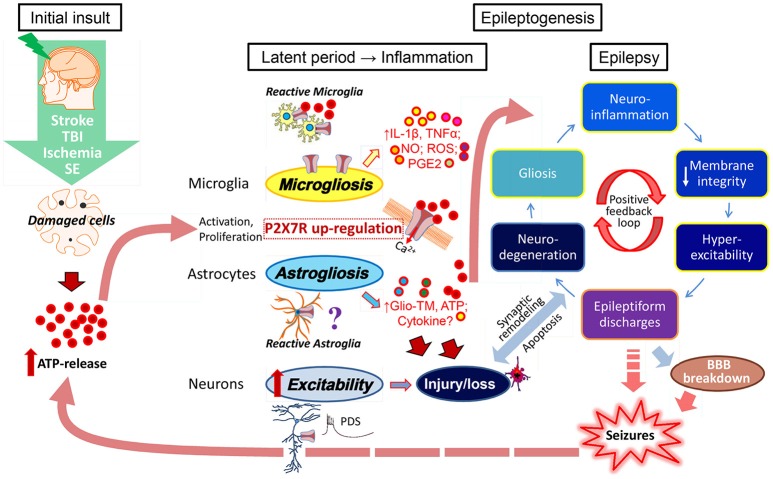
Despite the progress made in the development of new antiepileptic drugs (AEDs), the biggest challenges that epilepsy presents to drug development have remained unchanged for the last 80 years: finding a treatment with potential for modifying disease progression and reducing the percentage of patients resistant to all pharmacological interventions. The mechanism of action of the majority of AEDs is based on blocking Na and/or Ca channels, promotion of GABA or inhibition of glutamate signaling. In order for further progress to be made, however, a fuller picture of epilepsy will need to be considered, including changes to blood-brain barrier permeability, synaptic plasticity, network reorganization, and gliosis. In particular, brain inflammation has attracted much attention over recent years. Emerging evidence demonstrates a causal role for brain inflammation in lowering seizure thresholds and driving epileptogenesis. Consistent with this, intervening in pro-inflammatory cascades has shown promise in animal models of epilepsy, with clinical trials of anti-inflammatory agents already underway. The ATP-gated purinergic P2X7 receptor (P2X7) has been proposed as a novel drug target for a host of neurological conditions, including epilepsy. Constitutive expression of P2X7 in the CNS is mainly on microglia, but neuronal and astroglial expression has also been suggested. Its function as a gatekeeper of inflammation is most clearly understood, however, it also plays a number of other important roles pertinent to icto- and epileptogenesis: depolarization of the cell membrane, release of macromolecules, induction of apoptosis and synaptic reorganization. Changes in P2X7 expression have been reported following prolonged seizures (status epilepticus) and during chronic epilepsy in both experimental models and patients. While much of the early work focused on the study of P2X7 during status epilepticus, there is now mounting data showing involvement of this receptor during epilepsy. The present short review will discuss the most recent findings concerning P2X7 expression and function during epilepsy and the clinical potential for P2X7 antagonists as novel AEDs.
尽管新型抗癫痫药物(AEDs)的研发取得了进展,但在过去80年里,癫痫给药物研发带来的最大挑战仍未改变:找到一种有可能改变疾病进程并降低对所有药物干预均耐药的患者比例的治疗方法。大多数AEDs的作用机制是基于阻断钠和/或钙通道、促进γ-氨基丁酸(GABA)或抑制谷氨酸信号传导。然而,为了取得进一步进展,需要更全面地考虑癫痫的情况,包括血脑屏障通透性的变化、突触可塑性、网络重组和胶质增生。特别是,近年来脑炎症引起了广泛关注。新出现的证据表明,脑炎症在降低癫痫发作阈值和驱动癫痫发生中起因果作用。与此一致的是,在癫痫动物模型中,干预促炎级联反应已显示出前景,抗炎药物的临床试验也已在进行中。ATP门控嘌呤能P2X7受体(P2X7)已被提议作为包括癫痫在内的多种神经系统疾病的新型药物靶点。P2X7在中枢神经系统中的组成性表达主要在小胶质细胞上,但也有人提出神经元和星形胶质细胞也有表达。然而,其作为炎症守门人的功能最为明确,它还在癫痫发作和癫痫发生中发挥许多其他重要作用:细胞膜去极化、大分子释放、细胞凋亡诱导和突触重组。在实验模型和患者中,长时间癫痫发作(癫痫持续状态)后以及慢性癫痫期间,均有P2X7表达变化的报道。虽然早期的许多工作集中在癫痫持续状态期间对P2X7的研究,但现在越来越多的数据表明该受体在癫痫过程中发挥作用。本简短综述将讨论癫痫期间P2X7表达和功能的最新发现以及P2X7拮抗剂作为新型AEDs的临床潜力。