Bhushan Urvashi, Goswami Mridula
BDS, Postgraduate student in Department of Pedodontics and Preventive Dentistry at Maulana Azad Institute of Dental Sciences, New Delhi.
BDS, MDS, Head of the Department & Professor, Department of Pedodontics and Preventive Dentistry at Maulana Azad Institute of Dental Sciences, New Delhi.
J Clin Exp Dent. 2017 Feb 1;9(2):e211-e217. doi: 10.4317/jced.53259. eCollection 2017 Feb.
The success of pit and fissure sealants is directly related to their retention. The purpose of this study was to assess and compare the retention of pit and fissure sealants placed using acid etch alone and a combination of air abrasion and acid etch techniques.
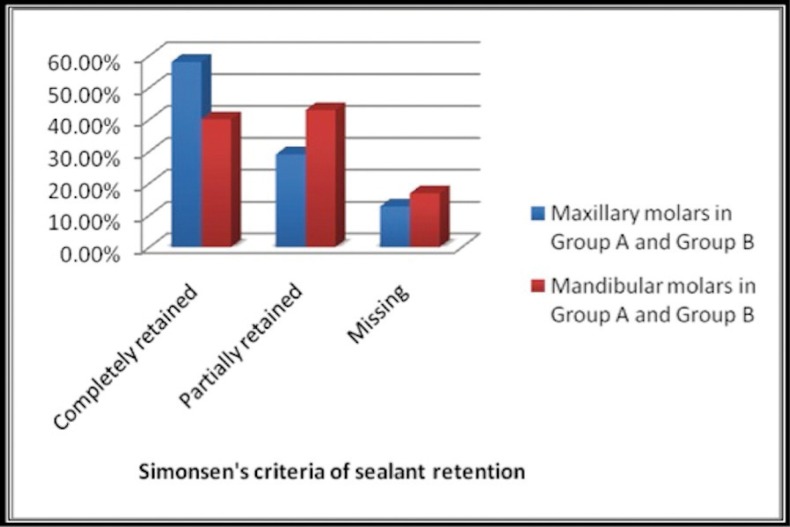
50 subjects aged 6-8 years were included in the study. Primary second molars and permanent first molars were sealed in all four quadrants using split mouth design. The right maxillary and mandibular molars (Group A) were treated by acid etching alone while the left maxillary and mandibular molars (Group B) were pretreated with air abrasion followed by acid etching before application of pit and fissure sealant. Retention of sealants was checked using Simonsen's criteria of sealant retention after three and six months of sealant application.
There was no significant difference in retention of sealants in Group A and Group B (<0.05) after three and six months follow up. The difference in sealant retention in primary and permanent molars was not significant (>0.05). Maxillary molars showed superior retention compared to mandibular molars, which was statistically significant at both three and six months (<0.05).
Combining air abrasion pretreatment with subsequent acid etching did not result in statistically significant difference in sealant retention compared to acid etching alone in both primary and permanent molars after 3 and 6 months follow up. An additional air abrasion pretreatment step can be avoided in pediatric patients when placing sealants and the procedure can be completed faster with better behavior management using acid etching alone. Pit and fissure sealant, acid etching, air abrasion.
窝沟封闭剂的成功直接与其保留率相关。本研究的目的是评估和比较单独使用酸蚀技术以及联合使用气磨和酸蚀技术放置窝沟封闭剂后的保留率。
本研究纳入了50名6至8岁的受试者。采用对侧半口设计,对所有四个象限的乳第二磨牙和恒第一磨牙进行封闭。右上颌和下颌磨牙(A组)仅采用酸蚀处理,而左上颌和下颌磨牙(B组)在应用窝沟封闭剂之前先进行气磨预处理,然后进行酸蚀。在封闭剂应用3个月和6个月后,使用西蒙森封闭剂保留标准检查封闭剂的保留情况。
随访3个月和6个月后,A组和B组封闭剂的保留率无显著差异(<0.05)。乳磨牙和恒磨牙封闭剂保留率的差异不显著(>0.05)。上颌磨牙的保留率高于下颌磨牙,在3个月和6个月时均具有统计学意义(<0.05)。
随访3个月和6个月后,与仅使用酸蚀相比,气磨预处理后再进行酸蚀在乳磨牙和恒磨牙封闭剂保留率方面无统计学显著差异。在为儿童患者放置封闭剂时,可以避免额外的气磨预处理步骤,仅使用酸蚀并通过更好的行为管理可以更快地完成操作。窝沟封闭剂、酸蚀、气磨。