Department of Sociology, University of South Carolina, Columbia, SC 29208, USA.
Department of Sociology, Stanford University, 450 Serra Mall, Bldg. 120, Stanford, CA, 94305, USA.
Sci Rep. 2017 Feb 17;7:42844. doi: 10.1038/srep42844.
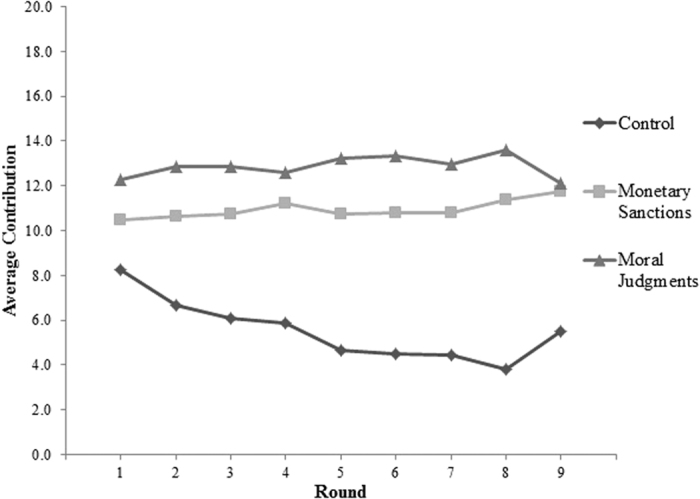
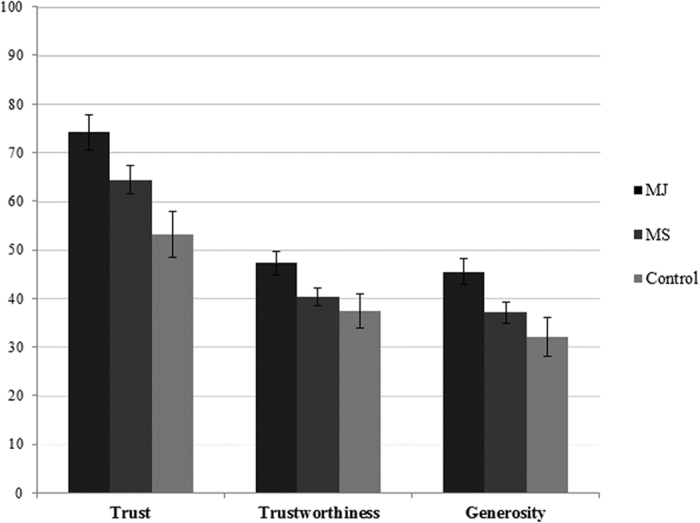
The threat of free-riding makes the marshalling of cooperation from group members a fundamental challenge of social life. Where classical social science theory saw the enforcement of moral boundaries as a critical way by which group members regulate one another's self-interest and build cooperation, moral judgments have most often been studied as processes internal to individuals. Here we investigate how the interpersonal expression of positive and negative moral judgments encourages cooperation in groups and prosocial behavior between group members. In a laboratory experiment, groups whose members could make moral judgments achieved greater cooperation than groups with no capacity to sanction, levels comparable to those of groups featuring costly material sanctions. In addition, members of moral judgment groups subsequently showed more interpersonal trust, trustworthiness, and generosity than all other groups. These findings extend prior work on peer enforcement, highlighting how the enforcement of moral boundaries offers an efficient solution to cooperation problems and promotes prosocial behavior between group members.
搭便车的威胁使得从群体成员那里组织合作成为社会生活的基本挑战。在古典社会科学理论中,人们认为通过执行道德边界,是群体成员相互制约自身利益和建立合作的关键方式,而道德判断通常被视为个体内部的过程。在这里,我们研究了积极和消极道德判断的人际表达如何鼓励群体合作和群体成员之间的亲社会行为。在一项实验室实验中,能够做出道德判断的群体比没有制裁能力的群体实现了更大的合作,其水平与具有昂贵物质制裁的群体相当。此外,道德判断群体的成员随后表现出比所有其他群体更多的人际信任、值得信赖和慷慨。这些发现扩展了关于同伴执行的先前工作,强调了执行道德边界如何为合作问题提供有效的解决方案,并促进群体成员之间的亲社会行为。