Andrade Gisele, Bertsch David J, Gazzinelli Andrea, King Charles H
Escola de Enfermagem, Universidade Federal de Minas Gerais, Belo Horizonte, MG, Brazil.
Center for Global Health and Diseases, Case Western Reserve University, Cleveland, Ohio, United States of America.
PLoS Negl Trop Dis. 2017 Feb 17;11(2):e0005372. doi: 10.1371/journal.pntd.0005372. eCollection 2017 Feb.
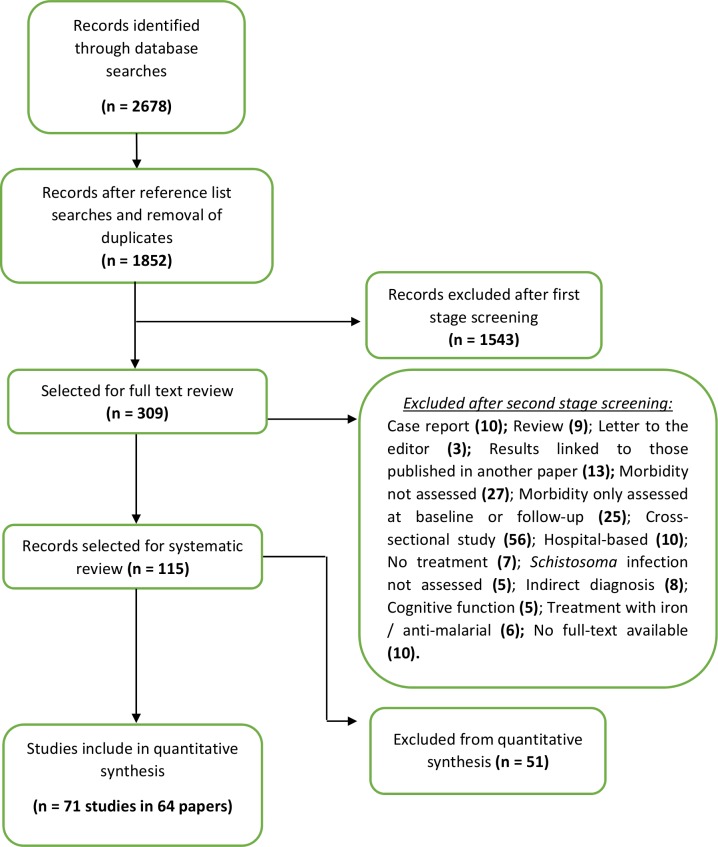
Since 1984, WHO has endorsed drug treatment to reduce Schistosoma infection and its consequent morbidity. Cross-sectional studies suggest pre-treatment correlation between infection intensity and risk for Schistosoma-related pathology. However, evidence also suggests that post-treatment reduction in intensity may not reverse morbidity because some morbidities occur at all levels of infection, and some reflect permanent tissue damage. The aim of this project was to systematically review evidence on drug-based control of schistosomiasis and to develop a quantitative estimate of the impact of post-treatment reductions in infection intensity on prevalence of infection-associated morbidity.
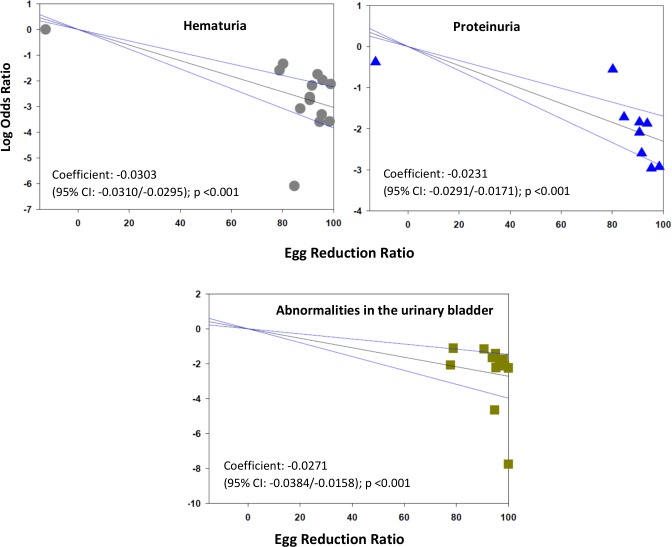
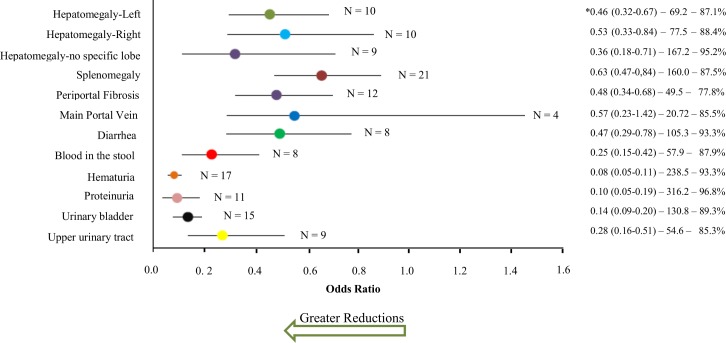
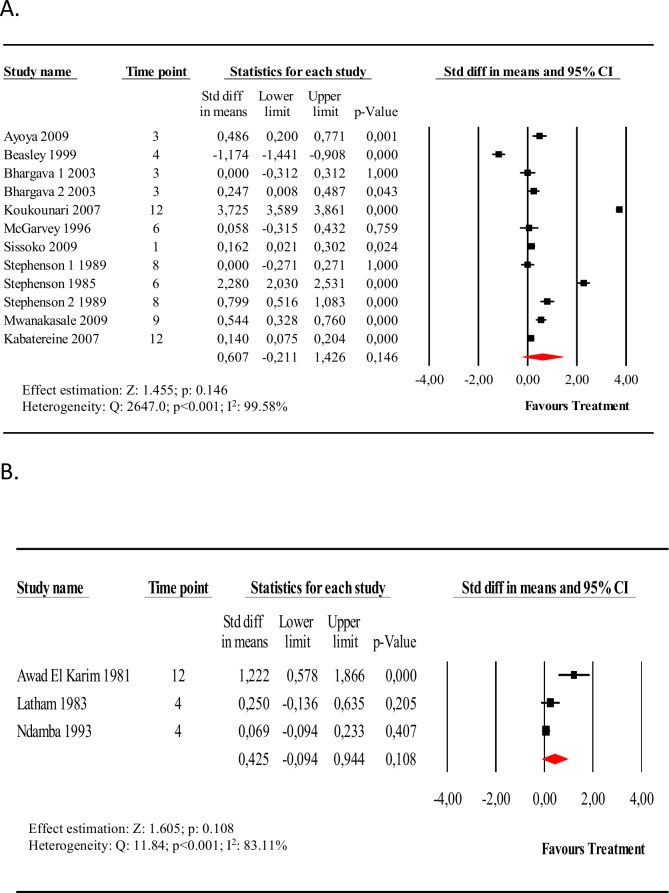
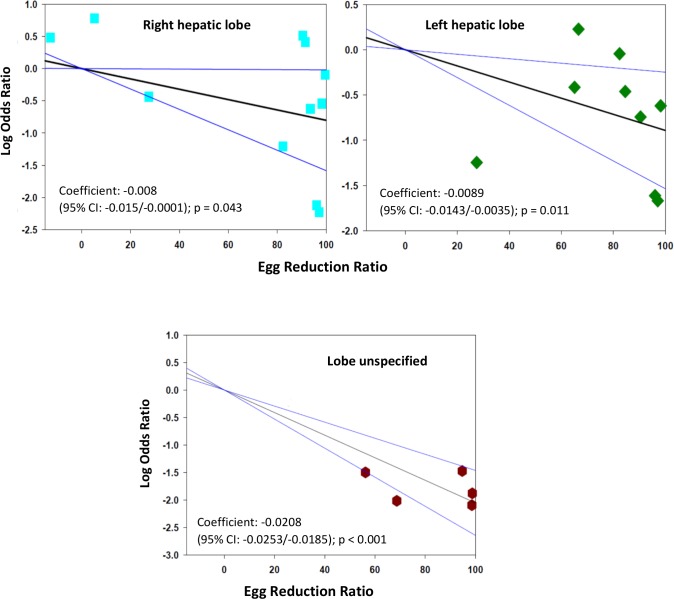
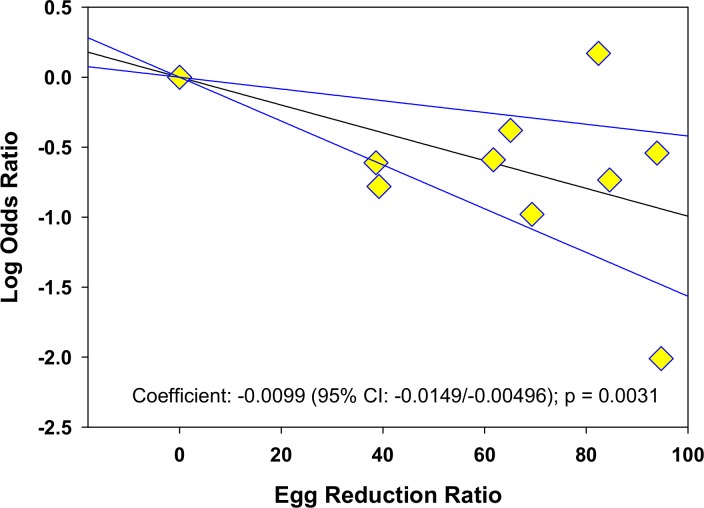
METHODOLOGY/PRINCIPAL FINDINGS: This review was registered at inception with PROSPERO (CRD42015026080). Studies that evaluated morbidity before and after treatment were identified by online searches and searches of private archives. Post-treatment odds ratios or standardized mean differences were calculated for each outcome, and these were correlated to treatment-related egg count reduction ratios (ERRs) by meta-regression. A greater ERR correlated with greater reduction in odds of most morbidities. Random effects meta-analysis was used to derive summary estimates: after treatment of S. mansoni and S. japonicum, left-sided hepatomegaly was reduced by 54%, right-sided hepatomegaly by 47%, splenomegaly by 37%, periportal fibrosis by 52%, diarrhea by 53%, and blood in stools by 75%. For S. haematobium, hematuria was reduced by 92%, proteinuria by 90%, bladder lesions by 86%, and upper urinary tract lesions by 72%. There were no consistent changes in portal dilation or hemoglobin levels. In sub-group analysis, age, infection status, region, parasite species, and interval to follow-up were associated with meaningful differences in outcome.
CONCLUSION/SIGNIFICANCE: While there are challenges to implementing therapy for schistosomiasis, and praziquantel therapy is not fully curative, reductions in egg output are significantly correlated with decreased morbidity and can be used to project diminution in disease burden when contemplating more aggressive strategies to minimize infection intensity.
自1984年以来,世界卫生组织已认可药物治疗以减少血吸虫感染及其所致的发病率。横断面研究表明,治疗前感染强度与血吸虫相关病理风险之间存在相关性。然而,有证据还表明,治疗后感染强度的降低可能无法逆转发病率,因为有些发病率在所有感染水平都会出现,而且有些反映的是永久性组织损伤。本项目的目的是系统评价基于药物控制血吸虫病的证据,并对治疗后感染强度降低对感染相关发病率患病率的影响进行定量评估。
方法/主要发现:本综述在开展时已在国际前瞻性系统评价注册库(PROSPERO,注册号:CRD42015026080)登记。通过在线检索和私人档案检索,确定了评估治疗前后发病率的研究。计算每个结局的治疗后比值比或标准化均数差值,并通过Meta回归将这些结果与治疗相关的虫卵计数减少率(ERRs)进行关联。更大的ERR与大多数发病率比值的更大降低相关。采用随机效应Meta分析得出汇总估计值:曼氏血吸虫和日本血吸虫治疗后,左侧肝肿大减少54%,右侧肝肿大减少47%,脾肿大减少37%,门周纤维化减少52%,腹泻减少53%,便血减少75%。对于埃及血吸虫,血尿减少92%,蛋白尿减少90%,膀胱病变减少86%,上尿路病变减少72%。门静脉扩张或血红蛋白水平没有一致变化。在亚组分析中,年龄、感染状况、地区、寄生虫种类和随访间隔与结局的显著差异相关。
结论/意义:虽然实施血吸虫病治疗存在挑战,而且吡喹酮治疗并非完全治愈,但虫卵排出量的减少与发病率降低显著相关,在考虑采取更积极的策略以尽量降低感染强度时,可用于预测疾病负担的减轻。