Xavier Seena Kanniparambil, Haneefa Shoja Muhammed, Anand Devkar Raviraj, Polo Picheswara Rao, Maheshwari Rajalekshmi, Shreedhara Chandrashekara Shastry, Setty Manganahalli Manjunath
Department of Pharmacognosy, Manipal College of Pharmaceutical Sciences, Manipal University, Manipal, Karnataka, India.
Department of Pharmacology, Manipal College of Pharmaceutical Sciences, Manipal University, Manipal, Karnataka, India.
Pharmacogn Mag. 2017 Jan-Mar;13(49):25-30. doi: 10.4103/0973-1296.197647.
is a plant, which is widely used in the indigenous system of medicine for the treatment of urolithiasis, renal disorders and inflammatory conditions. This is the first report on the antioxidant and nephroprotective activities of whole plant of .
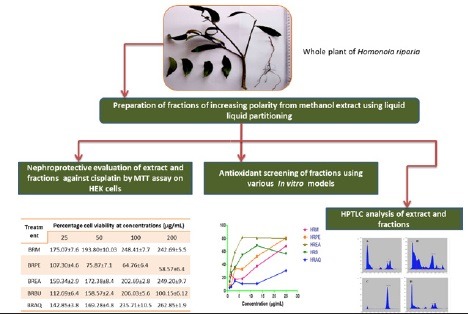
The present study aims at investigating the antioxidant and nephroprotective activity of the methanol extract and its different fractions of .
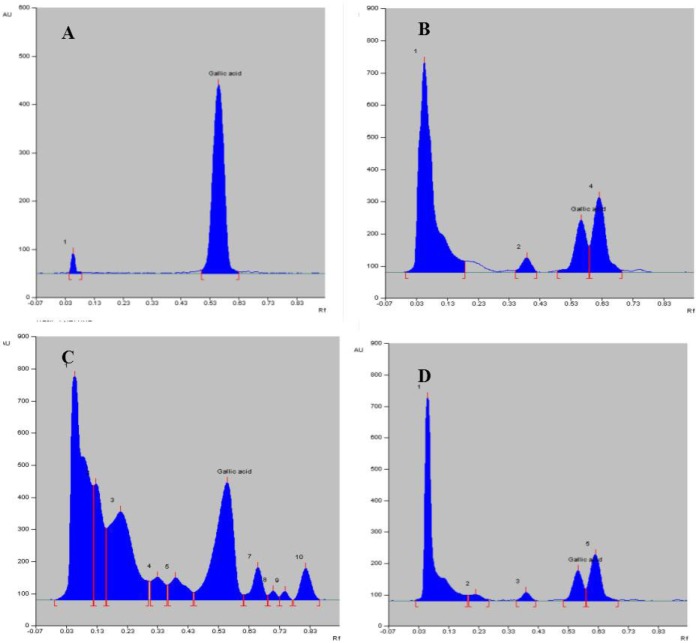
Petroleum ether (HRPE), Ethyl acetate (HREA), Butanol (HRBU), aqueous fractions (HRAQ) were prepared from the crude methanol extract of (HRM) using liquid partitioning. Total phenolic content, flavonoid content and antioxidant activity assay were performed according to suitable methods. Nephroprotective activities were evaluated by MTT assay using Human Embryonic Kidney cells against cisplatin induced toxicity. Quantification of gallic acid was performed using validated HPTLC method.
The studies showed that extract and fractions possess significant nephroprotective activity against cisplatin induced renal toxicity. All the extracts/fractions of whole plant of was found to be significantly reducing cisplatin induced toxicity (< 0.05). The highest activity was observed with HRBU and HRAQ with a percentage viability of 293.09 ± 4.3 and 345.07 ± 3.2 at a concentration of 200 µg/ml. Gallic acid was detected in the HRM/fractions using HPTLC.
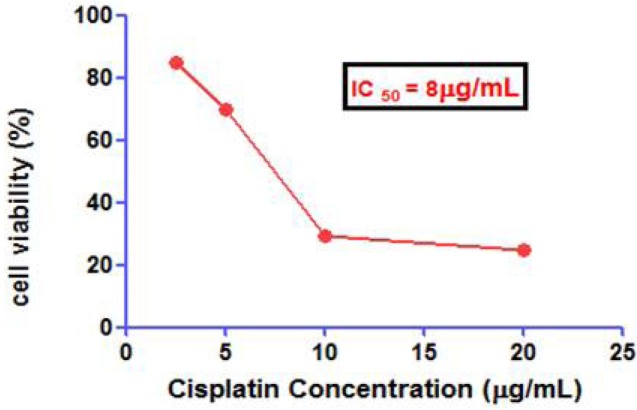
Cisplatin (8 μg/ml) exhibited 50 % inhibition in cell viability in HEK 293 cellsButanol and aqueous fractions of showed significant nephroprotective activity against cisplatin induced cell damage in HEK cells.Gallic acid was detected and quantified in the extract and fractions of whole plant of HPTLC: High Performance Thin Layer Chromatography, DPPH: 1,1-diphenyl-2-picrylhydrazyl, ABTS: 2,2'-azino-bis(3-ethylbenzothiazoline-6-sulfonic acid) diammonium salt, MTT: 3-(4,5-dimethylthiazolyl-2-yl)-2,5- diphenyl tetrazolium bromide, GAE: Gallic acid equivalents, QE: Quercetin equivalents, HEK: Human Embryonic Kidney, HRM: Methanol extract of H. riparia, HRPE: Petroleum ether fraction of H. riparia, HREA: ethyl acetate fraction of H. riparia, HRBU: Butanol fraction of H. riparia, HRAQ: Aqueous fraction of H. riparia, DMEM: Dulbecco's minimum essential medium, FBS: Foetal bovine serum, DMSO: Dimethyl sulfoxide, ANOVA: One way analysis of variance.
[植物名称]是一种植物,在传统医学体系中被广泛用于治疗尿路结石、肾脏疾病和炎症。这是关于[植物名称]全株抗氧化和肾保护活性的首次报道。
本研究旨在探讨[植物名称]甲醇提取物及其不同部位的抗氧化和肾保护活性。
采用液液分配法从[植物名称]粗甲醇提取物(HRM)中制备石油醚部位(HRPE)、乙酸乙酯部位(HREA)、正丁醇部位(HRBU)、水部位(HRAQ)。按照合适的方法进行总酚含量、黄酮含量和抗氧化活性测定。使用人胚肾细胞通过MTT法评估对顺铂诱导毒性的肾保护活性。采用经过验证的高效薄层色谱法对没食子酸进行定量。
研究表明,提取物及其部位对顺铂诱导的肾毒性具有显著的肾保护活性。发现[植物名称]全株的所有提取物/部位均能显著降低顺铂诱导的毒性(<0.05)。在浓度为200μg/ml时,HRBU和HRAQ的活性最高,细胞活力百分比分别为293.09±4.3和345.07±3.2。使用高效薄层色谱法在HRM/部位中检测到了没食子酸。
顺铂(8μg/ml)在人胚肾293细胞中使细胞活力受到50%的抑制。[植物名称]的正丁醇和水部位对顺铂诱导的人胚肾细胞损伤具有显著的肾保护活性。使用高效薄层色谱法在[植物名称]全株提取物及其部位中检测并定量了没食子酸。HPTLC:高效薄层色谱法,DPPH:1,1-二苯基-2-苦基肼,ABTS:2,2'-联氮-双-(3-乙基苯并噻唑啉-6-磺酸)二铵盐,MTT:3-(4,5-二甲基噻唑-2-基)-2,5-二苯基四氮唑溴盐,GAE:没食子酸当量,QE:槲皮素当量,HEK:人胚肾,HRM:[植物名称]甲醇提取物,HRPE:[植物名称]石油醚部位,HREA:[植物名称]乙酸乙酯部位,HRBU:[植物名称]正丁醇部位,HRAQ:[植物名称]水部位,DMEM:杜氏改良 Eagle 培养基,FBS:胎牛血清,DMSO:二甲基亚砜,ANOVA:单因素方差分析。