Ved Akash, Gupta Amresh, Rawat Ajay Kumar Singh
Goel Institute of Pharmacy and Sciences, Lucknow, Uttar Pradesh, India.
National Botanical Research Institute, Lucknow, Uttar Pradesh, India.
Pharmacogn Mag. 2017 Jan-Mar;13(49):108-113. doi: 10.4103/0973-1296.197648.
Linn. is an important plant in India traditional system of medicine which is widely used by different tribes in many countries.
In the present study, the antioxidant, cytotoxic and hepatoprotective activities of leaves were investigated against various models.
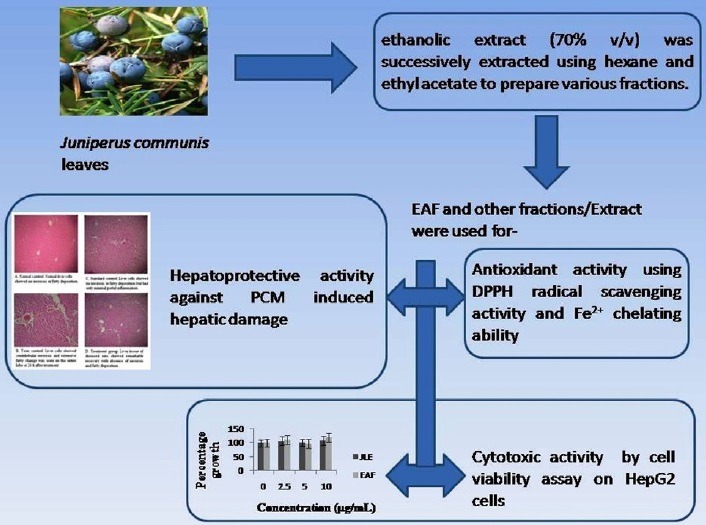
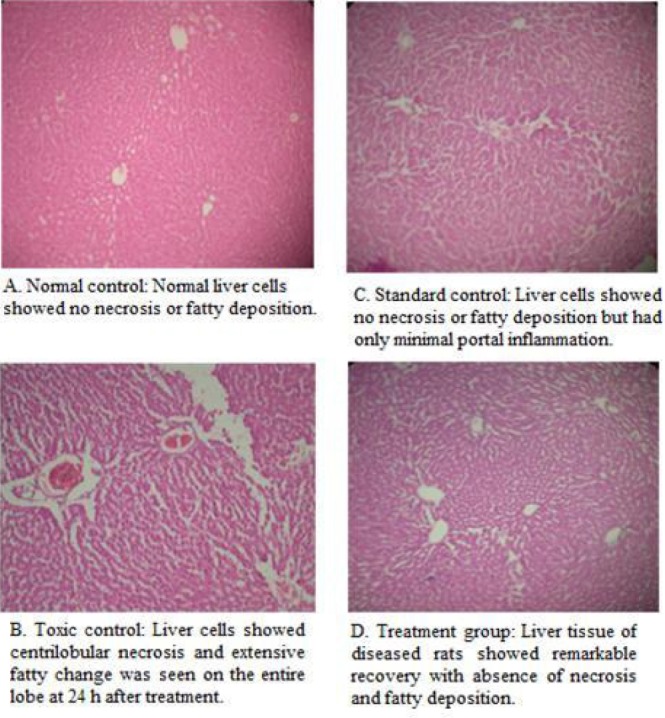
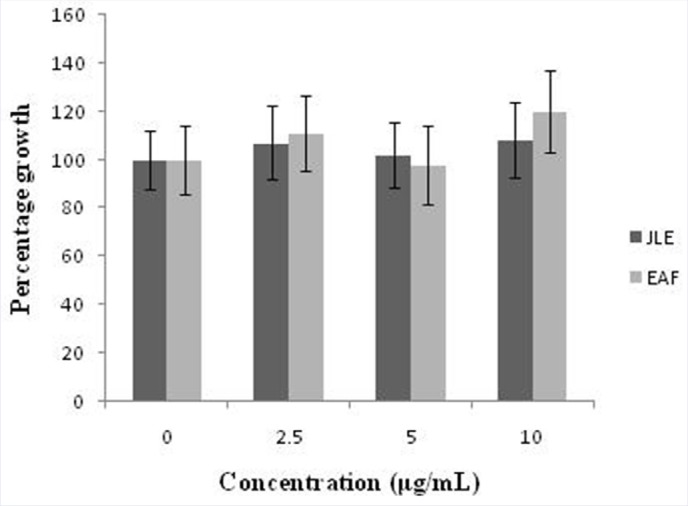
ethanolic extract (70% v/v) of leaves was successively extracted using hexane and ethyl acetate to prepare various fractions. Total phenol content was resolute by the Folin-Ciocalteau's process. The antioxidant properties of the different fractions/extract of leaves of were examined by 2,2-diphenyl-1-picrylhydrazyl (DPPH) radical scavenging activity and Fe chelating ability. Cytotoxic activity was examined by cell viability assay on HepG2 cells. Hepatoprotective activity of ethyl acetate fraction (EAF) evaluated against PCM-Paracetamol-induced hepatic damage in Wistar albino rats.
Total phenol content was found maximum 315.33 mg/GAE/g in EAF. Significant scavenging activity were found for EAF (IC = 177 μg/ml) as compared to standard BHT (IC = 138 μg/ml), while EAF showed good Fe chelating ability having an IC value of 261 mg/ML compared to standard ethylenediaminetetraacetic acid (7.7 mg/mL). It was found that EAF treated group shows remarkable decrease in serum Aspartate aminotransferase, serum Alanine aminotransferase, total bilirubin, direct bilirubin, and alkaline phosphatase level in treatment group as compared to the hepatotoxic group.
EAF of leaves is found to be potent antioxidant and hepatoprotective without any cytotoxicity and it can also be included in nutraceuticals with notable benefits for mankind or animal health.
Phenol-rich fraction (PRF) and other fractions/extract of leaves were screened for antioxidant, cytotoxic, and hepatoprotective activity.Significant antioxidant and hepatoprotective activity without any cytotoxicity were found while treating with ethyl acetate fraction (EAF). HepG2: Liver hepatocellular carcinoma, BHT: Butylated hydroxytoluene, PCM: Paracetamol, IC50: Half maximal inhibitory concentration, RSA: Radical Scavenging Activity, WST: Water-soluble tetrazolium.
Linn.是印度传统医学中的一种重要植物,在许多国家被不同部落广泛使用。
在本研究中,针对各种模型研究了[植物名称]叶的抗氧化、细胞毒性和肝保护活性。
用正己烷和乙酸乙酯依次萃取[植物名称]叶的乙醇提取物(70% v/v)以制备不同馏分。通过福林-西奥尔特法测定总酚含量。通过2,2-二苯基-1-苦基肼(DPPH)自由基清除活性和铁螯合能力检测[植物名称]叶不同馏分/提取物的抗氧化性能。通过对HepG2细胞的细胞活力测定检测细胞毒性活性。评估乙酸乙酯馏分(EAF)对扑热息痛诱导的Wistar白化大鼠肝损伤的肝保护活性。
发现EAF中的总酚含量最高,为315.33 mg/GAE/g。与标准丁基化羟基甲苯(IC50 = 138 μg/ml)相比,EAF具有显著的清除活性(IC50 = 177 μg/ml),而EAF显示出良好的铁螯合能力,其IC值为261 mg/ML,相比之下标准乙二胺四乙酸的IC值为7.7 mg/mL。发现与肝毒性组相比,EAF处理组的治疗组血清天冬氨酸转氨酶、血清丙氨酸转氨酶、总胆红素、直接胆红素和碱性磷酸酶水平显著降低。
发现[植物名称]叶的EAF具有强大的抗氧化和肝保护作用,且无任何细胞毒性,它还可被纳入对人类或动物健康有显著益处的营养保健品中。
对[植物名称]叶的富含酚类馏分(PRF)和其他馏分/提取物进行了抗氧化、细胞毒性和肝保护活性筛选。在用乙酸乙酯馏分(EAF)处理时,发现具有显著的抗氧化和肝保护活性且无任何细胞毒性。HepG2:肝肝细胞癌,BHT:丁基化羟基甲苯,PCM:扑热息痛,IC50:半数最大抑制浓度,RSA:自由基清除活性,WST:水溶性四唑。