Yin Li, Hu YingYing, Xu JiaLi, Guo Jing, Tu Jie, Yin ZhiQiang
Department of Dermatology, The First Affiliated Hospital of Nanjing Medical University , Nanjing , China.
Department of Oncology, The First Affiliated Hospital of Nanjing Medical University , Nanjing , China.
Front Immunol. 2017 Feb 3;8:91. doi: 10.3389/fimmu.2017.00091. eCollection 2017.
Psoriasis is a chronic immune-mediated inflammatory disease, and a mixed Th1/Th17 cytokine environment plays a critical role in the pathogenesis of psoriasis. Dermal fibroblasts secrete certain cytokines such as IL-6, IL-8, and CXCL-1, contributing to the hyperproliferative state of the epidermis in psoriatic skin. Ultraviolet B (UVB) phototherapy is one of the most commonly used treatments in psoriasis but the influence of UVB on human dermal fibroblasts (HDFs) in psoriasis treatment is not completely understood.
We conducted this study to mimic a psoriatic microenvironment in order to investigate and illustrate the combined effects of UVB, IL-17A, and TNF-α on HDFs.
The cultured HDFs were obtained from foreskin samples and divided into four groups, as follows: control; IL-17A/TNF-α; UVB; and IL-17A/TNF-α + UVB. Cultured HDFs were irradiated with 30 mJ/cm UVB followed by addition of IL-17A/TNF-α and incubated for 24 h. We used real-time quantitative PCR, Western blot, ELISA analysis, and flow cytometry to examine gene and protein expression of related pro-inflammatory cytokines and chemokines and receptors.
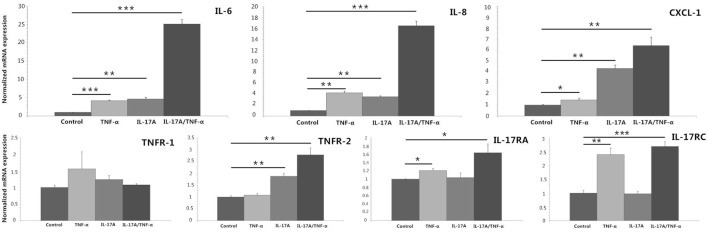
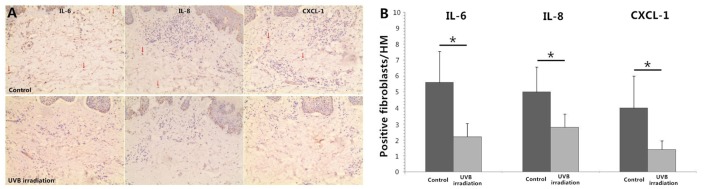
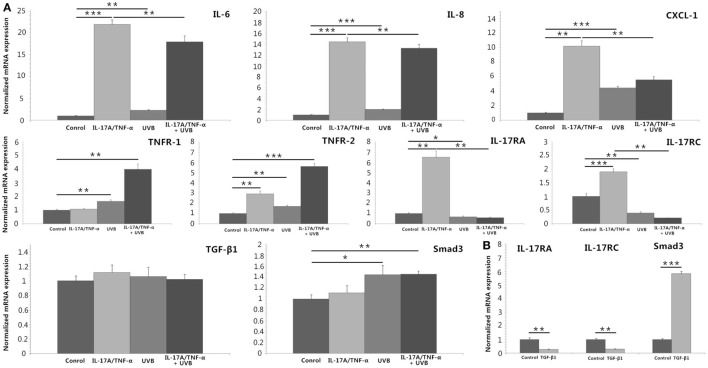
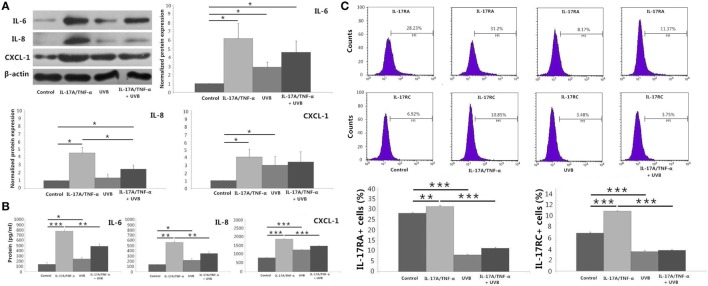
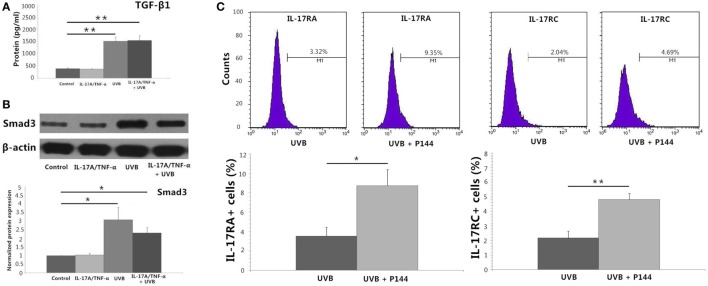
HDFs produced significant IL-6, IL-8, and CXCL-1 in response to IL-17A/TNF-α stimulation and UVB irradiation but UVB irradiation inhibited IL-17A/TNF-α-induced IL-6, IL-8, and CXCL-1 expression and downregulated the expression of IL-17RA and IL-17RC at both gene and protein levels. Additionally, UVB irradiation induced significant TGF-β1 protein secretion and expression of Smad3 mRNA and protein by HDFs. TGF-β1 significantly induced the expression of Smad3 mRNA and downregulated the IL-17RA and IL-17RC expression on HDFs.
UVB irradiation inhibits IL-17A/TNF-α-induced IL-6, IL-8, and CXCL-1 production in HDFs by decreasing the expression of IL-17RA and IL-17RC on fibroblasts through TGF-β1/Smad3 signaling pathway, which reveals a new mechanism of the therapeutic action of UVB on psoriasis.
银屑病是一种慢性免疫介导的炎症性疾病,Th1/Th17细胞因子混合环境在银屑病发病机制中起关键作用。真皮成纤维细胞分泌某些细胞因子,如白细胞介素-6(IL-6)、白细胞介素-8(IL-8)和CXC趋化因子配体1(CXCL-1),导致银屑病皮肤表皮的过度增殖状态。紫外线B(UVB)光疗是银屑病最常用的治疗方法之一,但UVB在银屑病治疗中对人真皮成纤维细胞(HDFs)的影响尚未完全明确。
我们进行本研究以模拟银屑病微环境,从而研究和阐明UVB、IL-17A和肿瘤坏死因子-α(TNF-α)对HDFs的联合作用。
从包皮样本中获取培养的HDFs并分为四组,如下:对照组;IL-17A/TNF-α组;UVB组;以及IL-17A/TNF-α + UVB组。对培养的HDFs进行30 mJ/cm的UVB照射,随后添加IL-17A/TNF-α并孵育24小时。我们使用实时定量聚合酶链反应、蛋白质免疫印迹法、酶联免疫吸附测定分析和流式细胞术检测相关促炎细胞因子、趋化因子及其受体的基因和蛋白表达。
HDFs在IL-17A/TNF-α刺激和UVB照射下产生显著的IL-6、IL-8和CXCL-1,但UVB照射抑制了IL-17A/TNF-α诱导的IL-6、IL-8和CXCL-1表达,并在基因和蛋白水平下调了IL-17RA和IL-17RC的表达。此外,UVB照射诱导HDFs分泌显著的转化生长因子-β1(TGF-β1)蛋白,并使Smad3信使核糖核酸(mRNA)和蛋白表达上调。TGF-β1显著诱导Smad3 mRNA表达,并下调HDFs上的IL-17RA和IL-17RC表达。
UVB照射通过TGF-β1/Smad3信号通路降低成纤维细胞上IL-17RA和IL-17RC的表达,从而抑制IL-17A/TNF-α诱导的HDFs中IL-6、IL-8和CXCL-1的产生,这揭示了UVB治疗银屑病的一种新机制。