MacDermid Joy C, Walton David M, Bobos Pavlos, Lomotan Margaret, Carlesso Lisa
School of Physical Therapy, Western University, 1151 Richmond Street, London, Ontario, N6A 3K7, Canada; Clinical Research Lab, Hand and Upper Limb Centre, St. Joseph's Health Care London, 268 Grosvenor Street, London, Ontario, N6A 4L6, Canada.
School of Physical Therapy, Western University, 1151 Richmond Street, London, Ontario, N6A 3K7, Canada.
Open Orthop J. 2016 Dec 30;10:746-756. doi: 10.2174/1874325001610010746. eCollection 2016.
Neck pain is common, but few studies have used qualitative methods to describe it.
To describe the quality, distribution and behavior of neck pain.
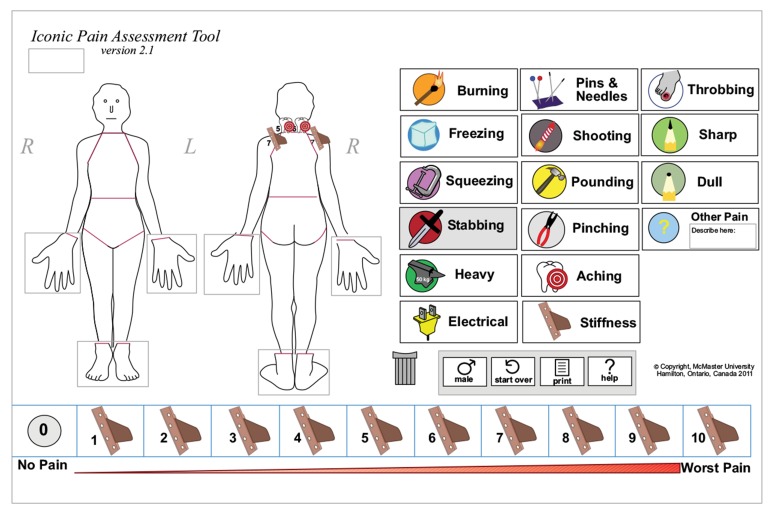
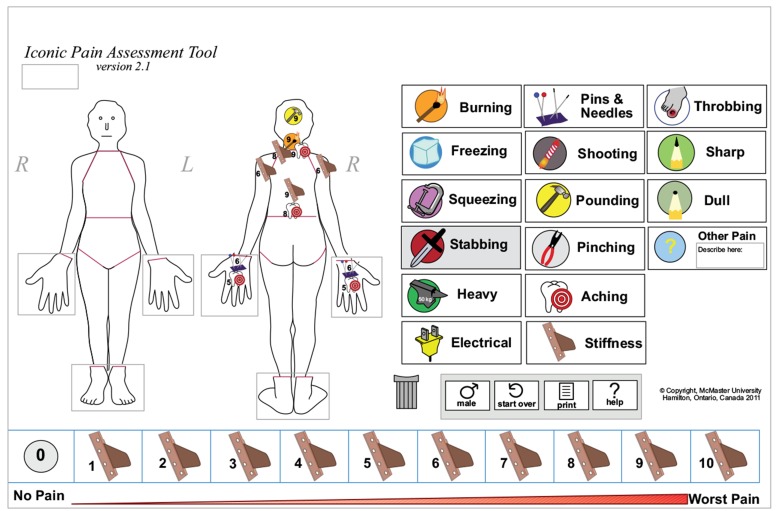
Sixteen people (15 females; mean age = 33 years (range = 20-69)) with neck pain >3 months were interviewed using a semi-structured guide. Interview data were recorded and transcribed verbatim. Descriptive content analysis was performed by two authors. Participants then completed an electronic descriptive pain tool, placing icons (word and icon descriptors to describe quality) on anatomic diagrams to identify location of pain, and intensity ratings at each location. This data was triangulated with interviews.
Aching pain and stiffness in the posterior neck and shoulder region were the most common pain complaints. All patients reported more than one pain quality. Associated headache was common (11/16 people); but varied in location and pain quality; 13/16 reported upper extremity symptoms. Neuropathic characteristics (burning) or sensory disturbance (numbness/tingling) occurred in some patients, but were less common. Activities that involved lifting/carrying and psychological stress were factors reported as exacerbating pain. Physical activity was valued as essential to function, but also instigated exacerbations. Concordance between the structured pain tool and interviews enhanced trustworthiness of our results. Integrating qualitative findings with a previous classification system derived a 7-axis neck pain classification: source/context, sample subgroup, distribution, duration, episode pattern, pain/symptom severity, disability/participation restriction.
Qualitative assessment and classification should consider the multiple dimensions of neck pain.
颈部疼痛很常见,但很少有研究采用定性方法来描述它。
描述颈部疼痛的性质、分布和表现。
采用半结构化指南对16名颈部疼痛超过3个月的患者(15名女性;平均年龄 = 33岁(范围 = 20 - 69岁))进行访谈。访谈数据进行记录并逐字转录。由两位作者进行描述性内容分析。参与者随后完成一个电子描述性疼痛工具,在解剖图上放置图标(用于描述性质的文字和图标描述符)以确定疼痛位置,并对每个位置进行强度评级。这些数据与访谈结果进行三角验证。
后颈部和肩部区域的酸痛和僵硬是最常见的疼痛主诉。所有患者均报告有不止一种疼痛性质。相关头痛很常见(11/16人);但位置和疼痛性质各不相同;13/16人报告有上肢症状。一些患者出现神经病理性特征(灼痛)或感觉障碍(麻木/刺痛),但不太常见。涉及提举/搬运和心理压力的活动被报告为加重疼痛的因素。体育活动被认为对功能至关重要,但也会引发疼痛加剧。结构化疼痛工具与访谈结果之间的一致性增强了我们结果的可信度。将定性研究结果与先前的分类系统相结合,得出了一个7轴颈部疼痛分类:来源/背景、样本亚组、分布、持续时间、发作模式、疼痛/症状严重程度、残疾/参与限制。
定性评估和分类应考虑颈部疼痛的多个维度。