Ryu Tae Ho, Kim Jin-Hong, Kim Jin Kyu
Department of Radiation Biotechnology, Korea Atomic Energy Research Institute, Jeongup 56212, Korea; Department of Biotechnology, Chonnam National University, Gwangju 61186, Korea.
Department of Radiation Biotechnology, Korea Atomic Energy Research Institute, Jeongup 56212, Korea; Department of Radiation Biotechnology and Applied Radioisotope Science, University of Science and Technology, Daejeon 34113, Korea.
Genome Integr. 2016 Dec 30;7:5. doi: 10.4103/2041-9414.197172. eCollection 2016.
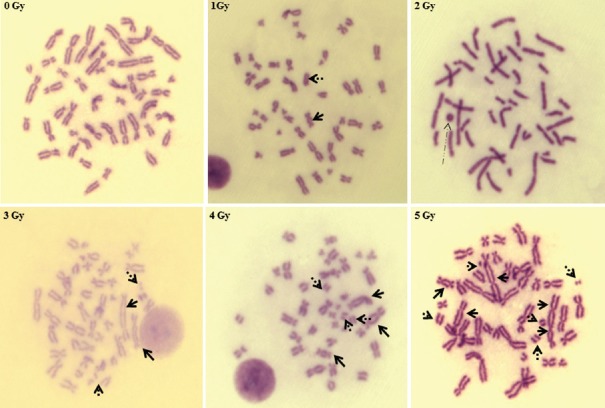
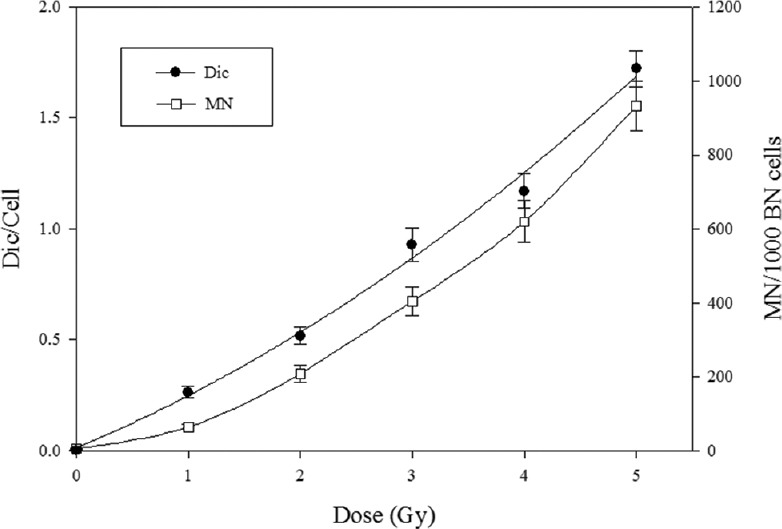
Biological dosimetry using chromosome aberration analyses in human peripheral blood lymphocytes is suitable and useful tool for estimating the dose when a nuclear or radiological emergency is investigated. Blood samples from five healthy donors were obtained to establish dose-response calibration curves for chromosomal aberrations after exposure to ionizing radiation. In this work, dicentric assay and CBMN assay were compared considering the sensitivity and accuracy of dose estimation. In a total of 21,688 analyzed metaphase spreads, 10,969 dicentric chromosomes, 563 centric rings and 11,364 acentric chromosomes were found. The number of metaphase cells decreased with increasing radiation dose. The centric rings were not found in the non-irradiated control. There was no relationship between radiation dose and acentric ring induction. The frequency of total MN increased in a dose-dependent manner. In comparison with the control value, MN increased about 9, 32, 75, 87, and 52 fold higher after treatment with 1, 2, 3, 4, and 5 Gy, respectively. The results revealed that the mean frequency of chromosomal aberrations, both in dicentric and in micronuclei analyses increased with increasing radiation dose.
在调查核或放射紧急情况时,利用人类外周血淋巴细胞中的染色体畸变分析进行生物剂量测定是估算剂量的合适且有用的工具。采集了五名健康供体的血样,以建立暴露于电离辐射后染色体畸变的剂量-反应校准曲线。在这项工作中,考虑到剂量估算的灵敏度和准确性,对双着丝粒分析和胞质分裂阻断微核分析(CBMN分析)进行了比较。在总共21688个分析的中期分裂相中,发现了10969条双着丝粒染色体、563个着丝粒环和11364条无着丝粒染色体。中期细胞的数量随着辐射剂量的增加而减少。在未受辐射的对照中未发现着丝粒环。辐射剂量与无着丝粒环诱导之间没有关系。总微核的频率以剂量依赖的方式增加。与对照值相比,分别用1、2、3、4和5 Gy处理后,微核增加了约9、32、75、87和52倍。结果表明,双着丝粒分析和微核分析中染色体畸变的平均频率均随着辐射剂量的增加而增加。