Vijayalakshmi J, Chaurasia Rajesh Kumar, Srinivas K Satish, Vijayalakshmi K, Paul Solomon F D, Bhat N N, Sapra B K
Department of Human Genetics, Sri Ramachandra Institute of Higher Education and Research (DU), Chennai, India.
Radiological Physics and Advisory Division, Bhabha Atomic Research Centre (BARC), Mumbai, India.
Heliyon. 2023 Jun 7;9(6):e17068. doi: 10.1016/j.heliyon.2023.e17068. eCollection 2023 Jun.
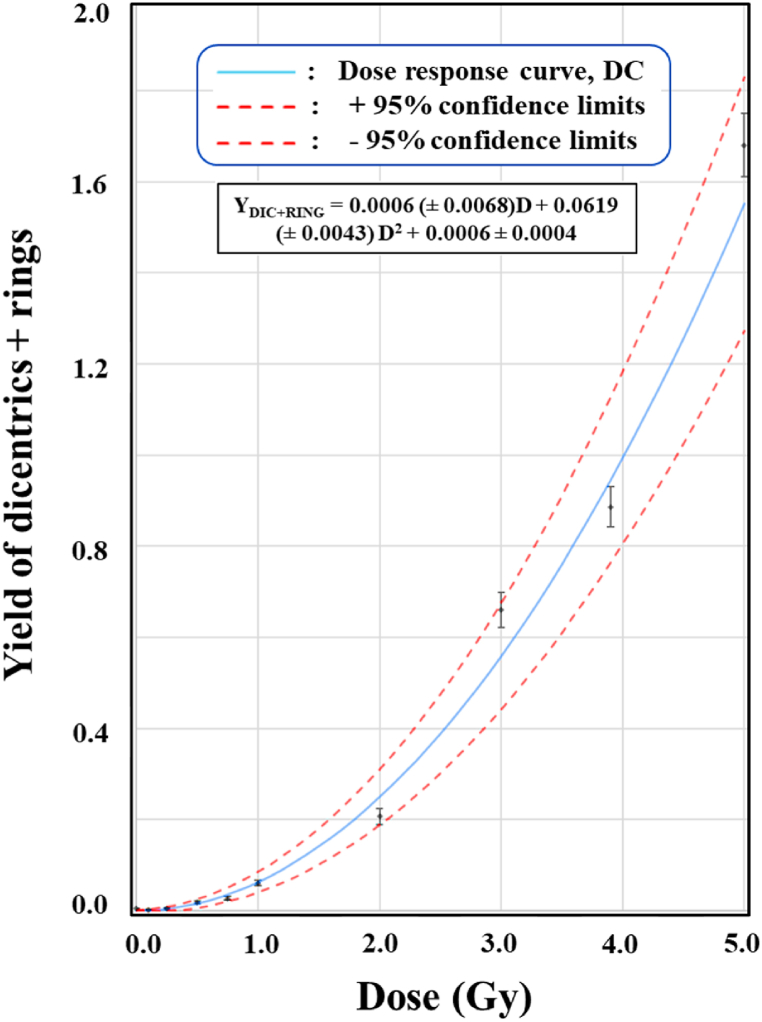
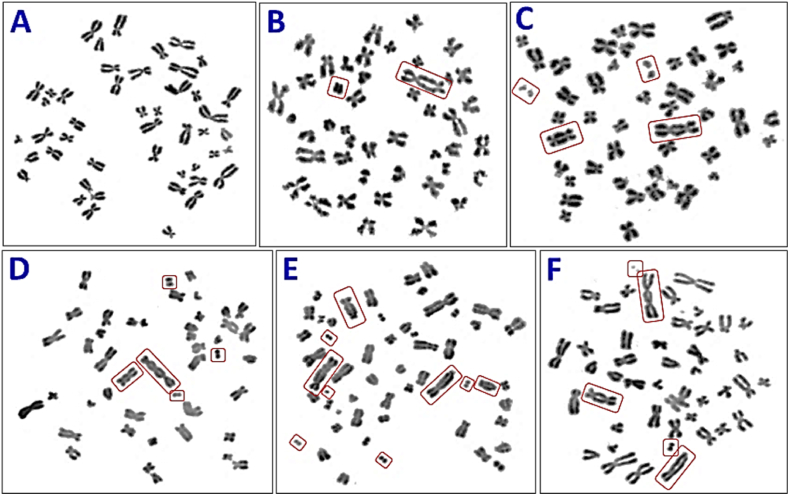
In the modern developing society, application of radiation has increased extensively. With significant improvement in the radiation protection practices, exposure to human could be minimized substantially, but cannot be avoided completely. Assessment of exposure is essential for regulatory decision and medical management as applicable. Until now, cytogenetic changes have served as surrogate marker of radiation exposure and have been extensively employed for biological dose estimation of various planned and unplanned exposures. Dicentric Chromosomal Aberration (DCA) is radiation specific and is considered as gold standard, micronucleus is not very specific to radiation and is considered as an alternative method for biodosimetry. In this study dose response curves were generated for X-ray induced "dicentric + ring" and micronuclei, in lymphocytes of three healthy volunteers [2 females (age 22, 23 years) and 1 male (24 year)]. The blood samples were irradiated with X-ray using LINAC (energy 6 MV, dose rate 6 Gy/min), in the dose range of 0-5Gy. Irradiated blood samples were cultured and processed to harvest metaphases, as per standard procedures recommended by International Atomic Energy Agency. Pooled data obtained from all the three volunteers, were in agreement with Poisson distribution for "dicentric + ring", however over dispersion was observed for micronuclei. Data ("dicentric + ring" and micronuclei) were fitted by linear quadratic model of the expression Y[bond, double bond]C + αD + βD using Dose Estimate software, version 5.2. The data fit has resulted in linear coefficient α = 0.0006 (±0.0068) "dicentric + ring" cell Gy and quadratic coefficient β = 0.0619 (±0.0043) "dicentric + ring" cell Gy for "dicentric + ring" and linear coefficient α = 0.0459 ± (0.0038) micronuclei cell Gy and quadratic coefficient β = 0.0185 ± (0.0010) micronuclei cell Gy for micronuclei, respectively. Background frequencies for "dicentric + ring" and micronuclei were 0.0006 ± 0.0004 and 0.0077 ± 0.0012 cell, respectively. Established curves were validated, by reconstructing the doses of 8 dose blinded samples (4 by DCA and 4 by CBMN) using coefficients generated here. Estimated doses were within the variation of 0.9-16% for "dicentric + ring" and 21.7-31.2% for micronuclei respectively. These established curves have potential to be employed for biodosimetry of occupational, clinical and accidental exposures, for initial triage and medical management.
在现代社会发展进程中,辐射的应用已广泛增加。随着辐射防护措施的显著改进,人体所受辐射暴露可大幅降至最低,但无法完全避免。进行暴露评估对于适用的监管决策和医疗管理至关重要。到目前为止,细胞遗传学变化一直作为辐射暴露的替代标志物,并已广泛用于各种计划内和计划外暴露的生物剂量估算。双着丝粒染色体畸变(DCA)具有辐射特异性,被视为金标准,微核对辐射的特异性不强,被视为生物剂量测定的替代方法。在本研究中,针对三名健康志愿者[2名女性(年龄分别为22岁、23岁)和1名男性(24岁)]淋巴细胞中X射线诱导的“双着丝粒 + 环状”染色体畸变和微核,生成了剂量反应曲线。使用直线加速器(能量6 MV,剂量率6 Gy/分钟)对血样进行0 - 5 Gy剂量范围内的X射线照射。按照国际原子能机构推荐的标准程序,对辐照后的血样进行培养和处理以收获中期细胞。从所有三名志愿者获得的汇总数据,“双着丝粒 + 环状”染色体畸变符合泊松分布,然而微核观察到过离散现象。使用剂量估计软件5.2版,通过Y[键,双键]C + αD + βD表达式的线性二次模型对数据(“双着丝粒 + 环状”染色体畸变和微核)进行拟合。数据拟合得出“双着丝粒 + 环状”染色体畸变的线性系数α = 0.0006(±0.0068)“双着丝粒 + 环状”细胞/戈瑞,二次系数β = 0.0619(±0.0043)“双着丝粒 + 环状”细胞/戈瑞;微核的线性系数α = 0.0459 ±(0.0038)微核细胞/戈瑞,二次系数β = 0.0185 ±(0.0010)微核细胞/戈瑞。“双着丝粒 + 环状”染色体畸变和微核的背景频率分别为0.0006 ± 0.0004和0.0077 ± 0.0012细胞。通过使用此处生成的系数重建8个剂量盲样(4个通过DCA,4个通过CBMN)的剂量,对建立的曲线进行验证。“双着丝粒 + 环状”染色体畸变的估计剂量在0.9 - 16%的变化范围内,微核的估计剂量在21.7 - 31.2%的变化范围内。这些建立的曲线有潜力用于职业、临床和意外暴露的生物剂量测定,用于初步分诊和医疗管理。