van Oort Pouline M P, de Bruin Sanne, Weda Hans, Knobel Hugo H, Schultz Marcus J, Bos Lieuwe D
Department of Intensive Care, Academic Medical Centre, Meibergdreef 9, 1105 AZ Amsterdam, The Netherlands.
Philips Research, 5656 AE Eindhoven, The Netherlands.
Int J Mol Sci. 2017 Feb 19;18(2):449. doi: 10.3390/ijms18020449.
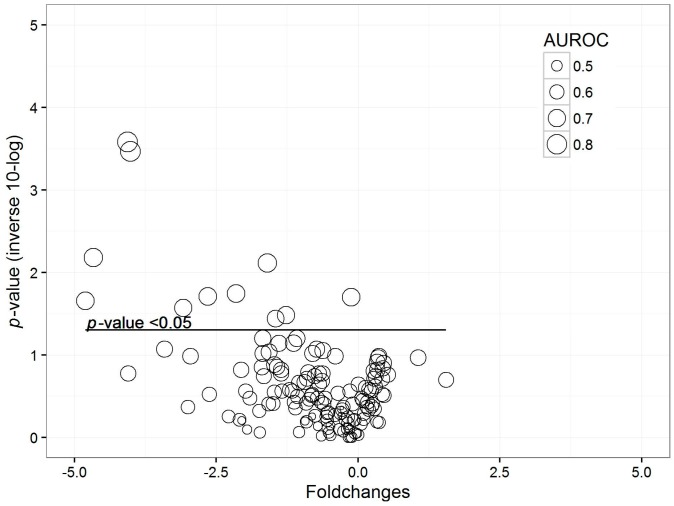
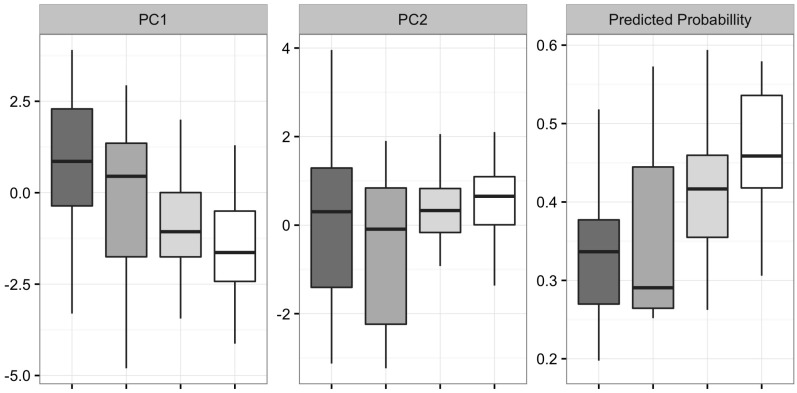
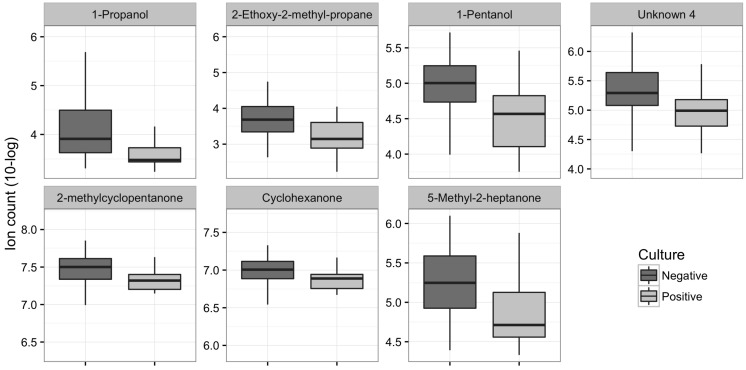
The diagnosis of hospital-acquired pneumonia remains challenging. We hypothesized that analysis of volatile organic compounds (VOCs) in exhaled breath could be used to diagnose pneumonia or the presence of pathogens in the respiratory tract in intubated and mechanically-ventilated intensive care unit patients. In this prospective, single-centre, cross-sectional cohort study breath from mechanically ventilated patients was analysed using gas chromatography-mass spectrometry. Potentially relevant VOCs were selected with a -value < 0.05 and an area under the receiver operating characteristics curve (AUROC) above 0.7. These VOCs were used for principal component analysis and partial least square discriminant analysis (PLS-DA). AUROC was used as a measure of accuracy. Ninety-three patients were included in the study. Twelve of 145 identified VOCs were significantly altered in patients with pneumonia compared to controls. In colonized patients, 52 VOCs were significantly different. Partial least square discriminant analysis classified patients with modest accuracy (AUROC: 0.73 (95% confidence interval (CI): 0.57-0.88) after leave-one-out cross-validation). For determining the colonization status of patients, the model had an AUROC of 0.69 (95% CI: 0.57-0.82) after leave-one-out cross-validation. To conclude, exhaled breath analysis can be used to discriminate pneumonia from controls with a modest to good accuracy. Furthermore breath profiling could be used to predict the presence and absence of pathogens in the respiratory tract. These findings need to be validated externally.
医院获得性肺炎的诊断仍然具有挑战性。我们假设,对呼出气体中的挥发性有机化合物(VOCs)进行分析,可用于诊断插管并接受机械通气的重症监护病房患者的肺炎或呼吸道病原体的存在情况。在这项前瞻性、单中心、横断面队列研究中,使用气相色谱-质谱联用仪对机械通气患者的呼出气体进行了分析。选择P值<0.05且受试者工作特征曲线下面积(AUROC)大于0.7的潜在相关VOCs。这些VOCs用于主成分分析和偏最小二乘判别分析(PLS-DA)。AUROC用作准确性的衡量指标。93名患者纳入了该研究。与对照组相比,肺炎患者中145种已识别的VOCs中有12种发生了显著变化。在定植患者中,52种VOCs有显著差异。留一法交叉验证后,偏最小二乘判别分析对患者进行分类的准确性一般(AUROC:0.73(95%置信区间(CI):0.57 - 0.88))。对于确定患者的定植状态,留一法交叉验证后该模型的AUROC为0.69(95%CI:0.57 - 0.82)。总之,呼出气体分析可用于以一般到良好的准确性区分肺炎与对照。此外,呼出气体分析可用于预测呼吸道中病原体的存在与否。这些发现需要在外部进行验证。