University Clermont Auvergne, Laboratory of Neurosensory Biophysics, UMR INSERM 1107, Clermont-Ferrand, France.
Department of Anesthesiology and Intensive Care, University Hospital, rue Montalembert, Clermont-Ferrand, 63000, France.
Crit Care. 2017 Feb 21;21(1):35. doi: 10.1186/s13054-017-1616-2.
In brain-injured patients intracranial pressure (ICP) is monitored invasively by a ventricular or intraparenchymal transducer. The procedure requires specific expertise and exposes the patient to complications such as malposition, hemorrhage or infection. As inner-ear fluid compartments are connected to the cerebrospinal fluid space, ICP changes elicit subtle changes in the physiology of the inner ear. Notably, we previously demonstrated that the phase of cochlear microphonic potential (CM) generated by sound stimuli rotates with ICP. The aim of our study was to validate the monitoring of CM as a noninvasive method to follow ICP.
Non-invasive measure of CM-phase was compared to ICP recorded invasively in a prospective series of patients with acute brain injury managed in a neuro-intensive care unit. The study focused on patients with varying ICP and normal middle-ear function.
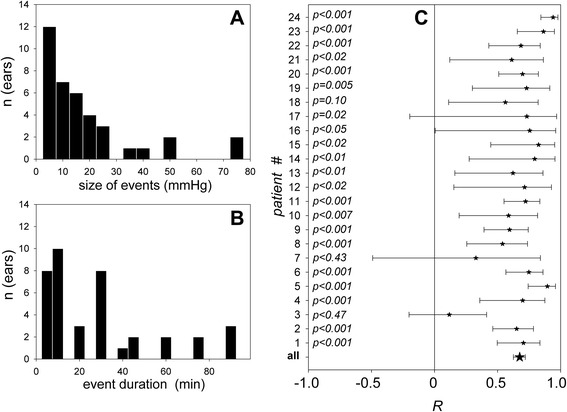
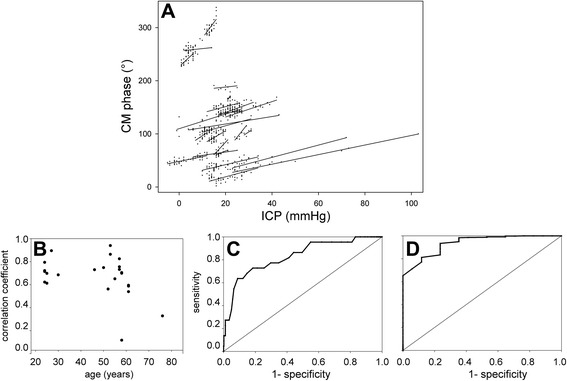
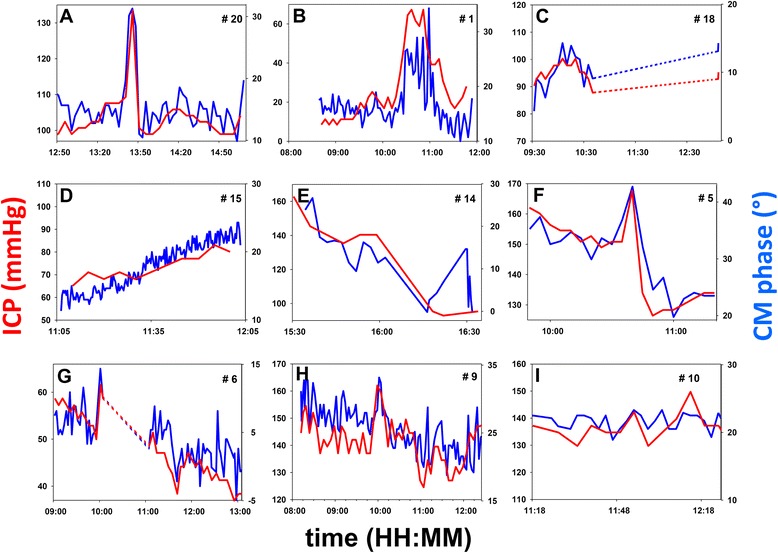
In the 24 patients with less than 4 days of endotracheal ventilation and whose ICP fluctuated (50-hour data), we demonstrated close correlation between CM-phase rotation and ICP (average 1.26 degrees/mmHg). As a binary classifier, CM phase changes of 7-10 degrees signaled 7.5-mmHg ICP increases with a sensitivity of 83% and 19% fallout.
Reference methods to measure ICP require the surgical placement of a pressure transducer. Noninvasive CM-based monitoring of ICP might be beneficial to early management of brain-injured patients with initially preserved consciousness and to the diagnosis of neurological conditions, whenever invasive monitoring cannot be performed.
ClinicalTrials.gov NCT01685476 , registered on 30 August 2012.
在脑损伤患者中,颅内压(ICP)通过脑室或脑实质换能器进行有创监测。该过程需要特定的专业知识,并且使患者面临诸如位置不当、出血或感染等并发症。由于内耳液室与脑脊液空间相连,因此 ICP 变化会引起内耳生理的细微变化。值得注意的是,我们之前已经证明,由声音刺激产生的耳蜗微音电位(CM)的相位随 ICP 旋转。我们研究的目的是验证 CM 监测作为一种非侵入性方法来跟踪 ICP。
在神经重症监护病房中对急性脑损伤患者进行前瞻性系列研究中,将非侵入性 CM 相位测量与有创记录的 ICP 进行了比较。该研究重点关注具有不同 ICP 和正常中耳功能的患者。
在 24 名接受机械通气时间少于 4 天且 ICP 波动(50 小时数据)的患者中,我们证明了 CM 相位旋转与 ICP 之间存在密切相关性(平均 1.26 度/mmHg)。作为二元分类器,CM 相位变化 7-10 度可预测 7.5mmHg 的 ICP 升高,其灵敏度为 83%,假阳性率为 19%。
测量 ICP 的参考方法需要手术放置压力换能器。对于最初意识保留的脑损伤患者以及在无法进行有创监测时,基于无创 CM 的 ICP 监测可能有益于早期管理,并有助于诊断神经状况。
ClinicalTrials.gov NCT01685476,于 2012 年 8 月 30 日注册。