O'Neill Darragh, Britton Annie, Brunner Eric J, Bell Steven
Research Department of Epidemiology and Public Health, University College London, London, United Kingdom
Research Department of Epidemiology and Public Health, University College London, London, United Kingdom.
J Am Heart Assoc. 2017 Feb 20;6(2):e005288. doi: 10.1161/JAHA.116.005288.
Emerging evidence suggests that arterial stiffness, an important marker of cardiovascular health, is associated with alcohol consumption. However, the role of longer-term consumption patterns in the progression of arterial stiffness over time remains unclear. A longitudinal cohort design was used to evaluate the association between alcohol consumption over 25 years and subsequent changes in arterial stiffness.
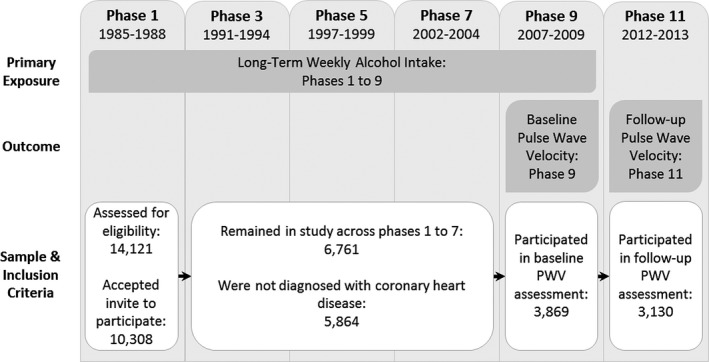
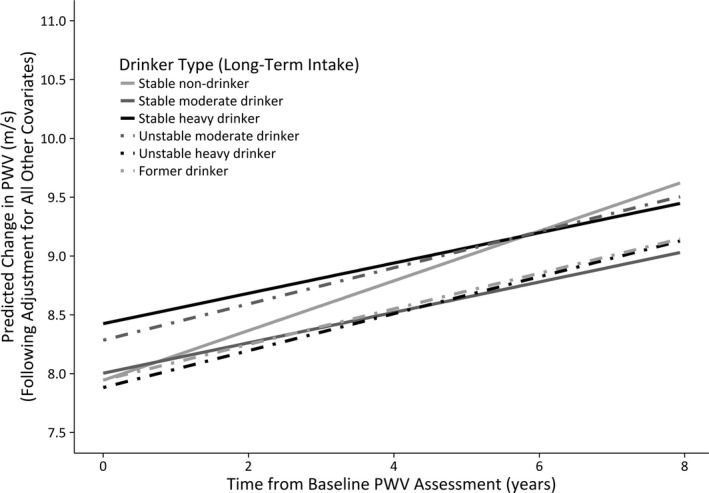
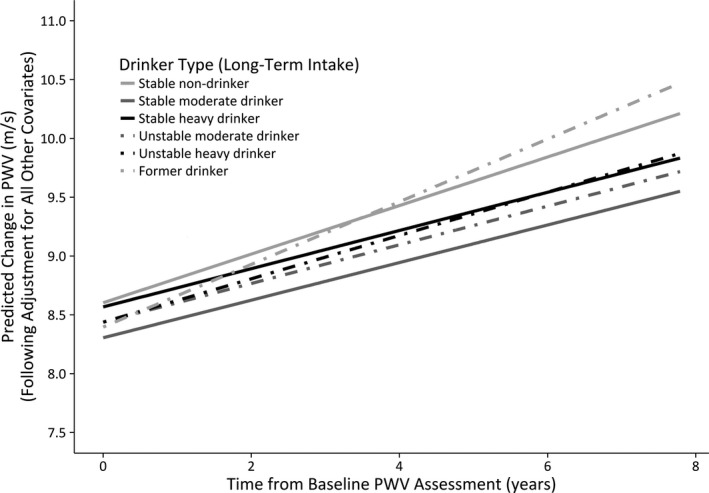
Data (N=3869; 73% male) were drawn from the Whitehall II cohort study of British civil servants, in which participants completed repeat pulse wave velocity assessments of arterial stiffness across a 4- to 5-year interval. Repeated alcohol intake measurements were used to categorize participants into alcohol consumer types, accounting for longitudinal variability in consumption. Sex-stratified linear mixed-effects modeling was used to investigate whether drinker types differed in their relationship to pulse wave velocity and its progression over time. Males with consistent long-term heavy intake >112 g of ethanol/week had significantly higher baseline pulse wave velocity (b=0.26 m/s; =0.045) than those who drank consistently moderately (1-112 g of ethanol/week). Male former drinkers showed significantly greater increases in arterial stiffness longitudinally compared to consistently moderate drinkers (b=0.11 m/s; =0.009). All associations were nonsignificant for females after adjustment for body mass index, heart rate, mean arterial pressure, diabetes mellitus, high-density lipoprotein, and triglycerides.
This work demonstrates that consistently heavy alcohol consumption is associated with higher cardiovascular risk, especially among males, and also provides new insights into the potential impact of changes in drinking levels over time. It discusses the additional insights possible when capturing longitudinal consumption patterns in lieu of reliance on recent intake alone.
URL: http://www.clinicaltrials.gov. Unique identifier: NCT02663791.
新出现的证据表明,动脉僵硬度作为心血管健康的一个重要指标,与饮酒有关。然而,长期饮酒模式在动脉僵硬度随时间进展过程中的作用仍不清楚。本研究采用纵向队列设计来评估25年的饮酒情况与随后动脉僵硬度变化之间的关联。
数据(N = 3869;73%为男性)来自英国公务员白厅II队列研究,参与者在4至5年的间隔内完成了重复的动脉僵硬度脉搏波速度评估。重复的酒精摄入量测量被用于将参与者分类为不同的饮酒类型,同时考虑到饮酒量的纵向变化。采用性别分层的线性混合效应模型来研究不同饮酒类型与脉搏波速度及其随时间进展的关系是否存在差异。长期持续大量饮酒(>112克乙醇/周)的男性的基线脉搏波速度显著高于持续适度饮酒(1 - 112克乙醇/周)的男性(b = 0.26米/秒;P = 0.045)。与持续适度饮酒者相比,男性戒酒者的动脉僵硬度纵向增加显著更大(b = 0.11米/秒;P = 0.009)。在调整体重指数、心率、平均动脉压、糖尿病、高密度脂蛋白和甘油三酯后,所有关联在女性中均无统计学意义。
这项研究表明,持续大量饮酒与更高的心血管风险相关,尤其是在男性中,同时也为饮酒水平随时间变化的潜在影响提供了新的见解。它讨论了在捕捉纵向饮酒模式而非仅依赖近期饮酒量时可能获得的更多见解。