Codina Charlotte J, Pascalis Olivier, Baseler Heidi A, Levine Alexandra T, Buckley David
Academic Unit of Ophthalmology and Orthoptics, School of Medicine and Biomedical Science, The University of Sheffield Sheffield, UK.
Laboratoire de Psychologie et NeuroCognition, Université de Grenoble Alpes Grenoble, France.
Front Psychol. 2017 Feb 6;8:50. doi: 10.3389/fpsyg.2017.00050. eCollection 2017.
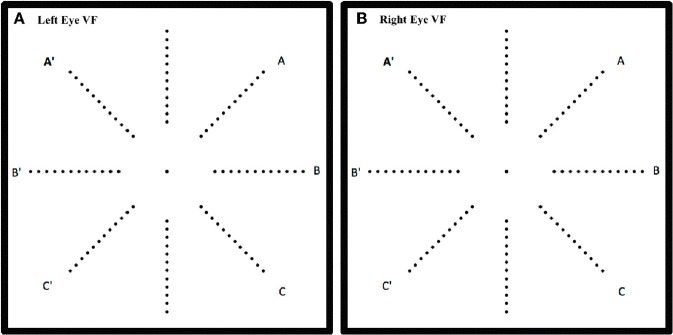
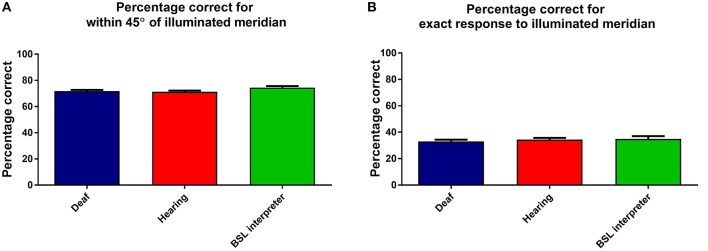
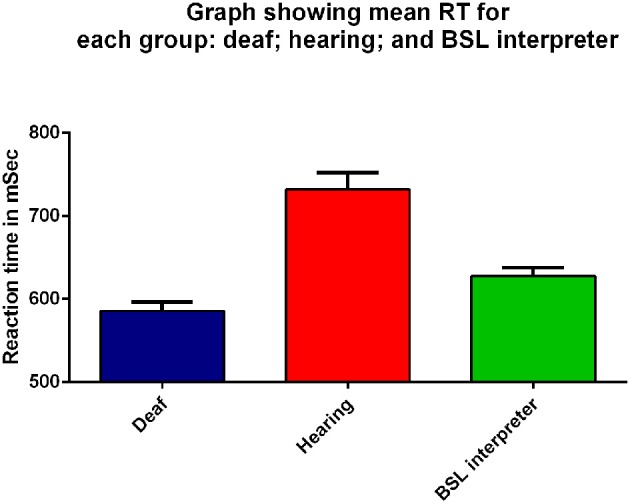
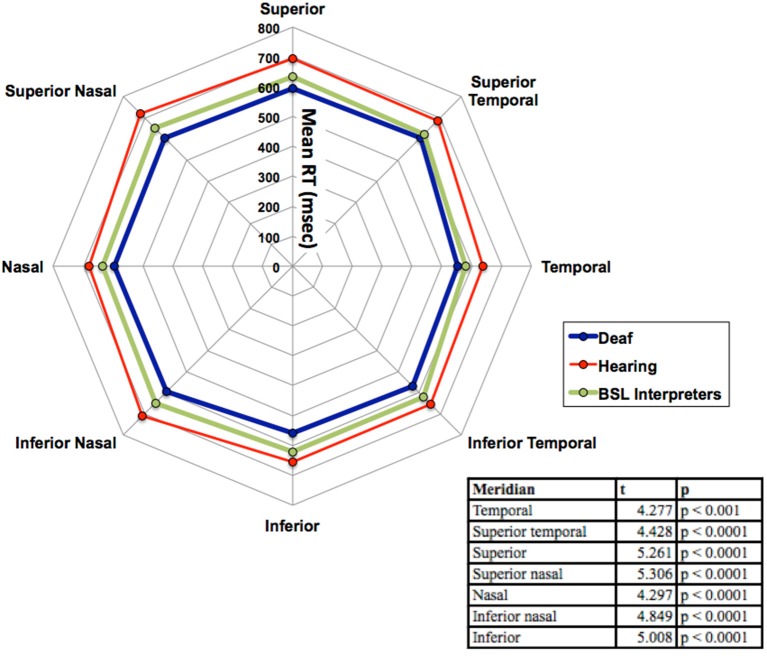
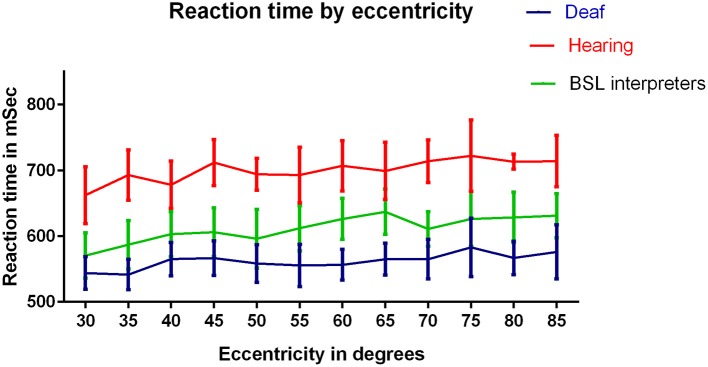
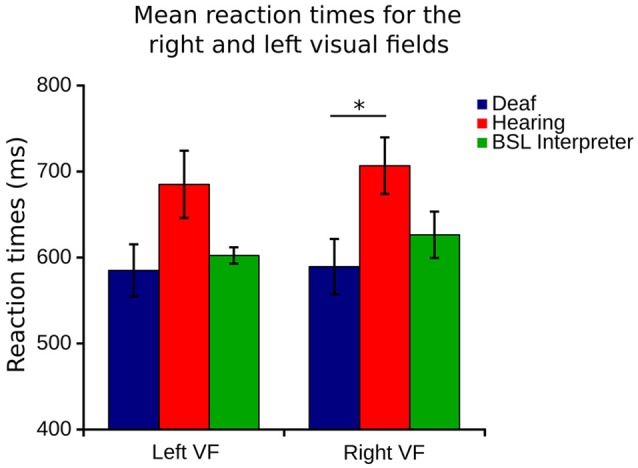
Following auditory deprivation, the remaining sense of vision has shown selective enhancement in visual cognition, especially in the area of near peripheral vision. Visual acuity is poor in the far periphery and may be an area where sound confers the greatest advantage in hearing persons. Experience with a visuospatial language such as British Sign Language (BSL) makes additional demands on the visual system. To test the different and separable effects of deafness and use of a visuo-spatial language on far peripheral visual processing, we investigated visual reaction times (RTs) and response accuracy to visual stimuli, between 30° and 85° along the four cardinal and four inter-cardinal meridians. We used three luminances of static, briefly illuminated stimuli in visually normal adults. The cohort tested included profoundly congenitally deaf adults ( = 17), hearing fluent BSL users ( = 8) and hearing non-signing adults ( = 18). All participants were tested using a peripheral forced choice paradigm designed previously to test deaf and hearing children (Codina et al., 2011a). Deaf adults demonstrated significantly faster RTs to all far peripheral stimuli and exceeded the abilities of both signing and non-signing hearing adults. Deaf adults were significantly faster than BSL interpreters, who in turn were significantly faster than hearing non-signing adults. The differences in RT demonstrated between groups were consistent across all visual field meridians and were not localized to any one region of the visual field. There were no differences found between any groups in accuracy of detecting these static stimuli at any retinal location. Early onset auditory deprivation appears to lead to a response time visual advantage in far peripheral responses to briefly presented, static LED stimuli, especially in the right visual field. Fluency in BSL facilitates faster visuo-motor responses in the peripheral visual field, but to a lesser extent than congenital, profound deafness.
在听觉剥夺之后,剩余的视觉在视觉认知方面表现出选择性增强,尤其是在近周边视觉区域。远周边的视力较差,而这可能是声音在听力正常者中赋予最大优势的区域。使用诸如英国手语(BSL)这样的视觉空间语言会对视觉系统提出额外要求。为了测试耳聋和使用视觉空间语言对远周边视觉处理的不同且可分离的影响,我们研究了沿四个基本子午线和四个中间子午线在30°至85°之间对视觉刺激的视觉反应时间(RTs)和反应准确性。我们在视力正常的成年人中使用了三种亮度的静态、短暂照亮的刺激物。测试的队列包括先天性深度耳聋的成年人(n = 17)、能流利使用BSL的听力正常者(n = 8)和不会手语的听力正常成年人(n = 18)。所有参与者都使用先前设计用于测试聋哑和听力正常儿童的周边强制选择范式进行测试(Codina等人,2011a)。耳聋成年人对所有远周边刺激的反应时间明显更快,超过了会手语和不会手语的听力正常成年人的能力。耳聋成年人比BSL口译员明显更快,而BSL口译员又比不会手语的听力正常成年人明显更快。各群体之间在反应时间上的差异在所有视野子午线上都是一致的,并且并不局限于视野的任何一个区域。在任何视网膜位置检测这些静态刺激的准确性方面,各群体之间没有发现差异。早期发生的听觉剥夺似乎会导致在对短暂呈现且静止的LED刺激的远周边反应中出现反应时间上的视觉优势,尤其是在右视野。熟练掌握BSL有助于在周边视野中更快地产生视觉运动反应,但程度小于先天性深度耳聋。