Cuscó Anna, Sánchez Armand, Altet Laura, Ferrer Lluís, Francino Olga
Molecular Genetics Veterinary Service (SVGM), Veterinary School, Universitat Autònoma de Barcelona, Barcelona, Spain; Vetgenomics, Ed Eureka, Parc de Recerca UAB, Barcelona, Spain.
Molecular Genetics Veterinary Service (SVGM), Veterinary School, Universitat Autònoma de Barcelona , Barcelona , Spain.
Front Vet Sci. 2017 Feb 6;4:6. doi: 10.3389/fvets.2017.00006. eCollection 2017.
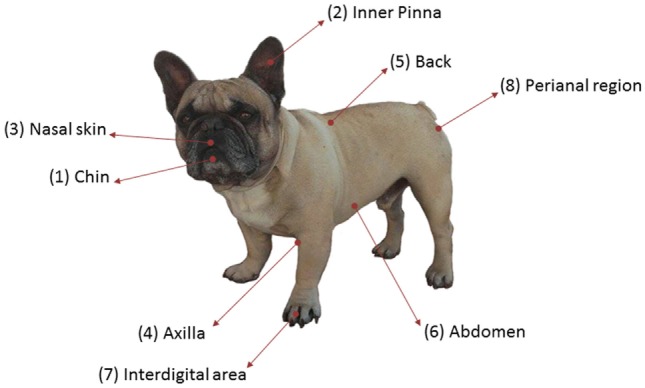
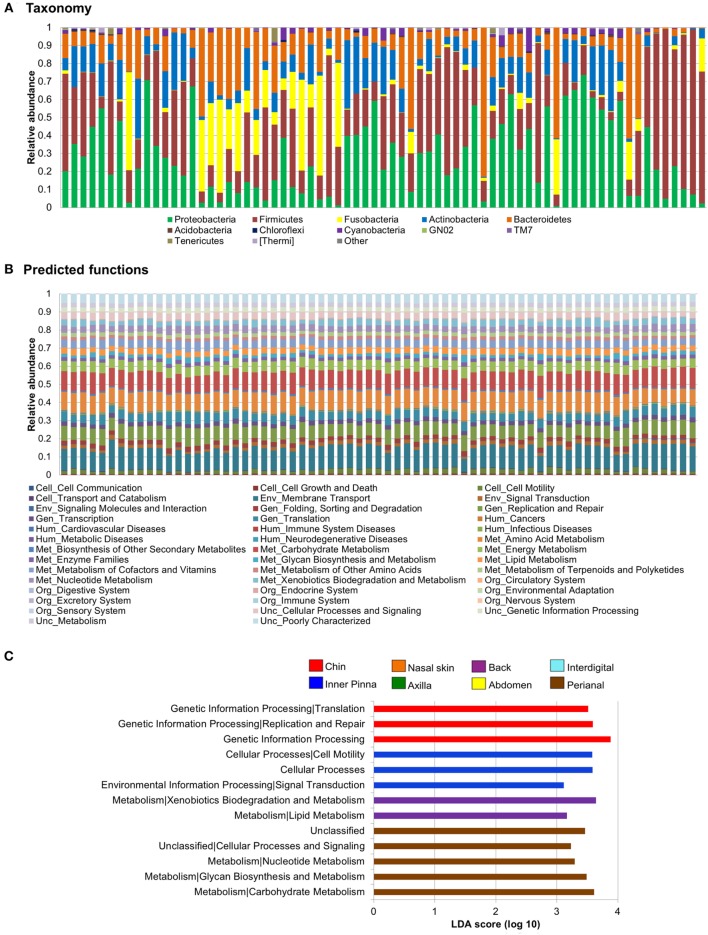
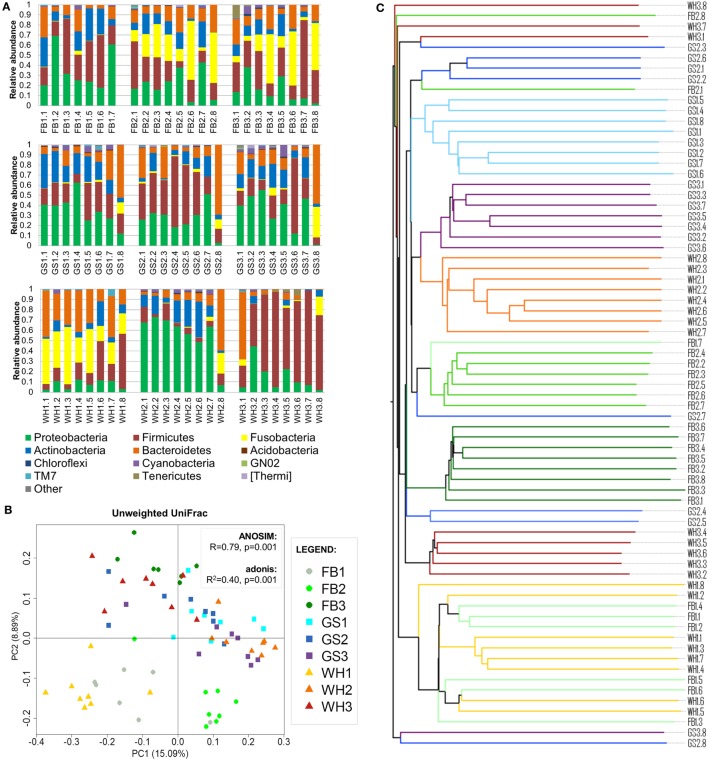
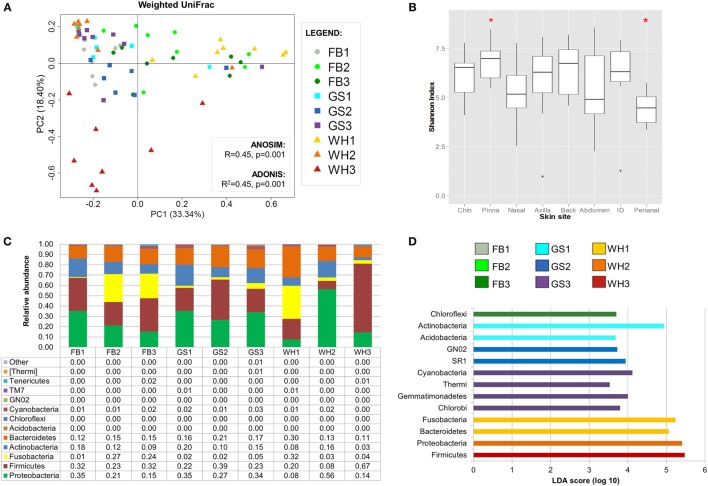
Dogs present almost all their skin sites covered by hair, but canine skin disorders are more common in certain skin sites and breeds. The goal of our study is to characterize the composition and variability of the skin microbiota in healthy dogs and to evaluate the effect of the breed, the skin site, and the individual. We have analyzed eight skin sites of nine healthy dogs from three different breeds by massive sequencing of 16S rRNA gene V1-V2 hypervariable regions. The main phyla inhabiting the skin microbiota in healthy dogs are Proteobacteria, Firmicutes, Fusobacteria, Actinobacteria, and Bacteroidetes. Our results suggest that skin microbiota composition pattern is individual specific, with some dogs presenting an even representation of the main phyla and other dogs with only a major phylum. The individual is the main force driving skin microbiota composition and diversity rather than the skin site or the breed. The individual is explaining 45% of the distances among samples, whereas skin site explains 19% and breed 9%. Moreover, analysis of similarities suggests a strong dissimilarity among individuals ( = 0.79, = 0.001) that is mainly explained by low-abundant species in each dog. Skin site also plays a role: inner pinna presents the highest diversity value, whereas perianal region presents the lowest one and the most differentiated microbiota composition.
狗的几乎所有皮肤部位都覆盖着毛发,但犬类皮肤疾病在某些皮肤部位和品种中更为常见。我们研究的目的是描述健康犬皮肤微生物群的组成和变异性,并评估品种、皮肤部位和个体的影响。我们通过对16S rRNA基因V1-V2高变区进行大规模测序,分析了来自三个不同品种的9只健康犬的八个皮肤部位。健康犬皮肤微生物群中的主要菌门是变形菌门、厚壁菌门、梭杆菌门、放线菌门和拟杆菌门。我们的结果表明,皮肤微生物群组成模式具有个体特异性,一些犬的主要菌门呈现均匀分布,而另一些犬只有一个主要菌门。个体是驱动皮肤微生物群组成和多样性的主要因素,而不是皮肤部位或品种。个体解释了样本间距离的45%,而皮肤部位解释了19%,品种解释了9%。此外,相似性分析表明个体之间存在强烈差异(F = 0.79,P = 0.001),这主要由每只狗中低丰度物种解释。皮肤部位也起作用:耳廓内部的多样性值最高,而肛周区域的多样性值最低,且微生物群组成差异最大。