Forsbrand Malin, Grahn Birgitta, Hill Jonathan C, Petersson Ingemar F, Sennehed Charlotte Post, Stigmar Kjerstin
Lund University, Faculty of Medicine, Department of Clinical Sciences Lund, Orthopedics, Lund, Sweden.
Epidemiology and Register Centre South, Region Skåne, Lund, Sweden.
BMC Musculoskelet Disord. 2017 Feb 21;18(1):89. doi: 10.1186/s12891-017-1449-9.
Patients with back and neck pain are often seen in primary care and it is important to provide them with tailored interventions based on risk stratification/triage. The STarT Back Screening Tool (SBT) is a widely used screening questionnaire which has not yet been validated for a population with back and/or neck pain with short duration. Our aim was to compare the concurrent validity of the SBT and the short form of the ÖMPSQ including psychometric properties and clinical utility in a primary care setting.
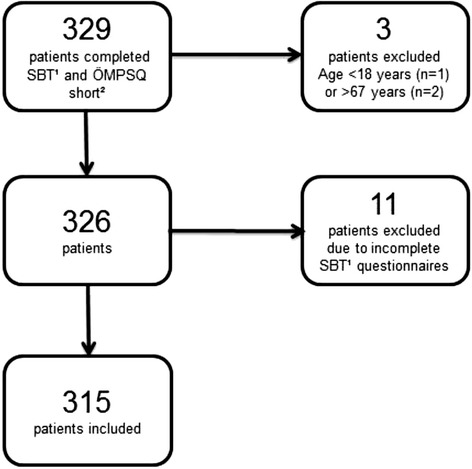
Patients who applied for physiotherapy by direct access (January 2013 to January 2014) at 35 primary care centers in south Sweden, with acute or subacute back and/or neck pain, aged 18-67 years, who were not currently on sick leave or had been on sick leave less than 60 days were asked to complete the SBT and ÖMPSQ-short questionnaire (n = 329). We used the Spearman's rank correlations to study correlations, cross tabulation and Cohen's kappa to analyze agreement of patient classification. Clinical utility was described as clinician scoring miscalculations and misclassifications of total and/or subscale scores.
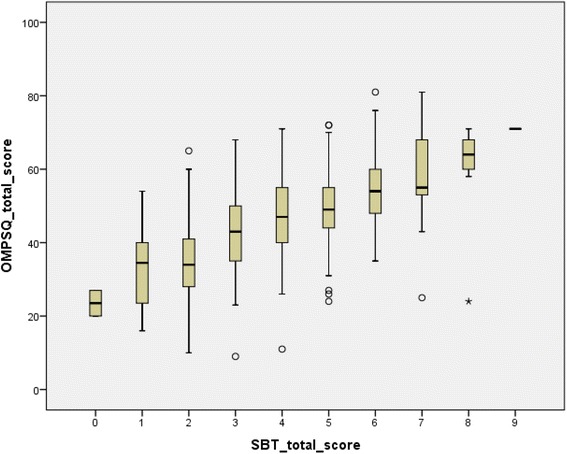
Completed SBT (9-items) and ÖMPSQ-short (10-items) data were available for 315/329 patients respectively. The statistical correlation for SBT and ÖMPSQ-short total scores was moderately strong (0.62, p < 0.01). In subgroup analyses, the correlations were 0.69 (p < 0.01) for males and 0.57 (p < 0.01) for females. The correlations were lower among older age groups, especially females over 50 years (0.21, p = 0.11). Classification to high or low risk for long-term pain and disability had moderate agreement (κ = 0.42). Observed classification agreement was 70.2%. The SBT had fewer miscalculations (13/315) than the ÖMPSQ-short (54/315).
The correlation between the SBT and the ÖMPSQ-short scores were moderately strong for individuals with acute or subacute back and/or neck pain. SBT seemed to be clinically feasible to use in clinical practice. We therefore suggest that SBT can be used for individuals with both BP and/or NP in primary care settings but it is important to be aware of that SBT's agreement with the ÖMPSQ-short was poor among females aged over 50 years.
ClinicalTrials.gov ID: NCT02609750 Registered: November 18, 2015.
在基层医疗中,经常会遇到背痛和颈痛患者,根据风险分层/分诊为他们提供量身定制的干预措施非常重要。STarT Back筛查工具(SBT)是一种广泛使用的筛查问卷,但尚未在短期背痛和/或颈痛人群中得到验证。我们的目的是在基层医疗环境中比较SBT与ÖMPSQ简表的同时效度,包括心理测量特性和临床实用性。
2013年1月至2014年1月期间,在瑞典南部35个基层医疗中心直接申请物理治疗的患者,年龄在18 - 67岁之间,患有急性或亚急性背痛和/或颈痛,目前未休病假或病假少于60天,被要求完成SBT和ÖMPSQ - 简短问卷(n = 329)。我们使用Spearman等级相关性来研究相关性,交叉表和Cohen's kappa来分析患者分类的一致性。临床实用性被描述为临床医生对总分和/或子量表分数的误算和误分类。
分别有315/329名患者获得了完整的SBT(9项)和ÖMPSQ - 简短(10项)数据。SBT和ÖMPSQ - 简短总分的统计相关性中等强度(0.62,p < 0.01)。在亚组分析中,男性的相关性为0.69(p < 0.01),女性为0.57(p < 0.01)。在老年人群中相关性较低,尤其是50岁以上的女性(0.21,p = 0.11)。对长期疼痛和残疾的高风险或低风险分类具有中等一致性(κ = 0.42)。观察到的分类一致性为70.2%。SBT的误算(13/315)比ÖMPSQ - 简短(54/315)少。
对于急性或亚急性背痛和/或颈痛患者,SBT与ÖMPSQ - 简短评分之间具有中等强度的相关性。SBT在临床实践中似乎具有临床可行性。因此,我们建议SBT可用于基层医疗环境中患有背痛和/或颈痛的个体,但重要的是要意识到,在50岁以上的女性中,SBT与ÖMPSQ - 简短的一致性较差。
ClinicalTrials.gov标识符:NCT02609750 注册时间:2015年11月18日。