Whitfield Yvonne, Johnson Karen, Hobbs Leigh, Middleton Dean, Dhar Badal, Vrbova Linda
Public Health Ontario, 480 University Avenue, Toronto, ON, M5G 1V2, Canada.
The Public Health Agency of Canada, Guelph, ON, Canada.
BMC Public Health. 2017 Feb 21;17(1):217. doi: 10.1186/s12889-017-4135-9.
Contact with animals and their environment has long been recognized as an important source of enteric zoonoses. However, there are limited data available on the burden of illness associated with specific types of animals in Canada. This study describes the overall burden of enteric zoonoses in Ontario, Canada from 2010 to 2012.
Confirmed cases of seven enteric zoonotic diseases (campylobacteriosis, cryptosporidiosis, giardiasis, listeriosis, salmonellosis, verotoxin-producing E. coli (VTEC) infection, and yersiniosis) with episode dates from 2010 to 2012 were extracted from the integrated Public Health Information System (iPHIS). Reported exposures were categorized as animal contact, foodborne, waterborne and 'other', with animal contact grouped into nine sub-categories based on the type of animal or transmission setting. Overall incidence rates and proportions by animal exposure categories, age and sex-specific incidence rates and hospitalization and death proportions were calculated and sex proportions compared.
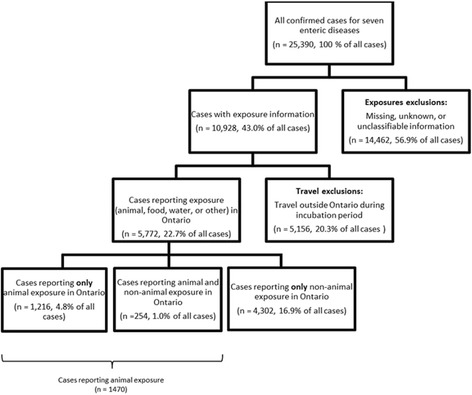
Our study found that approximately 26% of the enteric pathogens assessed during the 2010 to 2012 period reported contact with animals and their environments as the mode of transmission. Of enteric disease cases reporting animal contact, farm exposures were reported for 51.3%, dog or cat exposures for 26.3%, and reptile or amphibian exposures for 8.9%.
Contact with animals was reported more frequently during the period 2010 to 2012 in comparison to the period 1997 to 2003 when 6% or less of enteric cases were associated with animal contact. Public health professionals, stakeholders associated with animals and their related industries (e.g., pet treats, mobile zoos, abattoirs), and the public should recognize that animal contact is an important source of enteric illnesses in order to take measures to reduce the burden of illness from animal sources.
长期以来,与动物及其环境的接触一直被认为是肠道人畜共患病的重要来源。然而,关于加拿大特定类型动物相关疾病负担的数据有限。本研究描述了2010年至2012年加拿大安大略省肠道人畜共患病的总体负担。
从综合公共卫生信息系统(iPHIS)中提取2010年至2012年发病日期的7种肠道人畜共患病(弯曲杆菌病、隐孢子虫病、贾第虫病、李斯特菌病、沙门氏菌病、产志贺毒素大肠杆菌(VTEC)感染和耶尔森菌病)的确诊病例。报告的暴露分为动物接触、食源性、水源性和“其他”,动物接触根据动物类型或传播环境分为9个亚类。计算了动物暴露类别、年龄和性别特异性发病率以及住院和死亡比例的总体发病率和比例,并比较了性别比例。
我们的研究发现,在2010年至2012年期间评估的肠道病原体中,约26%报告与动物及其环境的接触为传播方式。在报告有动物接触的肠道疾病病例中,51.3%报告有农场暴露,26.3%报告有狗或猫暴露,8.9%报告有爬行动物或两栖动物暴露。
与1997年至2003年期间相比,2010年至2012年期间报告的与动物接触更为频繁,当时6%或更少的肠道病例与动物接触有关。公共卫生专业人员、与动物及其相关行业(如宠物食品、流动动物园、屠宰场)相关的利益相关者以及公众应认识到动物接触是肠道疾病的重要来源,以便采取措施减轻动物源性疾病的负担。