Adjunct Instructor, Department of Operative Dentistry, University of North Carolina School of Dentistry, Chapel Hill, NC.
Professor and Chair, Department of Operative Dentistry, University of North Carolina School of Dentistry, Chapel Hill, NC.
J Prosthet Dent. 2017 Sep;118(3):400-405. doi: 10.1016/j.prosdent.2016.10.022. Epub 2017 Feb 17.
Trueness and precision are used to evaluate the accuracy of intraoral optical impressions. Although the in vivo precision of intraoral optical impressions has been reported, in vivo trueness has not been evaluated because of limitations in the available protocols.
The purpose of this clinical study was to compare the accuracy (trueness and precision) of optical and conventional impressions by using a novel study design.
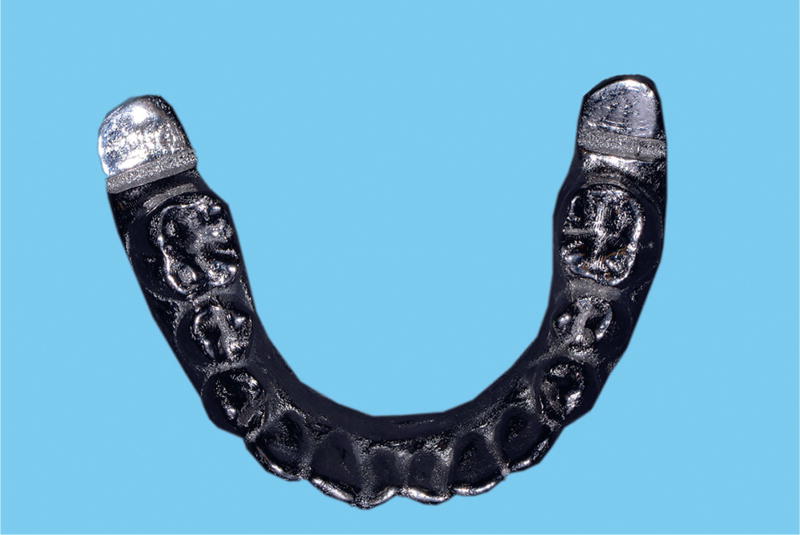
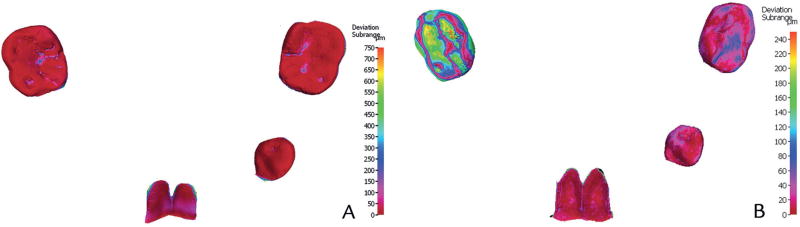
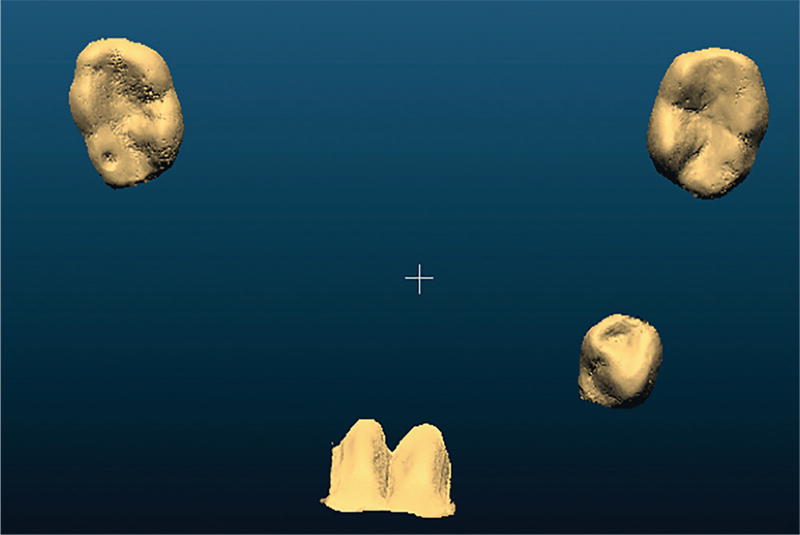
Five study participants consented and were enrolled. For each participant, optical and conventional (vinylsiloxanether) impressions of a custom-made intraoral Co-Cr alloy reference appliance fitted to the mandibular arch were obtained by 1 operator. Three-dimensional (3D) digital models were created for stone casts obtained from the conventional impression group and for the reference appliances by using a validated high-accuracy reference scanner. For the optical impression group, 3D digital models were obtained directly from the intraoral scans. The total mean trueness of each impression system was calculated by averaging the mean absolute deviations of the impression replicates from their 3D reference model for each participant, followed by averaging the obtained values across all participants. The total mean precision for each impression system was calculated by averaging the mean absolute deviations between all the impression replicas for each participant (10 pairs), followed by averaging the obtained values across all participants. Data were analyzed using repeated measures ANOVA (α=.05), first to assess whether a systematic difference in trueness or precision of replicate impressions could be found among participants and second to assess whether the mean trueness and precision values differed between the 2 impression systems.
Statistically significant differences were found between the 2 impression systems for both mean trueness (P=.010) and mean precision (P=.007). Conventional impressions had higher accuracy with a mean trueness of 17.0 ±6.6 μm and mean precision of 16.9 ±5.8 μm than optical impressions with a mean trueness of 46.2 ±11.4 μm and mean precision of 61.1 ±4.9 μm.
Complete arch (first molar-to-first molar) optical impressions were less accurate than conventional impressions but may be adequate for quadrant impressions.
准确性通常用于评估口腔内光学印模的精度。尽管已经报道了口腔内光学印模的重复性,但由于现有方案的局限性,尚未对其准确性进行评估。
本临床研究的目的是通过一种新的研究设计比较光学和常规印模的准确性(准确性和精密度)。
本研究共纳入了 5 名研究参与者。对于每位参与者,由同一位操作人员分别使用光学和常规(乙烯基硅氧烷醚)印模制取定制的口腔内 Co-Cr 合金参考模型。通过使用经过验证的高精度参考扫描仪,对常规印模组的石膏模型和参考模型进行三维(3D)数字模型的建立。对于光学印模组,直接从口腔内扫描获得 3D 数字模型。每个印模系统的总平均准确性通过平均每位参与者的印模复制件与其 3D 参考模型之间的平均绝对偏差来计算,然后将获得的值在所有参与者中平均。每个印模系统的总平均精密度通过平均每位参与者(10 对)所有印模复制件之间的平均绝对偏差来计算,然后将获得的值在所有参与者中平均。使用重复测量方差分析(α=.05)对数据进行分析,首先评估是否可以在参与者之间找到重复性印模精度的系统差异,其次评估两种印模系统之间的平均准确性和精度值是否存在差异。
两种印模系统在平均准确性(P=.010)和平均精度(P=.007)方面均存在显著差异。常规印模的准确性更高,平均准确性为 17.0 ±6.6μm,平均精度为 16.9 ±5.8μm,而光学印模的平均准确性为 46.2 ±11.4μm,平均精度为 61.1 ±4.9μm。
全牙弓(第一磨牙至第一磨牙)光学印模的准确性低于常规印模,但对于象限印模可能足够。