Wolfe Bryce, Wiepz Gregory J, Schotzko Michele, Bondarenko Gennadiy I, Durning Maureen, Simmons Heather A, Mejia Andres, Faith Nancy G, Sampene Emmanuel, Suresh Marulasiddappa, Kathariou Sophia, Czuprynski Charles J, Golos Thaddeus G
Wisconsin National Primate Research Center, University of Wisconsin-Madison, Madison, Wisconsin, USA.
Department of Pathology and Laboratory Medicine, University of Wisconsin-Madison, Madison, Wisconsin, USA.
mBio. 2017 Feb 21;8(1):e01938-16. doi: 10.1128/mBio.01938-16.
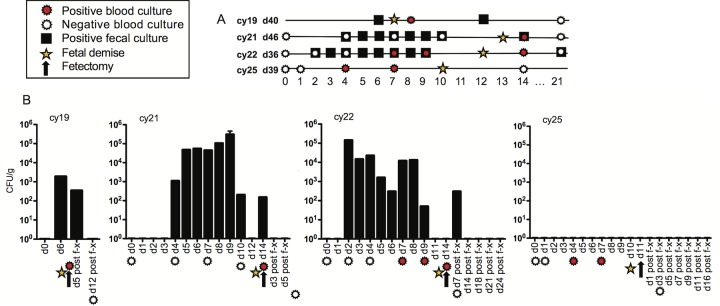
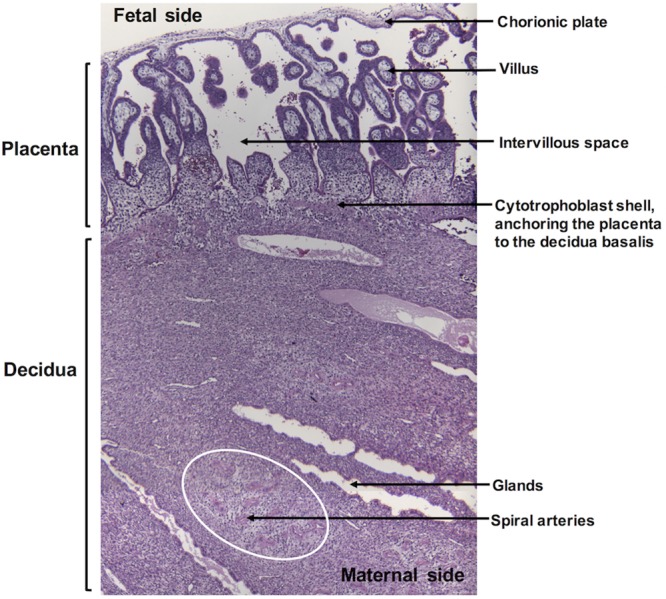
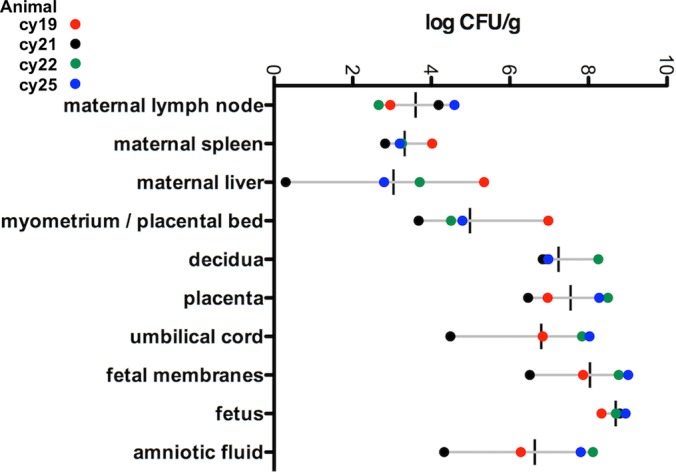
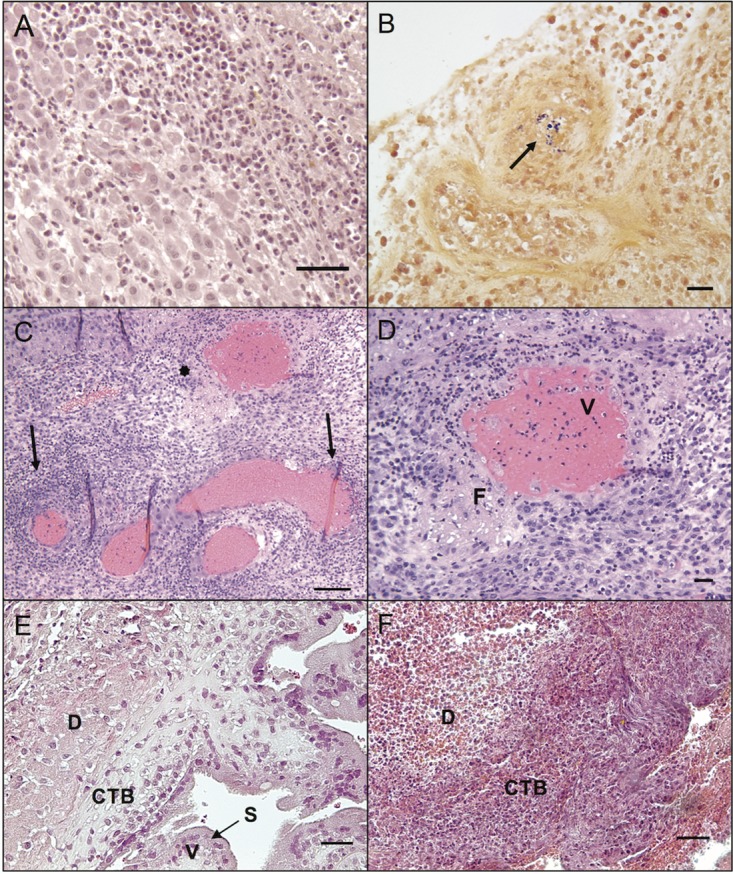
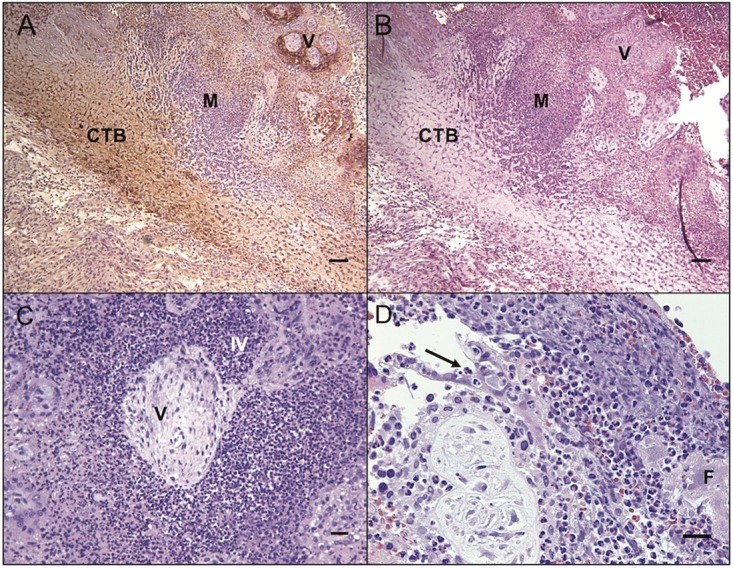
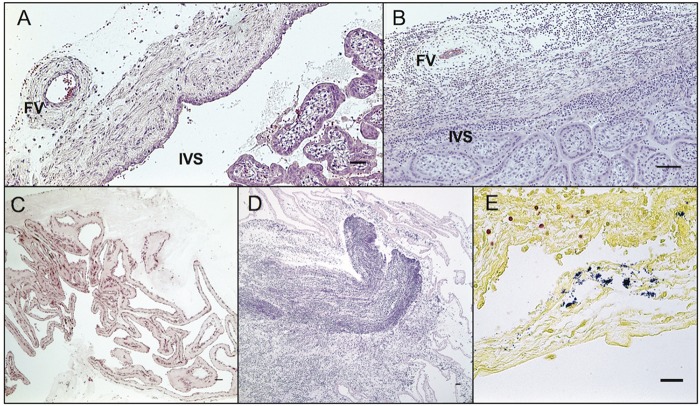
Infection with during pregnancy is associated with miscarriage, preterm birth, and neonatal complications, including sepsis and meningitis. While the risk of these conditions is thought to be greatest during the third trimester of pregnancy, the determinants of fetoplacental susceptibility to infection, the contribution of gestational age, and the progression of disease at the maternal-fetal interface are poorly understood. We developed a nonhuman primate model of listeriosis to better understand antecedents of adverse pregnancy outcomes in early pregnancy. Four pregnant cynomolgus macaques () received a single intragastric inoculation between days 36 and 46 of gestation with 10 CFU of an strain isolated from a previous cluster of human listeriosis cases that resulted in adverse pregnancy outcomes. Fecal shedding, maternal bacteremia, and fetal demise were consistently noted within 7 to 13 days. Biopsy specimens of maternal liver, spleen, and lymph node displayed variable inflammation and relatively low bacterial burden. In comparison, we observed greater bacterial burden in the decidua and placenta and the highest burden in fetal tissues. Histopathology indicated vasculitis, fibrinoid necrosis, and thrombosis of the decidual spiral arteries, acute chorioamnionitis and villitis in the placenta, and hematogenous infection of the fetus. Vascular pathology suggests early impact of infection on spiral arteries in the decidua, which we hypothesize precipitates subsequent placentitis and fetal demise. These results demonstrate that tropism for the maternal reproductive tract results in infection of the decidua, placenta, and the fetus itself during the first trimester of pregnancy. Although listeriosis is known to cause significant fetal morbidity and mortality, it is typically recognized in the third trimester of human pregnancy. Its impact on early pregnancy is poorly defined. Here we provide evidence that exposure to in the first trimester poses a greater risk of fetal loss than currently appreciated. Similarities in human and nonhuman primate placentation, physiology, and reproductive immunology make this work highly relevant to human pregnancy. We highlight the concept that the maternal immune response that protects the mother from serious disease is unable to protect the fetus, a concept relevant to classic TORCH (oxoplasmosis, ther, ubella, ytomegalovirus, and erpes) infections and newly illuminated by current Zika virus outbreaks. Studies with this model, using the well-understood organism , will permit precise analysis of host-pathogen interactions at the maternal-fetal interface and have broad significance to both recognized and emerging infections in the setting of pregnancy.
孕期感染 与流产、早产及新生儿并发症(包括败血症和脑膜炎)相关。虽然这些情况的风险被认为在妊娠晚期最高,但胎儿 - 胎盘对感染的易感性决定因素、孕周的影响以及母胎界面处疾病的进展尚不清楚。我们建立了一个李斯特菌病的非人灵长类动物模型,以更好地了解早期妊娠不良妊娠结局的先兆。4只怀孕的食蟹猴在妊娠第36至46天之间接受了一次胃内接种,接种的是从先前一组导致不良妊娠结局的人类李斯特菌病病例中分离出的10 CFU的 菌株。在7至13天内持续观察到粪便排菌、母体菌血症和胎儿死亡。母体肝脏、脾脏和淋巴结的活检标本显示出不同程度的炎症和相对较低的细菌载量。相比之下,我们在蜕膜和胎盘中观察到更高的细菌载量,在胎儿组织中细菌载量最高。组织病理学显示蜕膜螺旋动脉血管炎、纤维蛋白样坏死和血栓形成,胎盘急性绒毛膜羊膜炎和绒毛炎,以及胎儿血源性感染。血管病理学表明 感染对蜕膜螺旋动脉有早期影响,我们推测这会引发随后的胎盘炎和胎儿死亡。这些结果表明, 在孕期对母体生殖道的嗜性导致在妊娠早期蜕膜、胎盘和胎儿本身受到感染。虽然已知李斯特菌病会导致显著的胎儿发病和死亡,但它通常在人类妊娠晚期才被识别。其对早期妊娠的影响尚不清楚。在此我们提供证据表明,妊娠早期接触 导致胎儿丢失的风险比目前所认识到的更大。人类和非人灵长类动物在胎盘形成、生理学和生殖免疫学方面的相似性使得这项工作与人类妊娠高度相关。我们强调这样一个概念,即保护母亲免受严重疾病的母体免疫反应无法保护胎儿,这一概念与经典的TORCH(弓形虫病、梅毒、风疹、巨细胞病毒和疱疹)感染相关,并且在当前寨卡病毒疫情中得到了新的阐明。使用这种易于理解的生物体 对该模型进行研究,将能够精确分析母胎界面处的宿主 - 病原体相互作用,并且对孕期已认识到的和新出现的感染具有广泛意义。