Wisconsin National Primate Research Center, University of Wisconsin-Madison, Madison, WI, USA.
Department of Pathology and Laboratory Medicine, University of Wisconsin-Madison, Madison, WI, USA.
Biol Reprod. 2023 Nov 15;109(5):618-634. doi: 10.1093/biolre/ioad104.
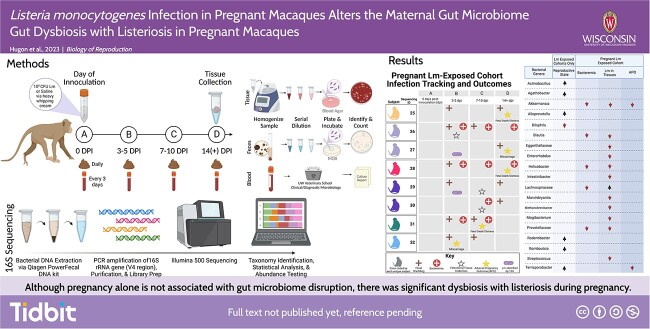
The bacterium Listeria monocytogenes (Lm) is associated with adverse pregnancy outcomes. Infection occurs through consumption of contaminated food that is disseminated to the maternal-fetal interface. The influence on the gastrointestinal microbiome during Lm infection remains unexplored in pregnancy. The objective of this study was to determine the impact of listeriosis on the gut microbiota of pregnant macaques.
A non-human primate model of listeriosis in pregnancy has been previously described. Both pregnant and non-pregnant cynomolgus macaques were inoculated with Lm and bacteremia and fecal shedding were monitored for 14 days. Non-pregnant animal tissues were collected at necropsy to determine bacterial burden, and fecal samples from both pregnant and non-pregnant animals were evaluated by 16S rRNA next-generation sequencing.
Unlike pregnant macaques, non-pregnant macaques did not exhibit bacteremia, fecal shedding, or tissue colonization by Lm. Dispersion of Lm during pregnancy was associated with a significant decrease in alpha diversity of the host gut microbiome, compared to non-pregnant counterparts. The combined effects of pregnancy and listeriosis were associated with a significant loss in microbial richness, although there were increases in some genera and decreases in others.
Although pregnancy alone is not associated with gut microbiome disruption, we observed dysbiosis with listeriosis during pregnancy. The macaque model may provide an understanding of the roles that pregnancy and the gut microbiota play in the ability of Lm to establish intestinal infection and disseminate throughout the host, thereby contributing to adverse pregnancy outcomes and risk to the developing fetus.
单核细胞增生李斯特菌(Lm)与不良妊娠结局有关。感染是通过食用传播到母体-胎儿界面的受污染食物引起的。在妊娠期间,Lm 感染对胃肠道微生物组的影响仍不清楚。本研究的目的是确定李斯特菌病对妊娠猕猴肠道微生物群的影响。
以前已经描述了妊娠期间李斯特菌病的非人类灵长类动物模型。用 Lm 接种妊娠和非妊娠食蟹猴,并监测菌血症和粪便排出 14 天。在尸检时收集非妊娠动物组织以确定细菌负荷,并用 16S rRNA 下一代测序评估来自妊娠和非妊娠动物的粪便样本。
与妊娠猕猴不同,非妊娠猕猴没有出现菌血症、粪便排出或组织定植 Lm。与非妊娠对照相比,妊娠期间 Lm 的扩散与宿主肠道微生物群的 alpha 多样性显着降低有关。与怀孕和李斯特菌病的综合影响相关的是微生物丰富度的显着丧失,尽管某些属增加而其他属减少。
尽管单独怀孕不会导致肠道微生物群失调,但我们在怀孕期间观察到李斯特菌病时出现了肠道微生态失调。猕猴模型可能有助于理解妊娠和肠道微生物群在 Lm 建立肠道感染和在宿主中传播的能力中所起的作用,从而导致不良的妊娠结局和对发育中胎儿的风险。