Wang Rui, Chen Zhaoyu, Fu Yongmei, Wei Xiaobo, Liao Jinchi, Liu Xu, He Bingjun, Xu Yunqi, Zou Jing, Yang Xiaoyan, Weng Ruihui, Tan Sheng, McElroy Christopher, Jin Kunlin, Wang Qing
Departments of Neurology, The Third Affiliated Hospital of Sun Yat-Sen University Guangzhou, China.
Departments of Emergency, The Third Affiliated Hospital of Sun Yat-Sen University Guangzhou, China.
Front Aging Neurosci. 2017 Feb 7;9:26. doi: 10.3389/fnagi.2017.00026. eCollection 2017.
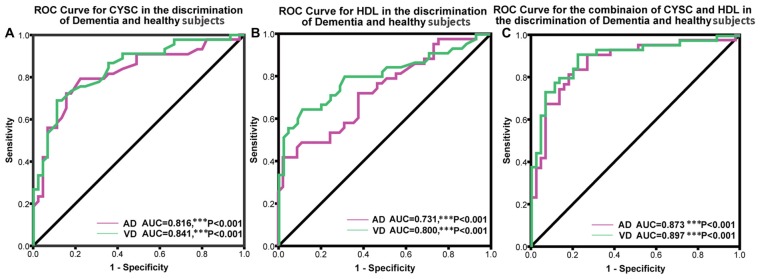
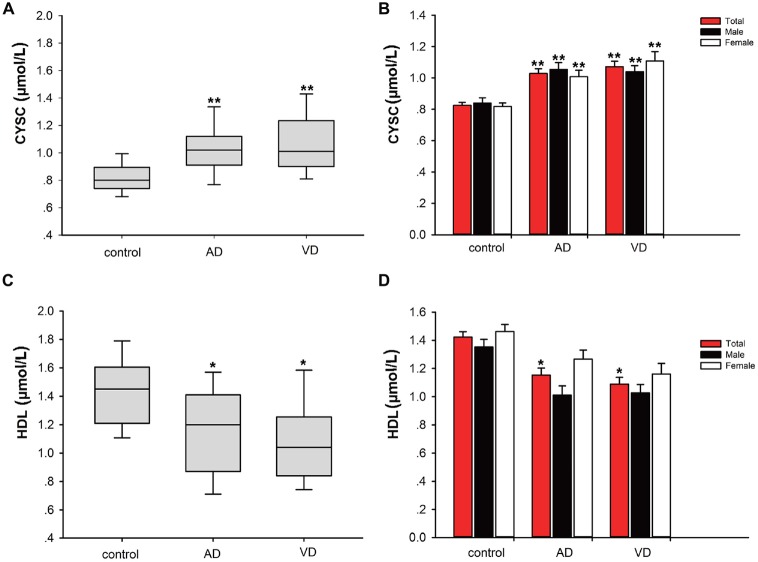
: Cystatin C (Cys C) and high-density lipoprotein (HDL) play critical roles in neurodegenerative diseases, such as dementia, Alzheimer's disease (AD) and vascular dementia (VaD). However, whether they can be used as reliable biomarkers to distinguish patients with dementia from healthy subjects and to determine disease severity remain largely unknown. : We conducted a cross-sectional study to determine plasma Cys C and HDL levels of 88 patients with dementia (43 AD patients, 45 VaD patients) and 45 healthy age-matched controls. The severity of dementia was determined based on the Schwab and England Activities of Daily Living (ADL) Scale, the Mini-mental State Examination (MMSE), the Global Deterioration Scale (GDS), the Lawton Instrumental ADL (IADL) Scale, and the Hachinski Ischemia Scale (Hachinski). Receiver operating characteristic (ROC) curves were calculated to determine the diagnostic accuracy of Cys C and HDL levels in distinguishing patients with dementia from healthy subjects. : We found that plasma Cys C levels were higher, but HDL levels were lower in AD and VaD patients respectively, compared to healthy control subjects. Yet, Cys C levels were highest among patients with VaD. Interestingly, plasma Cys C levels were significantly correlated with IADL Scale scores. In addition, the ROC curves for Cys C (area under the curve, AUC 0.816 for AD, AUC 0.841 for VaD) and HDL (AUC 0.800 for AD, AUC 0.731 for VaD) exhibited potential diagnostic value in distinguishing AD/VaD patients from healthy subjects. While the ROC curve for the combination of Cys C and HDL (AUC 0.873 for AD, AUC 0.897 for VaD) showed higher diagnostic accuracy in distinguishing AD/VaD patients from healthy subjects than the separate curves for each parameter. : Our findings suggest that the inflammatory mediators Cys C and HDL may play important roles in the pathogenesis of dementia, and plasma Cys C and HDL levels may be useful screening tools for differentiating AD/VaD patients from healthy subjects.
Plasma Cys C levels were higher in patients with AD/VaD than in healthy subjects.Plasma HDL levels were lower in patients with AD/VaD than in healthy subjects.Plasma Cys C levels were significantly correlated with dementia.The ROC curve for the combination of Cys C and HDL showed potential diagnostic value in distinguishing AD/VaD from healthy subjects.
胱抑素C(Cys C)和高密度脂蛋白(HDL)在神经退行性疾病如痴呆、阿尔茨海默病(AD)和血管性痴呆(VaD)中起关键作用。然而,它们是否可作为可靠的生物标志物用于区分痴呆患者与健康受试者以及确定疾病严重程度,在很大程度上仍不清楚。
我们进行了一项横断面研究,以测定88例痴呆患者(43例AD患者,45例VaD患者)和45例年龄匹配的健康对照者的血浆Cys C和HDL水平。根据施瓦布和英格兰日常生活活动量表(ADL)、简易精神状态检查表(MMSE)、总体衰退量表(GDS)、劳顿工具性日常生活活动量表(IADL)以及哈金斯基缺血量表(Hachinski)来确定痴呆的严重程度。计算受试者工作特征(ROC)曲线,以确定Cys C和HDL水平在区分痴呆患者与健康受试者方面的诊断准确性。
我们发现,与健康对照者相比,AD和VaD患者的血浆Cys C水平较高,但HDL水平分别较低。然而,VaD患者中的Cys C水平最高。有趣的是,血浆Cys C水平与IADL量表评分显著相关。此外,Cys C(曲线下面积,AD的AUC为0.816,VaD的AUC为0.841)和HDL(AD的AUC为0.800,VaD的AUC为0.731)的ROC曲线在区分AD/VaD患者与健康受试者方面显示出潜在的诊断价值。而Cys C和HDL联合检测的ROC曲线(AD的AUC为0.873,VaD的AUC为0.897)在区分AD/VaD患者与健康受试者方面比每个参数单独的曲线具有更高的诊断准确性。
我们的研究结果表明,炎症介质Cys C和HDL可能在痴呆的发病机制中起重要作用,血浆Cys C和HDL水平可能是区分AD/VaD患者与健康受试者的有用筛查工具。
AD/VaD患者的血浆Cys C水平高于健康受试者。AD/VaD患者的血浆HDL水平低于健康受试者。血浆Cys C水平与痴呆显著相关。Cys C和HDL联合检测的ROC曲线在区分AD/VaD与健康受试者方面显示出潜在的诊断价值。