Iwata Hisashi, Kobayashi Yosuke, Mizushima Daiki, Watanabe Taisuke, Ogihara Jun, Kasumi Takafumi
Applied Microbiology and Biotechnology Laboratory, Department of Chemistry and Lifescience, Nihon University, 1866 Kameino, Fujisawa, Kanagawa, 252-0880, Japan.
Bioproduction Research Institute, National Institute of Advanced Industrial Science and Technology, 1-1-1 Higashi, Tsukuba, Ibaraki, 305-8566, Japan.
AMB Express. 2017 Dec;7(1):45. doi: 10.1186/s13568-017-0342-0. Epub 2017 Feb 21.
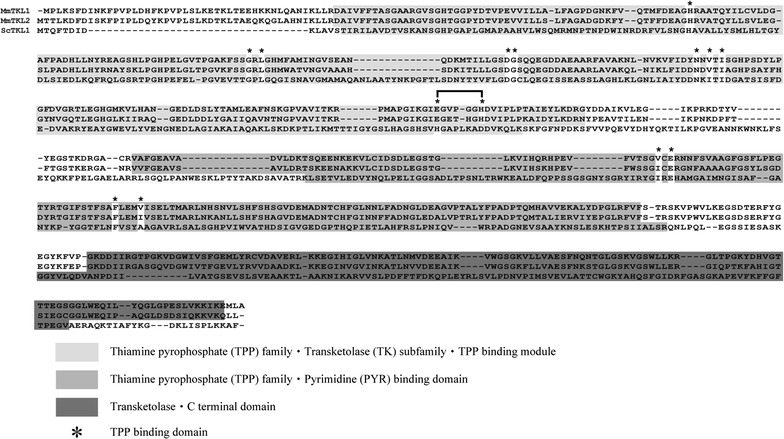
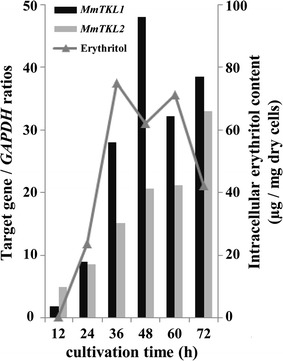
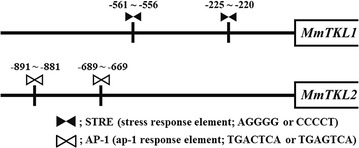
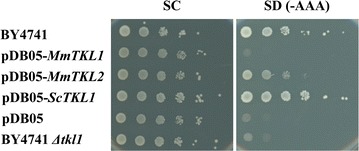
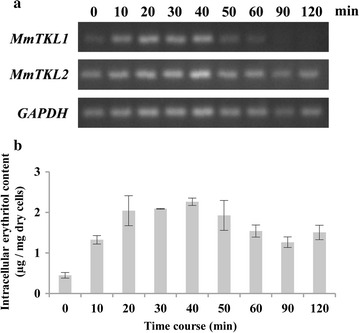
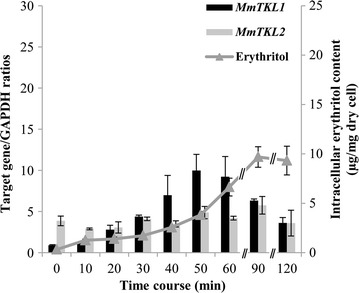
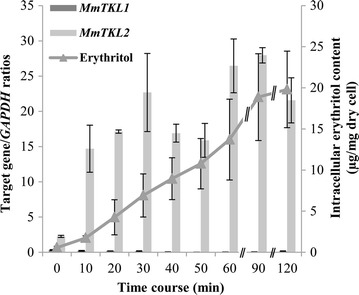
Two transketolase isogenes, MmTKL1 and MmTKL2, isolated from Moniliella megachiliensis were investigated for their roles in stress response and erythritol biosynthesis. The encoded proteins were highly homologous in amino acid sequence and domain structure. Two stress response elements (STREs) were found upstream of MmTKL1, while no STRE was found upstream of MmTKL2. In contrast, two Ap-1 elements were present upstream of MmTKL2, but none were detected upstream of MmTKL1. MmTKL2 partially complemented the aromatic amino acid auxotrophy of a Saccharomyces cerevisiae tkl1 deletion mutant, suggesting that at least one of the MmTKLs functioned as a transketolase in vivo. In response to short-term osmotic stress (20% glucose or 1.2 M NaCl) in Moniliella cells, MmTKL1 expression increased rapidly through the first 40 min before subsequently decreasing gradually, while MmTKL2 expression showed no significant change. In contrast, short-term oxidative stress (0.15 mM menadione) induced considerable increases in MmTKL2, while MmTKL1 expression remained low under the same conditions. Long-term osmotic stress (20% glucose) yielded increased expression of both genes starting at 12 h and continuing through 72 h. During either osmotic or oxidative stress, intracellular erythritol accumulation could clearly be correlated with the pattern of expression of either MmTKL1 or MmTKL2. These results strongly suggested that MmTKL1 is responsible primarily for the response to osmotic stress, while MmTKL2 is responsible primarily for the response to oxidative stress. Thus, we postulate that the two transketolase isoforms of M. megachiliensis play distinct and complementary roles in coordinating erythritol production in response to distinct environmental stresses.
对从巨大串珠霉中分离出的两个转酮醇酶同基因MmTKL1和MmTKL2在应激反应和赤藓糖醇生物合成中的作用进行了研究。编码的蛋白质在氨基酸序列和结构域结构上高度同源。在MmTKL1上游发现了两个应激反应元件(STREs),而在MmTKL2上游未发现STRE。相反,在MmTKL2上游存在两个Ap-1元件,但在MmTKL1上游未检测到。MmTKL2部分互补了酿酒酵母tkl1缺失突变体的芳香族氨基酸营养缺陷,表明至少有一个MmTKLs在体内作为转酮醇酶发挥作用。在巨大串珠霉细胞中,响应短期渗透胁迫(20%葡萄糖或1.2 M NaCl),MmTKL1表达在最初40分钟内迅速增加,随后逐渐下降,而MmTKL2表达无显著变化。相反,短期氧化胁迫(0.15 mM甲萘醌)诱导MmTKL2显著增加,而在相同条件下MmTKL1表达保持较低水平。长期渗透胁迫(20%葡萄糖)导致两个基因的表达从12小时开始增加并持续到72小时。在渗透或氧化胁迫期间,细胞内赤藓糖醇积累显然与MmTKL1或MmTKL2的表达模式相关。这些结果强烈表明,MmTKL1主要负责对渗透胁迫的反应,而MmTKL2主要负责对氧化胁迫的反应。因此,我们推测巨大串珠霉的两个转酮醇酶同工型在协调赤藓糖醇生产以响应不同环境胁迫中发挥着不同且互补的作用。