Gassmann Dimitri, Cheetham Marcus, Siebenhuener Klarissa, Holzer Barbara M, Meindl-Fridez Claudine, Hildenbrand Florian F, Virgini Vanessa, Martin Mike, Battegay Edouard
Department of Internal Medicine, University Hospital Zurich Center of Competence Multimorbidity University Research Priority Program "Dynamics of Healthy Aging," University of Zurich Department of Dermatology, University Hospital Zurich Division of Gerontopsychology and Gerontology, Department of Psychology, University of Zurich, Zurich, Switzerland.
Medicine (Baltimore). 2017 Feb;96(8):e6144. doi: 10.1097/MD.0000000000006144.
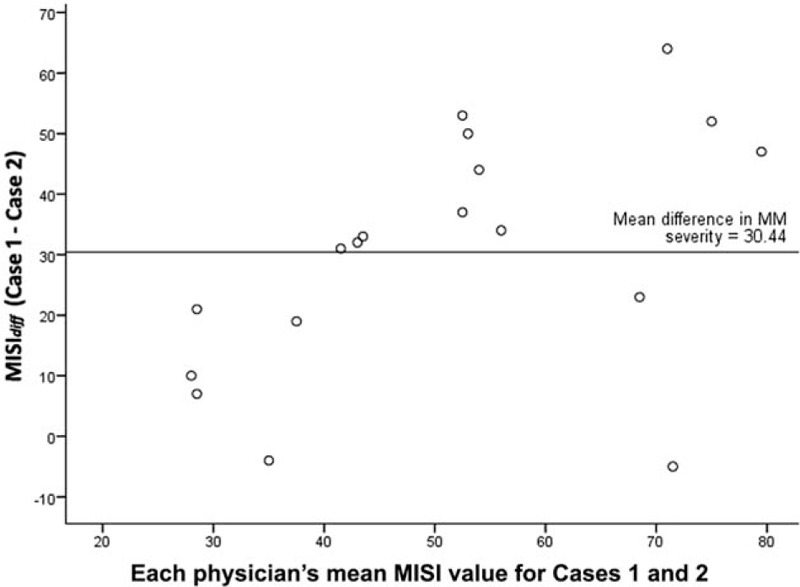
Therapeutic decision-making for patients with multimorbidity (MM) is challenging. Clinical practice guidelines inadequately address harmful interactions and resulting therapeutic conflicts within and among diseases. A patient-specific measure of MM severity that takes account of this conflict is needed.As a proof of concept, we evaluated whether the new Multimorbidity Interaction Severity Index (MISI) could be used to reliably differentiate patients in terms of lower versus higher potential for harmful interactions.Two hypothetical patient cases were generated, each with 6 concurrent morbidities. One case had a low (i.e., low conflict case) and the other a high (i.e., high conflict case) potential for harmful interactions. All possible interactions between conditions and treatments were extracted from each case's record into a multimorbidity interaction matrix. Experienced general internists (N = 18) judged each interaction in the matrix in terms of likely resource utilization needed to manage the interaction. Based on these judgements, a composite index of MM interaction severity, that is, the MISI, was generated for each physician and case.The difference between each physician's MISI score for the 2 cases (MISIdiff) was computed. Based on MISIdiff, the high conflict case was judged to be of significantly greater MM severity than was the low conflict case. The positive values of the inter-quartile range, a measure of variation (or disagreement) between the 2 cases, indicated general consistency of individual physicians in judging MM severity.The data indicate that the MISI can be used to reliably differentiate hypothetical multimorbid patients in terms of lesser versus greater severity of potentially harmful interactive effects. On this basis, the MISI will be further developed for use in patient-specific assessment and management of MM. The clinical relevance of the MISI as an alternative approach to defining MM severity is discussed.
对患有多种疾病(MM)的患者进行治疗决策具有挑战性。临床实践指南未能充分解决疾病内部和之间的有害相互作用以及由此产生的治疗冲突。需要一种考虑到这种冲突的针对患者的MM严重程度衡量指标。作为概念验证,我们评估了新的多病症相互作用严重程度指数(MISI)是否可用于可靠地区分患者潜在有害相互作用可能性较低与较高的情况。生成了两个假设的患者病例,每个病例有6种并发疾病。一个病例有害相互作用的可能性较低(即低冲突病例),另一个病例有害相互作用的可能性较高(即高冲突病例)。从每个病例记录中提取病症与治疗之间的所有可能相互作用,形成一个多病症相互作用矩阵。经验丰富的普通内科医生(N = 18)根据管理相互作用所需的可能资源利用情况对矩阵中的每种相互作用进行判断。基于这些判断,为每位医生和每个病例生成了MM相互作用严重程度的综合指数,即MISI。计算每位医生对这两个病例的MISI评分之间的差异(MISIdiff)。基于MISIdiff,高冲突病例被判定为MM严重程度明显高于低冲突病例。四分位间距的正值,即衡量两个病例之间差异(或分歧)的指标,表明个体医生在判断MM严重程度方面总体具有一致性。数据表明,MISI可用于可靠地区分假设的患有多种疾病的患者潜在有害相互作用效应的严重程度较低与较高的情况。在此基础上,将进一步开发MISI以用于针对患者的MM评估和管理。讨论了MISI作为定义MM严重程度的替代方法的临床相关性。