Kumari Punita, Srivastava Ashish, Ghosh Eshan, Ranjan Ravi, Dogra Shalini, Yadav Prem N, Shukla Arun K
Department of Biological Sciences and Bioengineering, Indian Institute of Technology, Kanpur 208016, India.
Division of Pharmacology, CSIR-Central Drug Research Institute, Lucknow, UP 226031, India.
Mol Biol Cell. 2017 Apr 15;28(8):1003-1010. doi: 10.1091/mbc.E16-12-0818. Epub 2017 Feb 22.
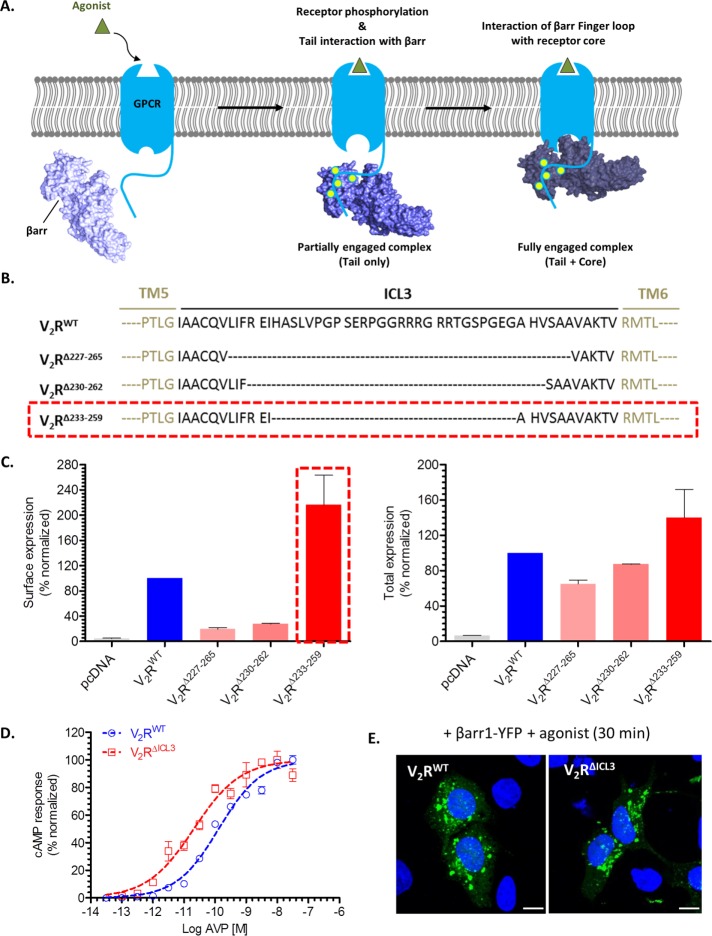
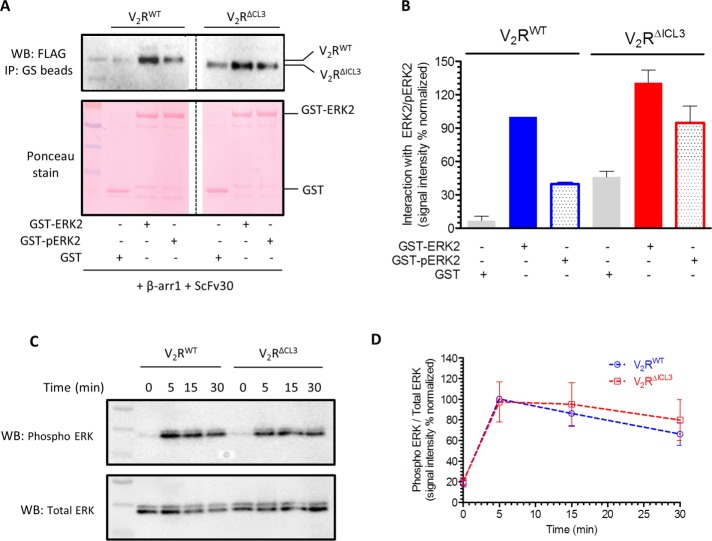
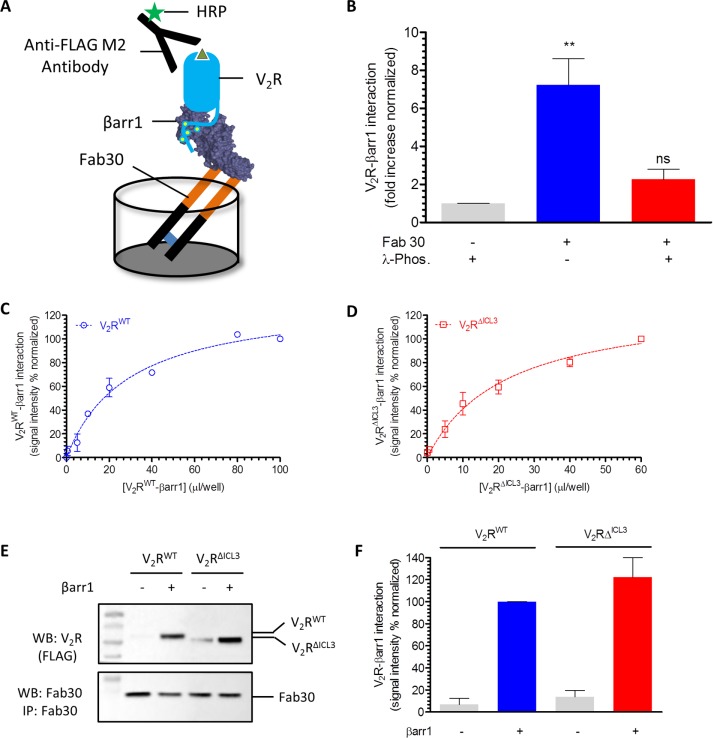
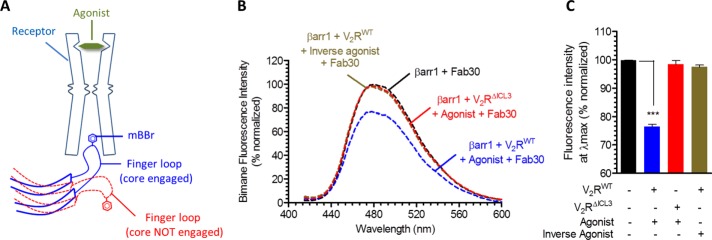
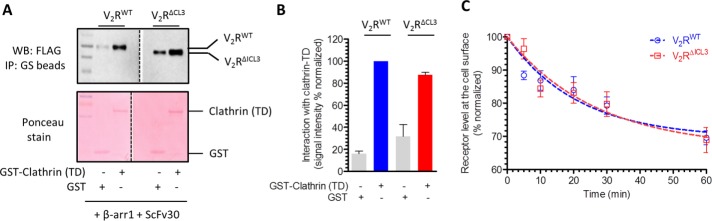
G protein-coupled receptors (GPCRs) exhibit highly conserved activation and signaling mechanisms by which agonist stimulation leads to coupling of heterotrimeric G proteins and generation of second messenger response. This is followed by receptor phosphorylation, primarily in the carboxyl terminus but also in the cytoplasmic loops, and subsequent binding of arrestins. GPCRs typically recruit arrestins through two different sets of interactions, one involving phosphorylated receptor tail and the other mediated by the receptor core. The engagement of both set of interactions (tail and core) is generally believed to be necessary for arrestin-dependent functional outcomes such as receptor desensitization, endocytosis, and G protein-independent signaling. Here we demonstrate that a vasopressin receptor (VR) mutant with truncated third intracellular loop (VR) can interact with β-arrestin 1 (βarr1) only through the phosphorylated tail without engaging the core interaction. Of interest, such a partially engaged VR-βarr1 complex can efficiently interact with clathrin terminal domain and ERK2 MAPK in vitro. Furthermore, this core interaction-deficient VR mutant exhibits efficient endocytosis and ERK activation upon agonist stimulation. Our data suggest that core interaction with βarr is dispensable for VR endocytosis and ERK activation and therefore provide novel insights into refining the current understanding of functional requirements in biphasic GPCR-βarr interaction.
G蛋白偶联受体(GPCRs)表现出高度保守的激活和信号传导机制,通过该机制,激动剂刺激导致异源三聚体G蛋白偶联并产生第二信使反应。随后是受体磷酸化,主要发生在羧基末端,但也发生在细胞质环中,随后是抑制蛋白的结合。GPCRs通常通过两组不同的相互作用招募抑制蛋白,一组涉及磷酸化的受体尾部,另一组由受体核心介导。一般认为,这两组相互作用(尾部和核心)的参与对于依赖抑制蛋白的功能结果(如受体脱敏、内吞作用和G蛋白非依赖性信号传导)是必要的。在这里,我们证明了一种具有截短的第三细胞内环的血管加压素受体(VR)突变体(VR)只能通过磷酸化的尾部与β抑制蛋白1(βarr1)相互作用,而不参与核心相互作用。有趣的是,这种部分参与的VR-βarr1复合物在体外可以有效地与网格蛋白末端结构域和ERK2丝裂原活化蛋白激酶相互作用。此外,这种缺乏核心相互作用的VR突变体在激动剂刺激后表现出有效的内吞作用和ERK激活。我们的数据表明,与βarr的核心相互作用对于VR内吞作用和ERK激活是可有可无的,因此为完善目前对双相GPCR-βarr相互作用功能需求的理解提供了新的见解。