Ji Jeong Seok, Yun Yaejin, Stepniewski Tomasz Maciej, Yoon Hye-Jin, Min Kyungjin, Park Ji Young, Chung Chiwoon, Eceolaza Miguel Dieguez, Chung Ka Young, Selent Jana, Lee Hyung Ho
Department of Chemistry, College of Natural Sciences, Seoul National University, Seoul, Republic of Korea.
Research Program on Biomedical Informatics, Hospital del Mar Research Institute and Pompeu Fabra University, Barcelona, Spain.
PLoS Biol. 2025 Aug 7;23(8):e3003312. doi: 10.1371/journal.pbio.3003312. eCollection 2025 Aug.
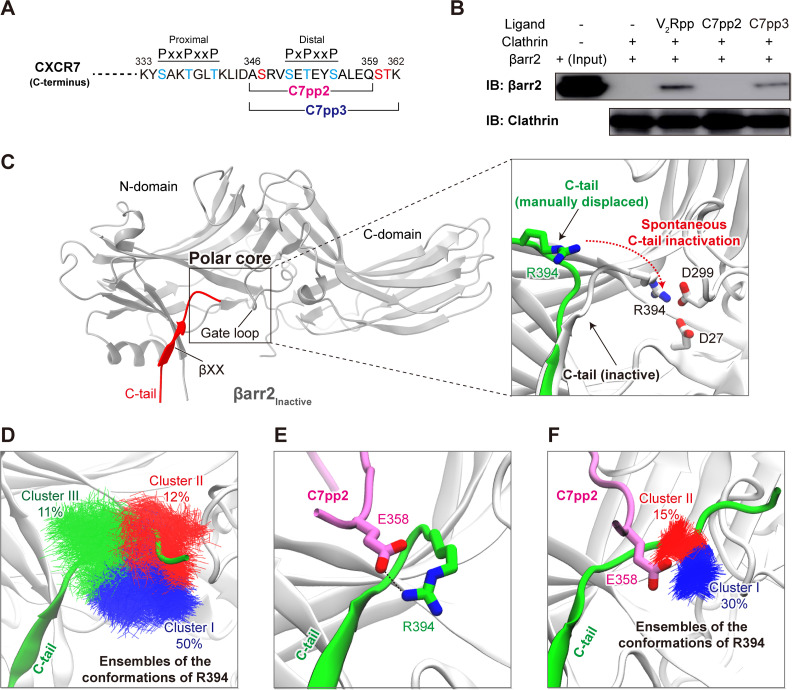
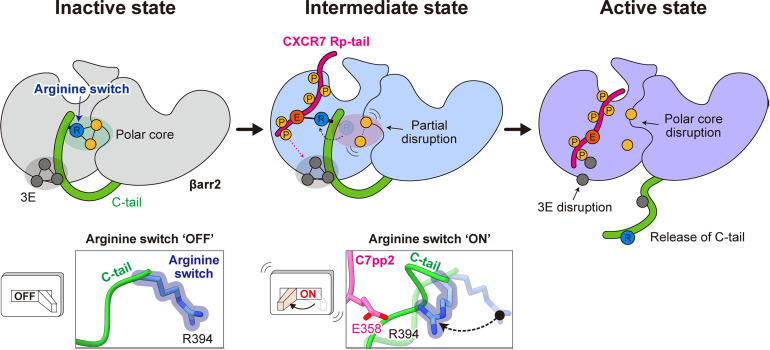
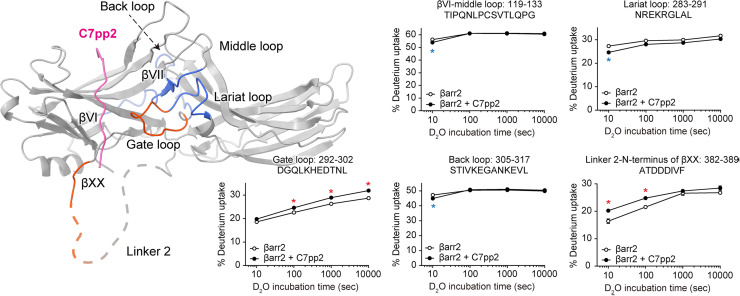
β-arrestins (βarrs) play a crucial role in regulating G protein-coupled receptor (GPCR) signaling and trafficking. Canonically, interactions of βarr with the phosphorylated intracellular GPCR-tail induce a multi-step conformational transition that results in the activation of βarr. Depending on the specific interaction pattern with the receptor, βarrs adopt multiple conformational states, each tightly linked to a specific functional outcome of βarr recruitment. Despite its physiological relevance, the structural determinants of βarr activation remain poorly understood. Using a combination of molecular dynamics simulations, biochemical and cell-based experiments, we reveal how specific interactions with a chemokine receptor 7 (CXCR7) promote the unbinding of the βarr2 C-tail-a crucial step in arrestin activation. Importantly, we observe that the expulsion of the C-tail is promoted by the displacement of a conserved arginine residue (Arg394) within the βarr polar core, which we dub "the arginine switch." Our study uncovers a role for the arginine switch that, upon engagement, destabilizes the polar core as a crucial step in the CXCR7-induced βarr activation.
β-抑制蛋白(βarrs)在调节G蛋白偶联受体(GPCR)信号传导和转运过程中发挥着关键作用。通常情况下,βarrs与磷酸化的细胞内GPCR尾部相互作用会引发多步构象转变,从而导致βarrs的激活。根据与受体的特定相互作用模式,βarrs会呈现多种构象状态,每种状态都与βarrs募集的特定功能结果紧密相关。尽管其具有生理相关性,但βarrs激活的结构决定因素仍知之甚少。通过结合分子动力学模拟、生化和细胞实验,我们揭示了与趋化因子受体7(CXCR7)的特定相互作用如何促进βarr2 C末端的解离——这是抑制蛋白激活的关键步骤。重要的是,我们观察到C末端的排出是由βarrs极性核心内一个保守的精氨酸残基(Arg394)的位移所促进的,我们将其称为“精氨酸开关”。我们的研究揭示了精氨酸开关的作用,即一旦参与其中,会使极性核心不稳定,这是CXCR7诱导βarrs激活的关键步骤。