Department of Psychology, Park Hall, University at Buffalo, Buffalo, NY, 14260, USA.
Department of Psychology, University of Washington, Seattle, WA, USA.
J Abnorm Child Psychol. 2018 Feb;46(2):319-330. doi: 10.1007/s10802-017-0277-6.
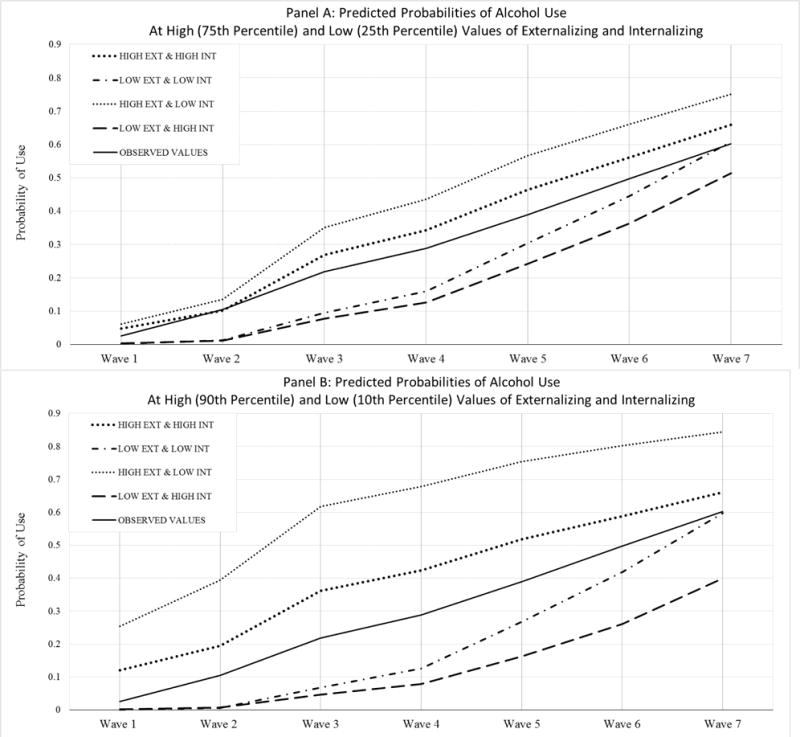
Externalizing symptoms robustly predict adolescent substance use (SU); however, findings regarding internalizing symptoms have been mixed, suggesting that there may be important moderators of the relationship between internalizing problems and SU. The present study used a longitudinal community sample (N = 387, 55% female, 83% White) to test whether externalizing symptoms moderated the relationship between internalizing symptoms and trajectories of alcohol and marijuana use from early (age 11-12 years old) to late (age 18-19 years old) adolescence. Two-part latent growth models were used to distinguish trajectories of probability of use from trajectories of amount of use among users. Results suggested that externalizing symptoms moderated the association between internalizing symptoms and probability of alcohol, but not marijuana use. The highest probability of alcohol use was observed at high levels of externalizing symptoms and low levels of internalizing symptoms. A negative protective effect of internalizing symptoms on probability of alcohol use was strongest in early adolescence for youth high on externalizing symptoms. Although moderation was not supported for amount of use among users, both domains of symptomology were associated with amount of alcohol and marijuana use as first-order effects. High levels of externalizing symptoms and low levels of internalizing symptoms were associated with high levels of amount of use among users. These findings suggest that developmental models of substance use that incorporate internalizing symptomology should consider the context of externalizing problems and distinguish probability and amount of use.
外化症状强烈预测青少年物质使用 (SU);然而,关于内化症状的研究结果喜忧参半,这表明内化问题与 SU 之间的关系可能存在重要的调节因素。本研究使用纵向社区样本 (N = 387,55%女性,83%白人) 来检验外化症状是否调节内化症状与青少年早期 (11-12 岁) 到晚期 (18-19 岁) 期间酒精和大麻使用轨迹之间的关系。双部分潜在增长模型用于区分使用者中使用概率轨迹和使用量轨迹。结果表明,外化症状调节了内化症状与酒精使用概率之间的关联,但与大麻使用概率无关。在外化症状水平高和内化症状水平低的情况下,酒精使用的概率最高。对于外化症状高的青少年来说,内化症状对酒精使用概率的负保护作用在青少年早期最强。虽然对使用者中使用量的调节不支持,但症状学的两个领域都与酒精和大麻使用量呈一阶关系。高水平的外化症状和低水平的内化症状与使用者的高水平使用量有关。这些发现表明,纳入内化症状学的物质使用发展模型应考虑外化问题的背景,并区分使用概率和使用量。