Department of Psychology, University at Buffalo, State University of New York, Buffalo, New York.
Department of Psychology, University of Washington, Seattle, Washington.
Alcohol Clin Exp Res. 2017 Dec;41(12):2185-2196. doi: 10.1111/acer.13512. Epub 2017 Nov 10.
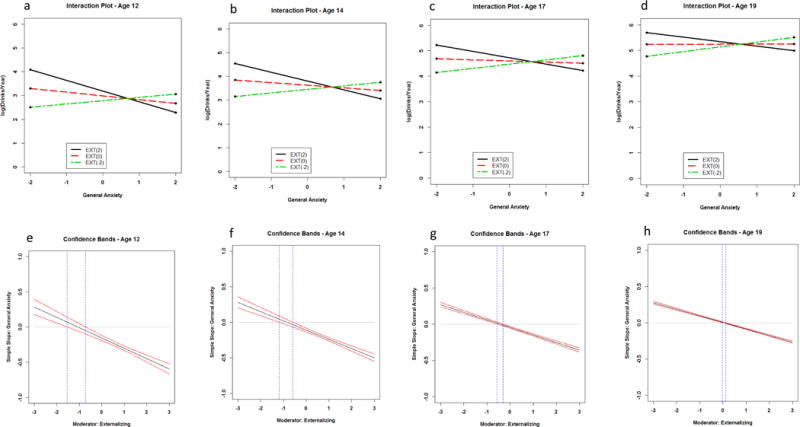
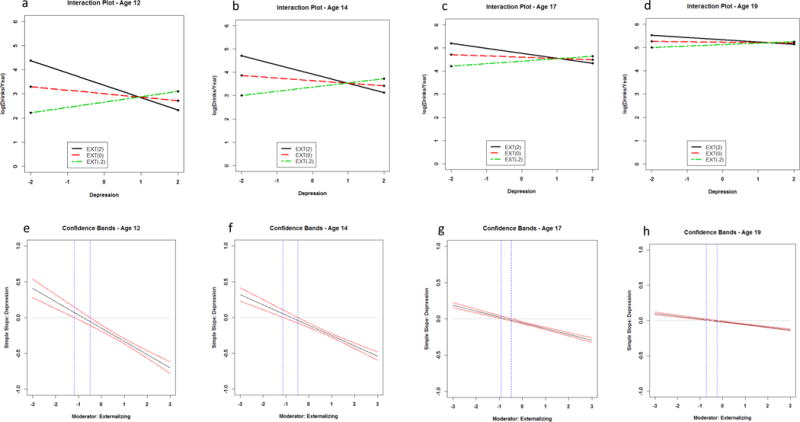
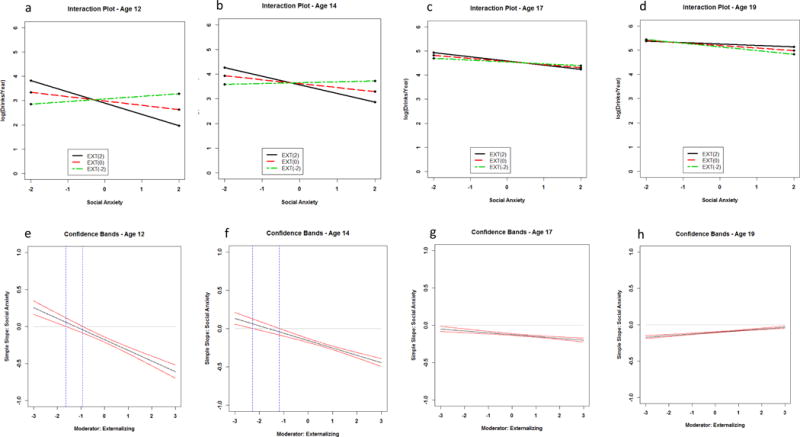
As predicted by self-medication theories that drinking is motivated by a desire to ameliorate emotional distress, some studies find internalizing symptoms (e.g., anxiety, depression) increase risk of adolescent drinking; however, such a risk effect has not been supported consistently. Our prior work examined externalizing symptoms as a potential moderator of the association between internalizing symptoms and adolescent alcohol use to explain some of the inconsistencies in the literature. We found that internalizing symptoms were protective against early adolescent alcohol use particularly for youth elevated on externalizing symptoms (a 2-way interaction). Our sample has now been followed for several additional assessments that extend into young adulthood, and the current study tests whether the protective effect of internalizing symptoms may change as youth age into young adulthood, and whether this age-moderating effect varied across different clusters of internalizing symptoms (social anxiety, generalized anxiety, and depression). Internalizing symptoms were hypothesized to shift from a protective factor to a risk factor with age, particularly for youth elevated on externalizing symptoms.
A community sample of 387 adolescents was followed for 9 annual assessments (mean age = 12.1 years at the first assessment and 55% female). Multilevel cross-lagged 2-part zero-inflated Poisson models were used to test hypotheses.
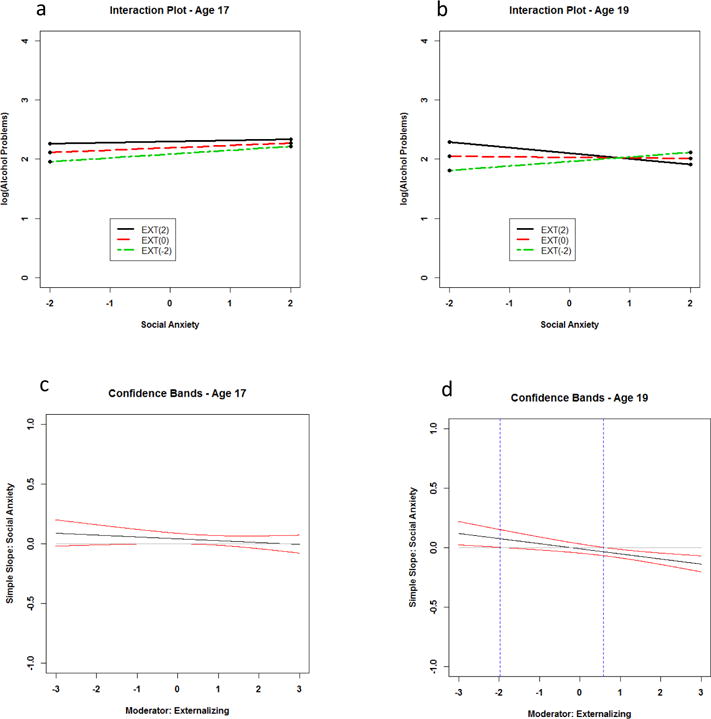
The most robust moderating effects were for levels of alcohol use, such that the protective effect of all internalizing symptom clusters was most evident in the context of moderate to high levels of externalizing problems. A risk effect of internalizing symptoms was evident at low levels of externalizing symptoms. With age, the risk and protective effects of internalizing symptoms were evident at less extreme levels of externalizing behavior. With respect to alcohol-related problems, findings did not support age moderation for generalized anxiety or depression, but it was supported for social anxiety.
Findings highlight the importance of considering the role of emotional distress from a developmental perspective and in the context of externalizing behavior problems.
根据自我用药理论的预测,饮酒是为了缓解情绪困扰,一些研究发现内化症状(如焦虑、抑郁)会增加青少年饮酒的风险;然而,这种风险效应并没有得到一致的支持。我们之前的工作研究了外化症状作为内化症状与青少年饮酒之间关联的潜在调节因素,以解释文献中的一些不一致之处。我们发现,内化症状对青少年早期饮酒具有保护作用,特别是对于外化症状升高的青少年(双向交互作用)。我们的样本现在已经进行了几次额外的评估,这些评估延伸到了成年早期,目前的研究测试了内化症状的保护作用是否会随着青少年年龄增长而变化,以及这种年龄调节效应是否因不同的内化症状聚类(社交焦虑、广泛性焦虑和抑郁)而有所不同。内化症状被假设随着年龄的增长从保护因素转变为风险因素,特别是对于外化症状升高的青少年。
对 387 名青少年进行了为期 9 年的随访(第一次评估时的平均年龄为 12.1 岁,女性占 55%)。采用多层次交叉滞后两部分零膨胀泊松模型检验假设。
最显著的调节效应是酒精使用水平,即所有内化症状群的保护作用在中高水平的外化问题背景下最为明显。内化症状的风险效应在低水平的外化症状下明显。随着年龄的增长,内化症状的风险和保护作用在低水平的外化行为下更为明显。就酒精相关问题而言,一般焦虑或抑郁的年龄调节作用并不支持,但社会焦虑的年龄调节作用得到支持。
研究结果强调了从发展角度考虑情绪困扰以及在与外化行为问题的背景下考虑情绪困扰的重要性。