Maghbooli Zhila, Hossein-Nezhad Arash, Ramezani Majid, Moattari Syamak
Osteoporosis Research Center, Endocrinology and Metabolism Research Institute of Tehran University of Medical Sciences, Tehran, Islamic Republic Of Iran.
Department of Medicine, Section of Endocrinology, Nutrition, and Diabetes, Vitamin D, Skin and Bone Research Laboratory, Boston University Medical Center, Boston, MA, United States.
JMIR Res Protoc. 2017 Feb 23;6(2):e29. doi: 10.2196/resprot.7114.
Prenatal exposure to air pollutants can increase the risk of adverse birth outcomes and susceptibility to a number of complex disorders later in life. Despite this general understanding, the molecular and cellular responses to air pollution exposure during early life are not completely clear.
The aims of this study are to test the association between air pollution and adverse pregnancy outcomes, and to determine whether the levels of maternal and cord blood and of placental DNA methylation during pregnancy predict adverse birth outcomes in polluted areas.
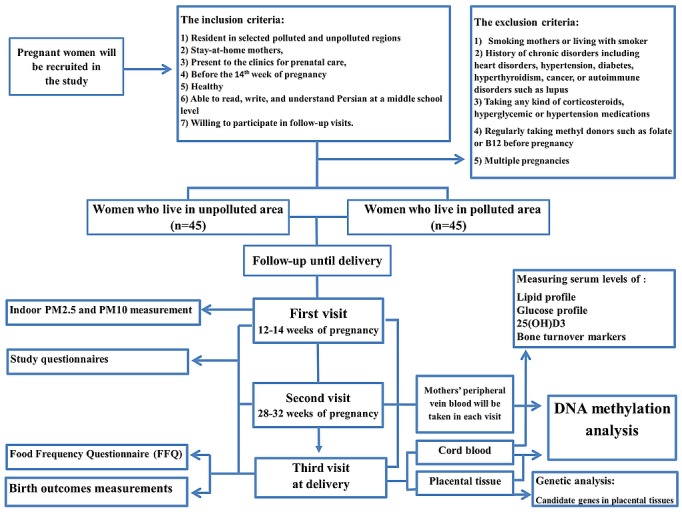
This is a birth cohort study. We will enroll pregnant healthy women attending prenatal care clinics in Tehran, Iran, who are resident in selected polluted and unpolluted regions before the 14th week of pregnancy. We will calculate the regional background levels of fine particulate matter (particles with a diameter between 2.5 and 10 μm) and nitrogen dioxide for all regions of by using data from the Tehran Air Quality Control Company. Then, we will select 2 regions as the polluted and unpolluted areas of interest. Healthy mothers living in the selected polluted and non polluted regions will be enrolled in this study. A maternal health history questionnaire will be completed at each trimester. During the first and second trimester, we will draw mothers' blood for biochemical and DNA methylation analyses. At the time of delivery time, we will collect maternal and cord blood for biochemical, gene expression, and DNA methylation analyses. We will also record birth outcomes (the newborn's sex, birth date, birth weight and length, gestational age, Apgar score, and level of neonatal care required).
The project was funded in March 2016 and enrollment will be completed in August 2017. Data analysis is under way, and the first results are expected to be submitted for publication in November 2017.
We supposed that prenatal exposures to air pollutants can influence fetal reprogramming by epigenetic modifications such as DNA methylation. This could explain the association between air pollution and adverse pregnancy outcomes.
孕期暴露于空气污染物中会增加不良出生结局的风险,并使人在日后生活中更易患多种复杂疾病。尽管对此已有普遍认识,但生命早期对空气污染暴露的分子和细胞反应尚不完全清楚。
本研究旨在检验空气污染与不良妊娠结局之间的关联,并确定孕期母亲血液、脐带血及胎盘DNA甲基化水平能否预测污染地区的不良出生结局。
这是一项出生队列研究。我们将招募在伊朗德黑兰产前保健诊所就诊的健康孕妇,她们在怀孕第14周前居住在选定的污染和未污染地区。我们将利用德黑兰空气质量控制公司的数据计算所有地区细颗粒物(直径在2.5至10μm之间的颗粒)和二氧化氮的区域背景水平。然后,我们将选择2个地区作为感兴趣的污染和未污染区域。居住在选定污染和未污染区域的健康母亲将被纳入本研究。在每个孕期都要完成一份母亲健康史问卷。在孕早期和孕中期,我们将采集母亲血液进行生化和DNA甲基化分析。在分娩时,我们将采集母亲和脐带血进行生化、基因表达和DNA甲基化分析。我们还将记录出生结局(新生儿性别、出生日期、出生体重和身长、胎龄、阿氏评分以及所需的新生儿护理水平)。
该项目于2016年3月获得资助,招募工作将于2017年8月完成。数据分析正在进行中,预计首批结果将于2017年11月提交发表。
我们推测孕期暴露于空气污染物可能通过DNA甲基化等表观遗传修饰影响胎儿重编程。这可以解释空气污染与不良妊娠结局之间的关联。