Hansson Elisabeth, Carlström Eric, Olsson Lars-Eric, Nyman Jan, Koinberg Ingalill
The Sahlgrenska Academy-Institute of Health and Care Sciences, University of Gothenburg, Gothenburg, Sweden.
Centre for Person-Centred Care (GPCC), Gothenburg University, Gothenburg, Sweden.
BMC Nurs. 2017 Feb 21;16:9. doi: 10.1186/s12912-017-0206-6. eCollection 2017.
The incidence of head and neck cancer is increasing slightly. Head and neck cancer but also it's necessary and often successful treatment may affect general domains of health-related quality of life and provoke a variety of adverse symptoms and side effects, both during and after treatment. The objective of this study was to compare a person-centred care intervention in terms of health-related quality of life, disease-specific symptoms or problems, with traditional care as a control group for patients with head and neck cancer.
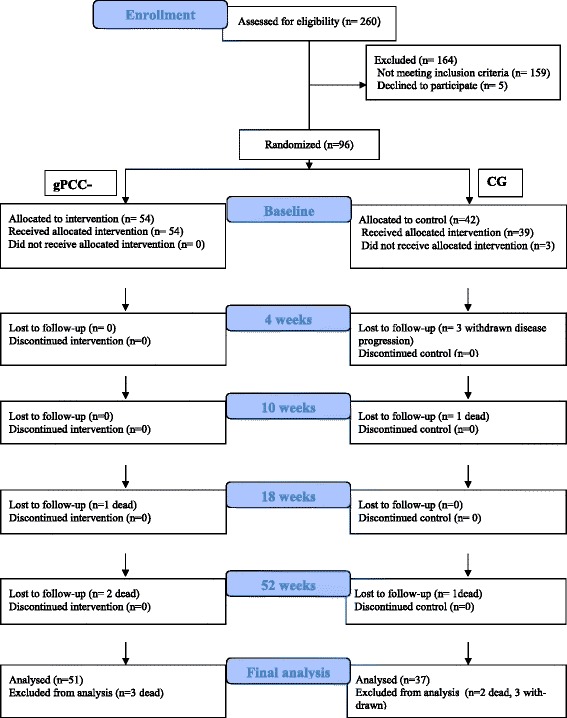
In this randomized controlled trial, person-centred-care intervention and traditional care (control) groups comprised 54 and 42 patients, respectively. Outcome measures used were: the EORTC QLQ-C30 and the EORTC QLQ-C35. Both groups answered the questionnaires at baseline and after 4, 10, 18 and 52 weeks from start of treatment. The questionnaires' scores were compared between groups by using independent samples test and non-parametric test for continuous variables. For categorical data, Fisher's exact test was used. Longitudinal data were analysed using generalized linear models for normally distributed repeated measures data.
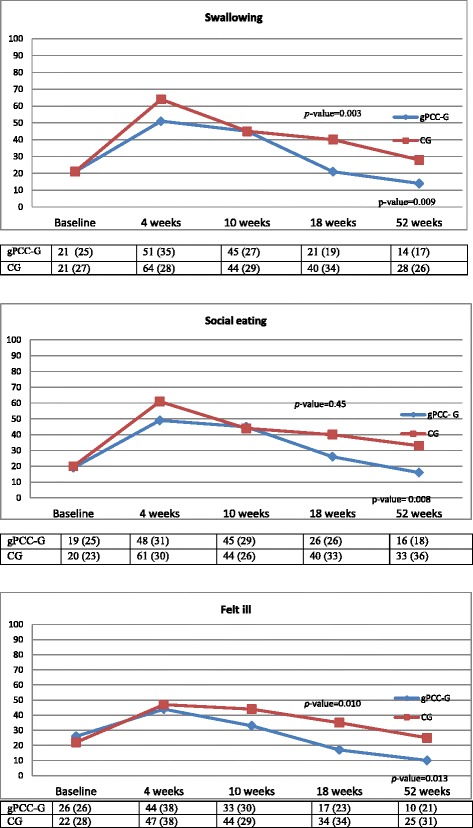
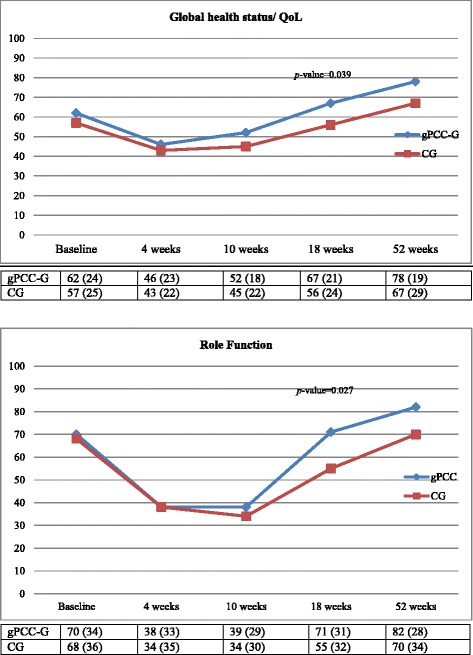
At baseline, the intervention and control groups were comparable in terms of medical and sociodemographic variables, clinical characteristics, health-related quality of life and disease-specific symptoms or problems. At all the follow-up points, even during the worst period for the patients, the person-centred-care group consistently reported better scores than the control group. The differences were numerically but not always statistically significant. When testing longitudinal data, statistically significant results were found for head and neck cancer-specific problems, swallowing ( = 0.014), social eating ( = 0.048) and feeling ill ( = 0.021).
The results from this study suggest that adopting the person-centred-care concept practiced here could be a way to improve function and wellbeing in patients with head and neck cancer.
The study was retrospectively registered in 2016-12-05 in Clinical Trials gov. "Can a Person-centred-care Intervention Improve Health-related Quality of Life in Patients With Head and Neck Cancer" registration number: NCT02982746.
头颈癌的发病率正在略有上升。头颈癌及其必要且往往成功的治疗可能会影响与健康相关的生活质量的总体领域,并在治疗期间和之后引发各种不良症状和副作用。本研究的目的是比较以患者为中心的护理干预在与健康相关的生活质量、疾病特异性症状或问题方面,与作为对照组的传统护理对头颈癌患者的影响。
在这项随机对照试验中,以患者为中心的护理干预组和传统护理(对照组)分别包括54名和42名患者。使用的结局指标为:欧洲癌症研究与治疗组织核心生活质量问卷(EORTC QLQ-C30)和欧洲癌症研究与治疗组织头颈癌特异性生活质量问卷(EORTC QLQ-C35)。两组在基线时以及治疗开始后的第4、10、18和52周回答问卷。通过使用独立样本检验和连续变量的非参数检验比较两组问卷得分。对于分类数据,使用Fisher精确检验。使用广义线性模型对正态分布的重复测量数据进行纵向数据分析。
在基线时,干预组和对照组在医疗和社会人口统计学变量、临床特征、与健康相关的生活质量以及疾病特异性症状或问题方面具有可比性。在所有随访点,即使在患者最糟糕的时期,以患者为中心的护理组的得分始终高于对照组。差异在数值上存在,但并非总是具有统计学意义。在检验纵向数据时,发现头颈癌特异性问题、吞咽(P = 0.014)、社交进食(P = 0.048)和感觉不适(P = 0.021)具有统计学意义。
本研究结果表明,采用此处实践的以患者为中心的护理理念可能是改善头颈癌患者功能和幸福感的一种方法。
该研究于2016年12月5日在ClinicalTrials.gov进行回顾性注册。“以患者为中心的护理干预能否改善头颈癌患者的健康相关生活质量”注册号:NCT02982746。