Moreno-Paublete Rocio, Canlon Barbara, Cederroth Christopher R
Laboratory of Experimental Audiology, Department of Physiology and Pharmacology, Karolinska Institutet Stockholm, Sweden.
Front Cell Neurosci. 2017 Feb 7;11:19. doi: 10.3389/fncel.2017.00019. eCollection 2017.
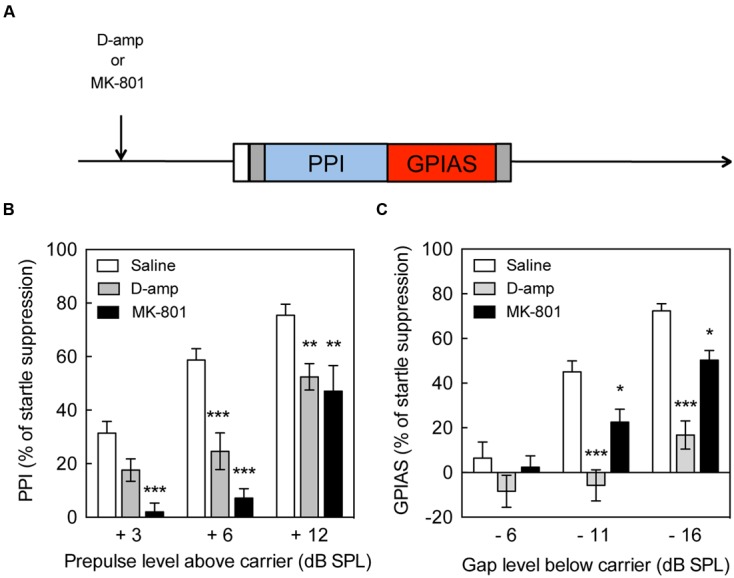
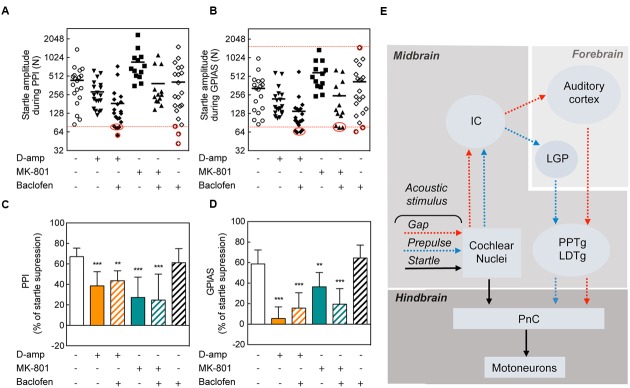
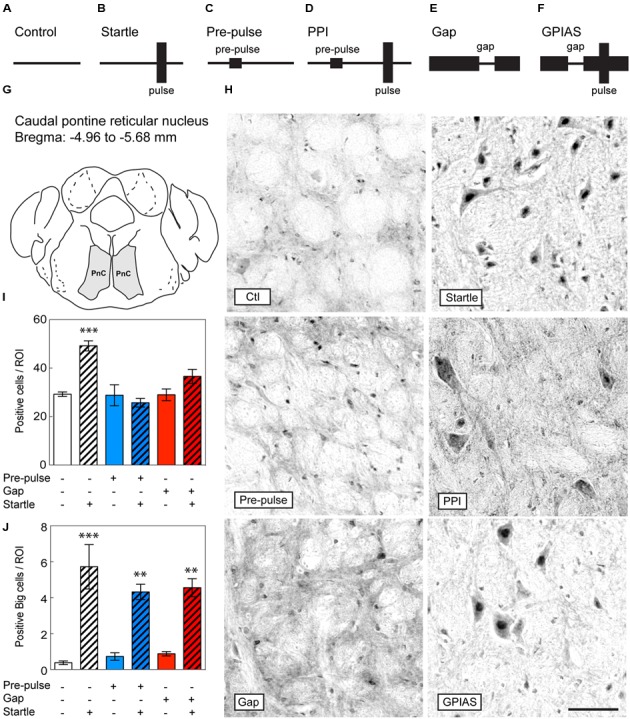
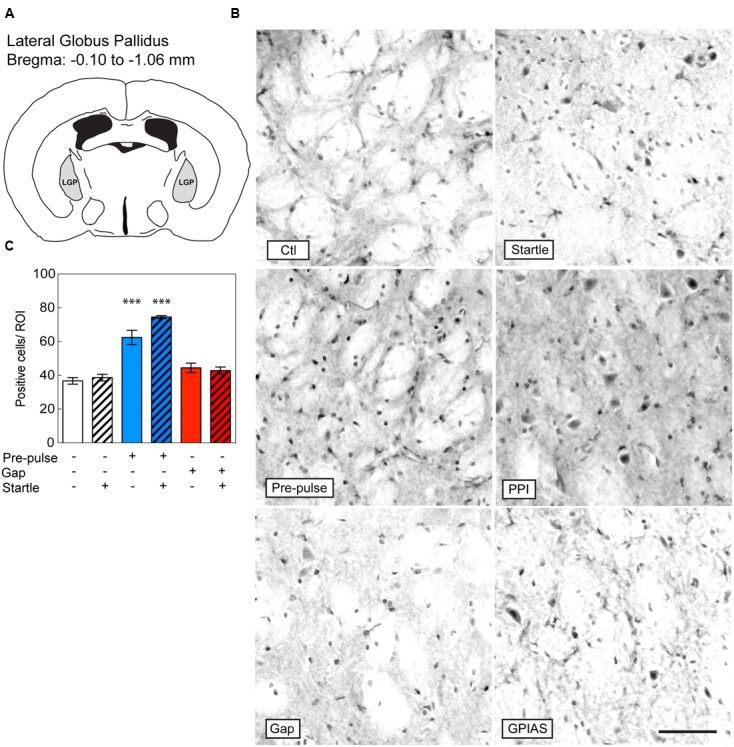
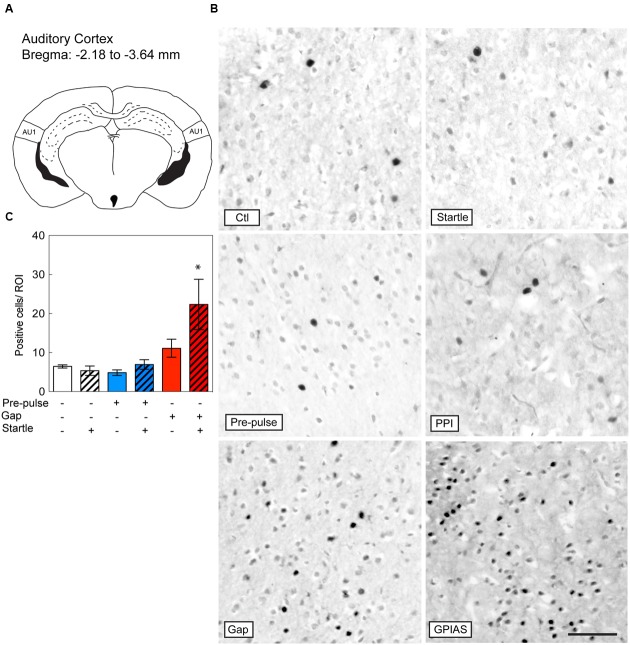
Gap pre-pulse inhibition of the acoustic startle (GPIAS) is a behavioral paradigm used for inferring the presence of tinnitus in animal models as well as humans. In contrast to pre-pulse inhibition (PPI), the neural circuitry controlling GPIAS is poorly understood. To increase our knowledge on GPIAS, a comparative study with PPI was performed in mice combining these behavioral tests and c-Fos activity mapping in brain areas involved in the inhibition of the acoustic startle reflex (ASR). Both pre-pulses and gaps efficiently inhibited the ASR and abolished the induction of c-Fos in the pontine reticular nucleus. Differential c-Fos activation was found between PPI and GPIAS in the forebrain whereby PPI activated the lateral globus pallidus and GPIAS activated the primary auditory cortex. Thus, different neural maps are regulating the inhibition of the startle response by pre-pulses or gaps. To further investigate this differential response to PPI and GPIAS, we pharmacologically disrupted PPI and GPIAS with D-amphetamine or Dizocilpine (MK-801) to target dopamine efflux and to block NMDA receptors, respectively. Both D-amp and MK-801 efficiently decreased PPI and GPIAS. We administered Baclofen, an agonist GABA receptor, but failed to detect any robust rescue of the effects of D-amp and MK-801 suggesting that PPI and GPIAS are GABA-independent. These novel findings demonstrate that the inhibition of the ASR by pre-pulses or gaps is orchestrated by different neural pathways.
听觉惊跳反应的间隙前脉冲抑制(GPIAS)是一种行为范式,用于推断动物模型和人类中耳鸣的存在。与前脉冲抑制(PPI)不同,控制GPIAS的神经回路尚不清楚。为了增加我们对GPIAS的了解,我们在小鼠中进行了一项与PPI的对比研究,结合了这些行为测试以及在参与抑制听觉惊跳反射(ASR)的脑区进行c-Fos活性图谱分析。前脉冲和间隙均能有效抑制ASR,并消除脑桥网状核中c-Fos的诱导。在前脑中发现PPI和GPIAS之间存在c-Fos激活差异,其中PPI激活外侧苍白球,而GPIAS激活初级听觉皮层。因此,不同的神经图谱调节前脉冲或间隙对惊跳反应的抑制。为了进一步研究对PPI和GPIAS的这种差异反应,我们分别用D-苯丙胺或地佐环平(MK-801)对PPI和GPIAS进行药理学破坏,以靶向多巴胺释放和阻断NMDA受体。D-苯丙胺和MK-801均能有效降低PPI和GPIAS。我们给予了GABA受体激动剂巴氯芬,但未能检测到对D-苯丙胺和MK-801作用的任何显著挽救作用,这表明PPI和GPIAS不依赖GABA。这些新发现表明,前脉冲或间隙对ASR的抑制是由不同的神经通路协调的。