Xiong Wei, Xu Mei, Zhao Yunfeng, Wu Xueling, Pudasaini Bigyan, Liu Jin-Ming
Department of Cardio-Pulmonary Circulation, Shanghai Pulmonary Hospital, Tongji University School of Medicine.
Department of Pediatrics, Gongli Hospital, Second Military Medical University.
Int J Chron Obstruct Pulmon Dis. 2017 Feb 13;12:615-625. doi: 10.2147/COPD.S124041. eCollection 2017.
The major characteristic of COPD is systemic inflammation. The parameters such as neutrophil-to-lymphocyte ratio (NLR) and eosinophil-to-basophil ratio (EBR) in routine blood test (RBT) are considered to be the underlying biomarkers of inflammation. We hypothesized that the prognosis of patients with COPD can be predicted with RBT.
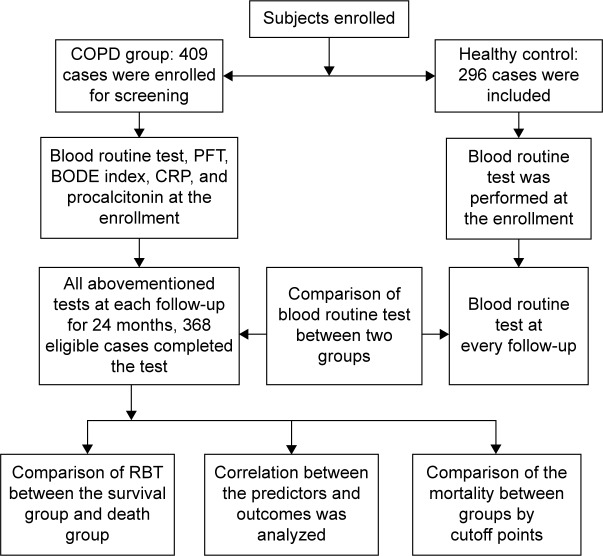
Patients with COPD in stable stage were enrolled. The RBT, pulmonary function testing (PFT), BODE index, C-reactive protein (CRP), procalcitonin, and erythrocyte sedimentation rate (ESR) were performed at enrollment and every follow-up once in every 3 months during the 24-month follow-up period. Meanwhile, exacerbation count and mortality incidence were recorded. The correlation between the prognostic biomarkers and the prognosis of patients was analyzed.
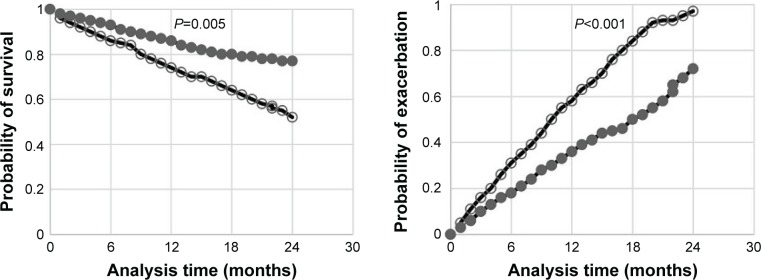
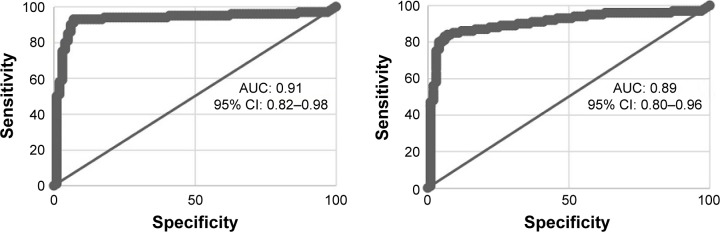
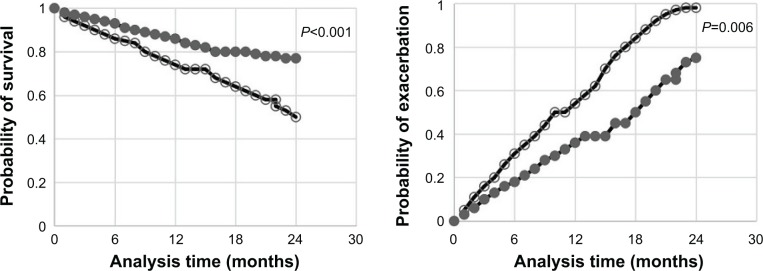
The NLR and EBR in RBT have a significant correlation with the severity of patients with COPD. The NLR is an independent predictor for mortality and the EBR is an independent predictor for exacerbation.
As an inexpensive, accessible, and convenient assay, RBT may be used as a practical means in the prediction of prognosis of patients with COPD in future clinical settings.
慢性阻塞性肺疾病(COPD)的主要特征是全身炎症。血常规检查(RBT)中的中性粒细胞与淋巴细胞比值(NLR)和嗜酸性粒细胞与嗜碱性粒细胞比值(EBR)等参数被认为是炎症的潜在生物标志物。我们假设可以通过血常规检查预测COPD患者的预后。
纳入稳定期COPD患者。在入组时以及24个月随访期内每3个月进行一次随访时,进行血常规检查、肺功能测试(PFT)、BODE指数、C反应蛋白(CRP)、降钙素原和红细胞沉降率(ESR)检查。同时,记录急性加重次数和死亡率。分析预后生物标志物与患者预后之间的相关性。
血常规检查中的NLR和EBR与COPD患者的严重程度显著相关。NLR是死亡率的独立预测因子,EBR是急性加重的独立预测因子。
作为一种廉价、可及且便捷的检测方法,血常规检查未来可能在临床中作为预测COPD患者预后的实用手段。