Györi Noémi, Giannakou Ioanna, Chatzidionysiou Katerina, Magder Laurence, van Vollenhoven Ronald F, Petri Michelle
ClinTRID-Unit for Clinical Therapy Research, Inflammatory Diseases, Department of Medicine , Karolinska University Hospital, Karolinska Institute , Stockholm , Sweden.
Division of Rheumatology , School of Medicine, Johns Hopkins University , Baltimore, MD , USA.
Lupus Sci Med. 2017 Feb 8;4(1):e000192. doi: 10.1136/lupus-2016-000192. eCollection 2017.
To describe SLE disease activity patterns in the Hopkins Lupus Cohort.
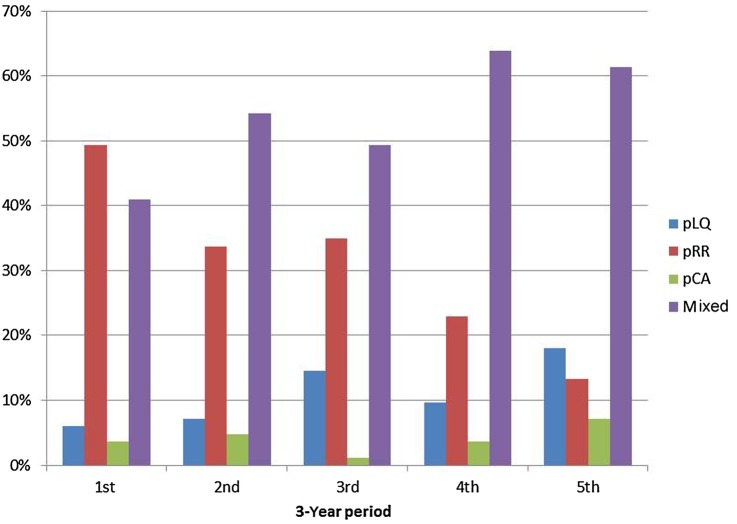
Disease activity was studied in 1886 patients followed-up for 1-28 years. Disease activity patterns were defined using (1) Physician Global Assessment (PGA) and (2) modified SLE Disease Activity Index (M-SLEDAI) as follows: long quiescent (LQ), M-SLEDAI=0/PGA=0 at all visits; relapsing-remitting (RR), periods of activity (M-SLEDAI>0/PGA>0) interspersed with inactivity (M-SLEDAI=0/PGA=0); chronic active (CA), M-SLEDAI>0/PGA>0 at all visits. The pattern of first 3 consecutive follow-up years was determined in 916 patients as: persistent LQ (pLQ), persistent RR (pRR) and persistent CA (pCA), LQ, RR and CA pattern in each of the 3 years, respectively; mixed, at least two different pattern types were identified.
The RR pattern accounted for the greatest proportion of follow-up time both by M-SLEDAI and PGA, representing 53.8% and 49.9% of total patient-years, respectively. The second most frequent pattern was LQ based on M-SLEDAI (30.7%) and CA based on PGA (40.4%). For the first 3-year intervals, the mixed pattern type was the most common (56.6%). The pRR was the second most frequent (M-SLEDAI 33.3%, PGA 26.5%), while pLQ (M-SLEDAI 6.4%, PGA 0.7%) and pCA were less frequent (M-SLEDAI 3.7%, PGA 16.3%).
The RR pattern was the most prevalent pattern. LQ was achieved in a subset of patients, using the M-SLEDAI. However, the PGA captured mild activity missed on the M-SLEDAI in these patients. Over a 3-year perspective, less than half of patients maintained their original pattern.
描述霍普金斯狼疮队列中的系统性红斑狼疮(SLE)疾病活动模式。
对1886例患者进行了1至28年的随访,研究疾病活动情况。疾病活动模式定义如下:(1)医生整体评估(PGA);(2)改良SLE疾病活动指数(M-SLEDAI):长期缓解(LQ),所有随访时M-SLEDAI = 0/PGA = 0;复发缓解型(RR),活动期(M-SLEDAI>0/PGA>0)与非活动期(M-SLEDAI = 0/PGA = 0)交替出现;慢性活动型(CA),所有随访时M-SLEDAI>0/PGA>0。在916例患者中确定了连续3年首次随访的模式为:持续长期缓解(pLQ)、持续复发缓解(pRR)和持续慢性活动(pCA),即3年中每年分别为LQ、RR和CA模式;混合型,至少识别出两种不同的模式类型。
RR模式在M-SLEDAI和PGA评估中占随访时间的比例最大,分别占总患者年数的53.8%和49.9%。基于M-SLEDAI的第二常见模式是LQ(30.7%),基于PGA的是CA(40.4%)。在最初的3年间隔中,混合型最常见(56.6%)。pRR是第二常见的(M-SLEDAI为33.3%,PGA为26.5%),而pLQ(M-SLEDAI为6.4%,PGA为0.7%)和pCA较少见(M-SLEDAI为3.7%,PGA为16.3%)。
RR模式是最普遍的模式。使用M-SLEDAI时,一部分患者实现了长期缓解。然而,PGA发现了这些患者中M-SLEDAI遗漏的轻度活动。从3年的角度来看,不到一半的患者维持了其最初的模式。