Treurnicht Martina, Colville Jonathan F, Joppa Lucas N, Huyser Onno, Manning John
Department of Conservation Ecology and Entomology, Stellenbosch University, Stellenbosch, Western Cape, South Africa; Institute of Landscape and Plant Ecology, University of Hohenheim, Stuttgart, Germany; South African Environmental Observation Network Fynbos Node, Cape Town, Western Cape, South Africa.
Kirstenbosch Research Centre, South African National Biodiversity Institute, Cape Town, Western Cape, South Africa; Statistics in Ecology, Environment and Conservation, Department of Statistical Sciences, University of Cape Town, Cape Town, Western Cape, South Africa.
PeerJ. 2017 Feb 21;5:e2984. doi: 10.7717/peerj.2984. eCollection 2017.
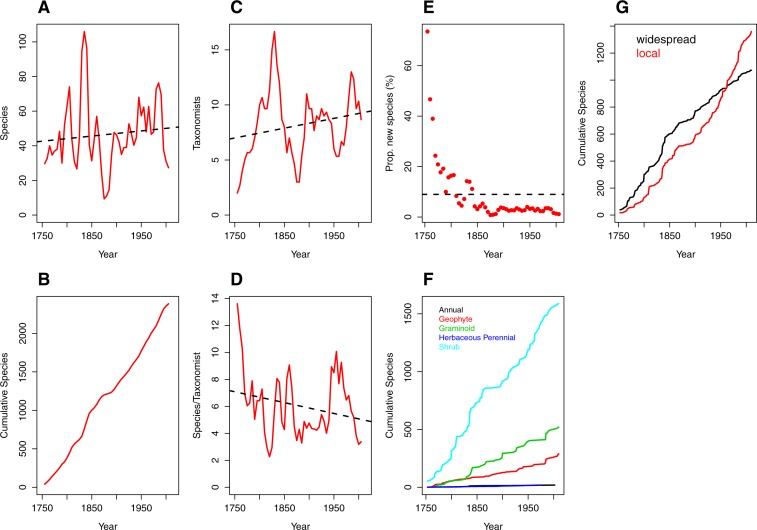
The Cape Floristic Region-the world's smallest and third richest botanical hotspot-has benefited from sustained levels of taxonomic effort and exploration for almost three centuries, but how close is this to resulting in a near-complete plant species inventory? We analyse a core component of this flora over a 250-year period for trends in taxonomic effort and species discovery linked to ecological and conservation attributes. We show that >40% of the current total of species was described within the first 100 years of exploration, followed by a continued steady rate of description. We propose that <1% of the flora is still to be described. We document a relatively constant cohort of taxonomists, working over 250 years at what we interpret to be their 'taxonomic maximum.' Rates of description of new species were independent of plant growth-form but narrow-range taxa have constituted a significantly greater proportion of species discoveries since 1950. This suggests that the fraction of undiscovered species predominantly comprises localised endemics that are thus of high conservation concern. Our analysis provides important real-world insights for other hotspots in the context of global strategic plans for biodiversity in informing considerations of the likely effort required in attaining set targets of comprehensive plant inventories. In a time of unprecedented biodiversity loss, we argue for a focused research agenda across disciplines to increase the rate of species descriptions in global biodiversity hotspots.
开普植物区系——世界上最小且物种丰富度排名第三的植物多样性热点地区——在近三个世纪以来一直受益于持续的分类学研究和探索工作。但距离完成一份近乎完整的植物物种清单还有多远呢?我们分析了该植物区系的一个核心组成部分在250年时间里与生态和保护属性相关的分类学研究工作趋势以及物种发现情况。我们发现,目前物种总数的40%以上是在探索的最初100年内被描述的,之后描述速率持续稳定。我们认为仍有待描述的植物区系不到1%。我们记录了一群相对稳定的分类学家,他们在250年里一直以我们所认为的“分类学极限”开展工作。新物种的描述速率与植物生长型无关,但自1950年以来,狭域分类群在物种发现中所占比例显著更大。这表明未被发现的物种主要是局部特有种,因此具有很高的保护价值。我们的分析为全球生物多样性战略计划背景下的其他热点地区提供了重要的现实见解,有助于考虑在实现全面植物清单既定目标时可能需要付出的努力。在生物多样性损失空前的时代,我们主张跨学科制定重点研究议程,以提高全球生物多样性热点地区物种描述的速率。