Allott E H, Macias E, Sanders S, Knudsen B S, Thomas G V, Hursting S D, Freedland S J
Department of Nutrition, University of North Carolina at Chapel Hill, Chapel Hill, NC, USA.
Department of Surgery, Samuel Oschin Comprehensive Cancer Institute, Cedars-Sinai Medical Center, Los Angeles, CA, USA.
Prostate Cancer Prostatic Dis. 2017 Jun;20(2):165-171. doi: 10.1038/pcan.2016.73. Epub 2017 Feb 28.
Previously, we showed that carbohydrate restriction with calorie restriction slowed tumor growth in xenograft mouse prostate cancer models. Herein, we examined the impact of carbohydrate restriction without calorie restriction on tumor development within the context of diet-induced obesity in the Hi-Myc transgenic mouse model of prostate cancer.
Mice were randomized at 5 weeks of age to ad libitum western diet (WD; 40% fat, 42% carbohydrate; n=39) or ad libitum no carbohydrate ketogenic diet (NCKD; 82% fat, 1% carbohydrate; n=44). At age 3 or 6 months, mice were killed, prostates weighed and prostate histology, proliferation, apoptosis and macrophage infiltration evaluated by hematoxylin and eosin, Ki67, TUNEL and F4/80 staining, respectively. Body composition was assessed by DEXA, serum cytokines measured using multiplex, and Akt/mTOR signaling assessed by Western.
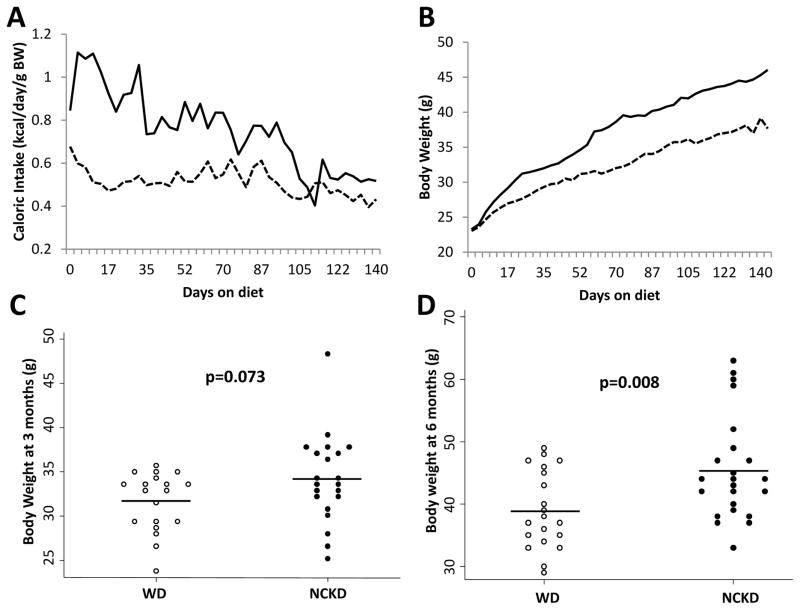
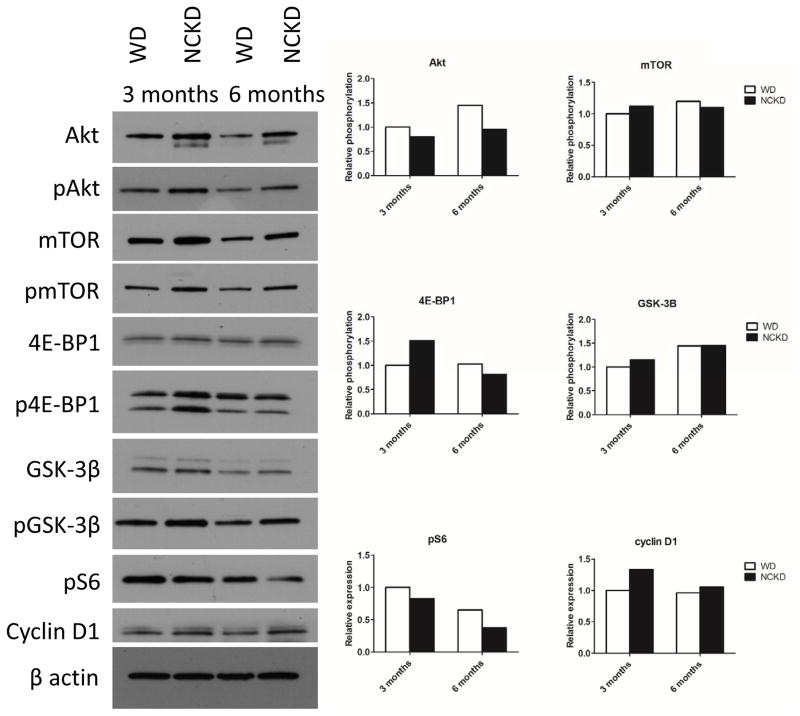
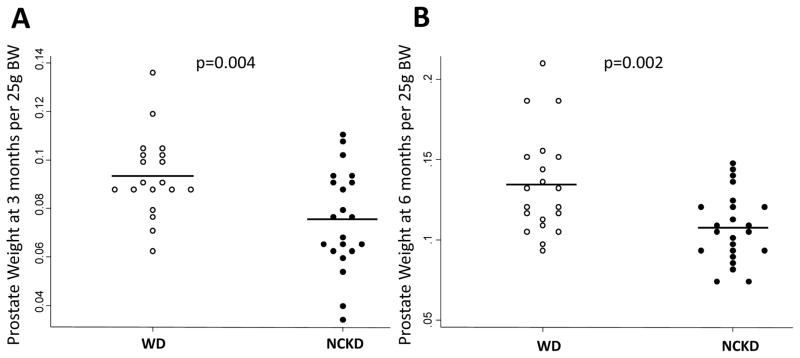
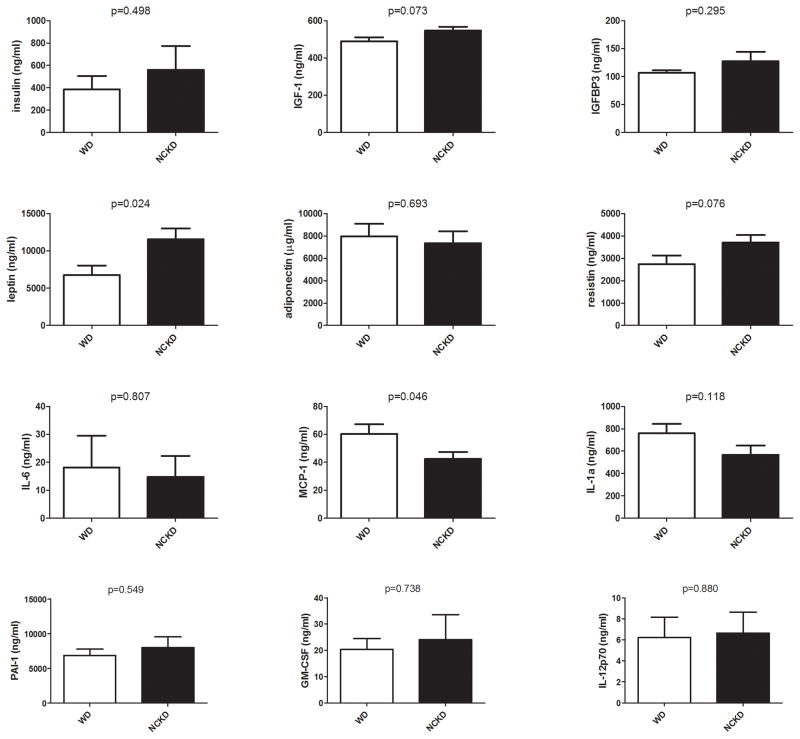
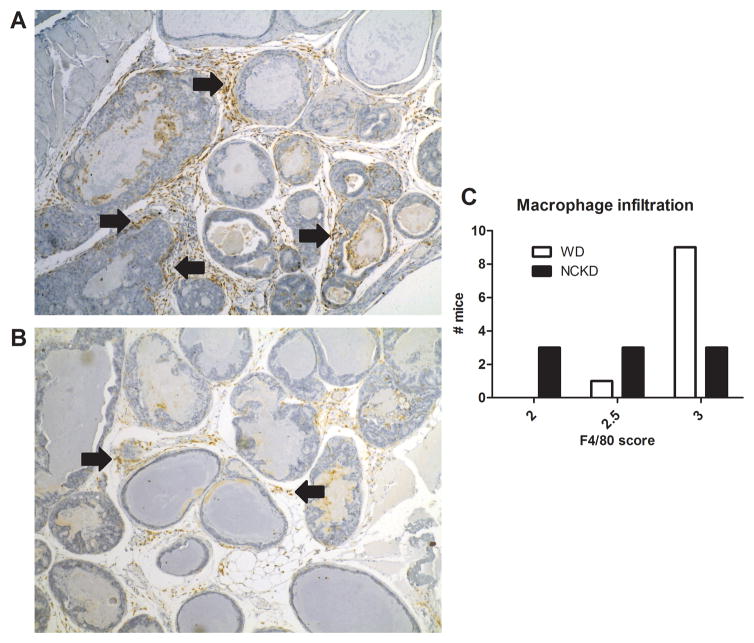
Caloric intake was higher in the NCKD group, resulting in elevated body weights at 6 months of age, relative to the WD group (45 g vs 38g; P=0.008). Despite elevated body weights, serum monocyte chemoattractant protein (MCP)-1 and interleukin (IL)-1α levels were lower in NCKD versus WD mice (P=0.046 and P=0.118, respectively), and macrophage infiltration was reduced in prostates of NCKD versus WD mice (P=0.028). Relative Akt phosphorylation and phospho-S6 ribosomal protein levels were reduced in prostates of NCKD versus WD mice. However, while mice randomized to NCKD had smaller prostates after adjustment for body weight at 3 and 6 months (P=0.004 and P=0.002, respectively), NCKD mice had higher rates of adenocarcinoma at 6 months compared to WD mice (100 vs 80%, P=0.04).
Despite higher caloric intake and elevated body weights, carbohydrate restriction lowered serum MCP-1 levels, reduced prostate macrophage infiltration, reduced prostate weight, but failed to slow adenocarcinoma development. Together, these data suggest that although carbohydrate restriction within the context of obesity may reduce obesity-associated systemic inflammation and perhaps slow tumor growth, it is not sufficient to counteract obesity-associated tumor development.
此前,我们发现在异种移植小鼠前列腺癌模型中,碳水化合物限制联合热量限制可减缓肿瘤生长。在此,我们在饮食诱导肥胖的Hi-Myc转基因前列腺癌小鼠模型中,研究了无热量限制的碳水化合物限制对肿瘤发展的影响。
5周龄小鼠被随机分为自由摄食西方饮食(WD;40%脂肪,42%碳水化合物;n = 39)或自由摄食无碳水化合物生酮饮食(NCKD;82%脂肪,1%碳水化合物;n = 44)。在3或6月龄时处死小鼠,称取前列腺重量,并分别通过苏木精和伊红染色、Ki67染色、TUNEL染色和F4/80染色评估前列腺组织学、增殖、凋亡和巨噬细胞浸润情况。通过双能X线吸收法评估身体组成,使用多重分析法测量血清细胞因子,并通过蛋白质免疫印迹法评估Akt/mTOR信号通路。
与WD组相比,NCKD组的热量摄入更高,导致6月龄时体重升高(45克对38克;P = 0.008)。尽管体重升高,但与WD小鼠相比,NCKD小鼠的血清单核细胞趋化蛋白(MCP)-1和白细胞介素(IL)-1α水平较低(分别为P = 0.046和P = 0.118),且NCKD小鼠前列腺中的巨噬细胞浸润减少(P = 0.028)。与WD小鼠相比,NCKD小鼠前列腺中相对Akt磷酸化和磷酸化S6核糖体蛋白水平降低。然而,虽然在3和6月龄时,调整体重后随机分配到NCKD组的小鼠前列腺较小(分别为P = 0.004和P = 0.002),但与WD小鼠相比,NCKD小鼠在6月龄时腺癌发生率更高(100%对80%,P = 0.04)。
尽管热量摄入更高且体重升高,但碳水化合物限制降低了血清MCP-1水平,减少了前列腺巨噬细胞浸润,降低了前列腺重量,但未能减缓腺癌发展。总之,这些数据表明,尽管肥胖情况下的碳水化合物限制可能会减少与肥胖相关的全身炎症,或许还能减缓肿瘤生长,但不足以抵消与肥胖相关的肿瘤发展。