Shenzhen Institues of Adavanced Technology, Chinese Academy of Science, Shenzhen 518055, China.
Department of Electrical and Electronic Engineering, The University of Hong Kong, Hong Kong 9990779, China.
Sensors (Basel). 2017 Feb 24;17(3):457. doi: 10.3390/s17030457.
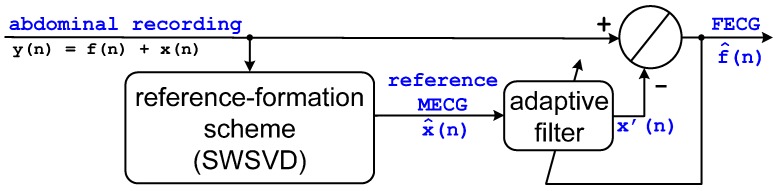
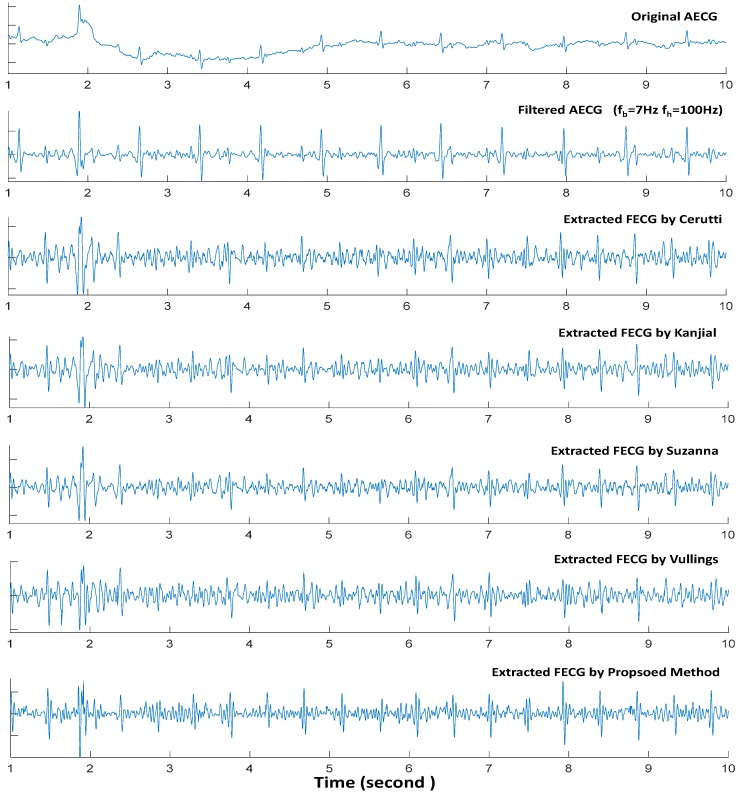
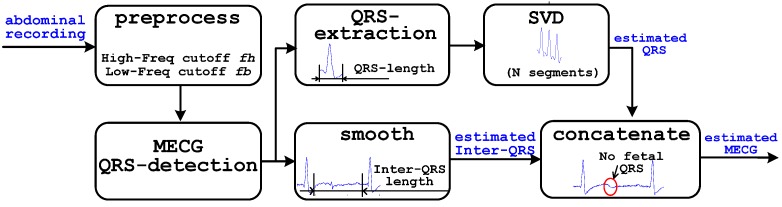
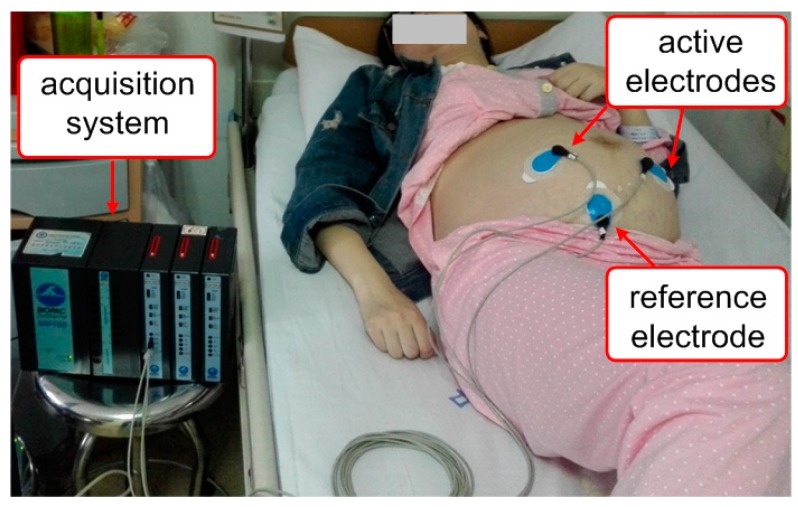
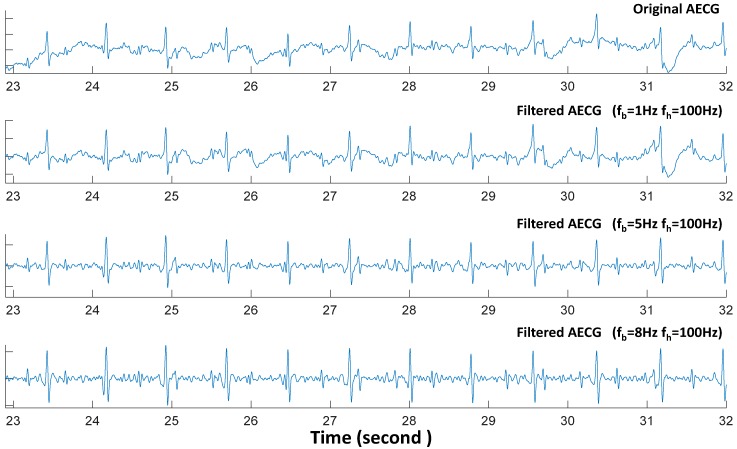
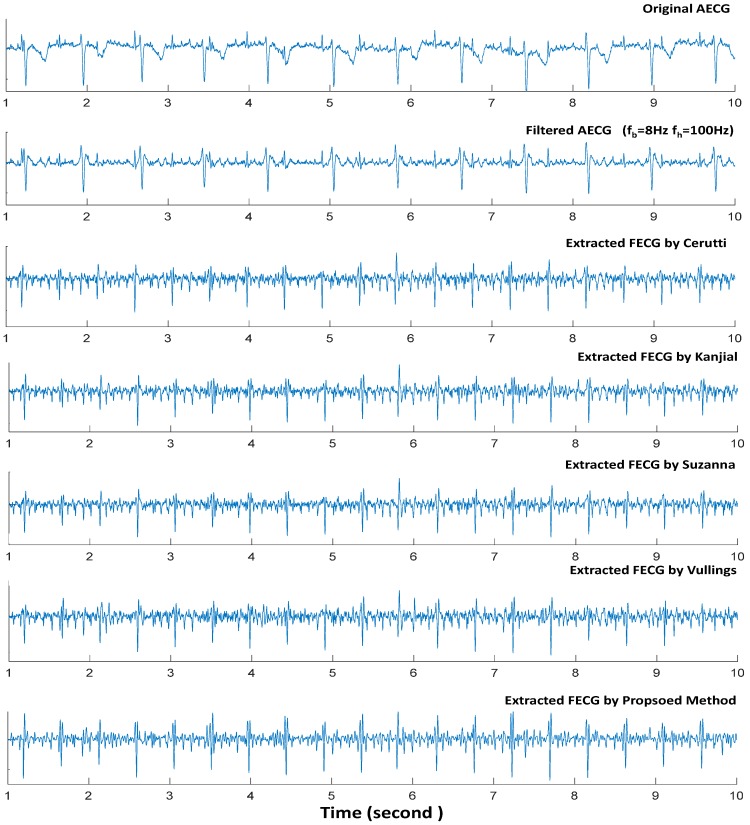
Non-invasive fetal electrocardiograms (FECGs) are an alternative method to standard means of fetal monitoring which permit long-term continual monitoring. However, in abdominal recording, the FECG amplitude is weak in the temporal domain and overlaps with the maternal electrocardiogram (MECG) in the spectral domain. Research in the area of non-invasive separations of FECG from abdominal electrocardiograms (AECGs) is in its infancy and several studies are currently focusing on this area. An adaptive noise canceller (ANC) is commonly used for cancelling interference in cases where the reference signal only correlates with an interference signal, and not with a signal of interest. However, results from some existing studies suggest that propagation of electrocardiogram (ECG) signals from the maternal heart to the abdomen is nonlinear, hence the adaptive filter approach may fail if the thoracic and abdominal MECG lack strict waveform similarity. In this study, singular value decomposition (SVD) and smooth window (SW) techniques are combined to build a reference signal in an ANC. This is to avoid the limitation that thoracic MECGs recorded separately must be similar to abdominal MECGs in waveform. Validation of the proposed method with r01 and r07 signals from a public dataset, and a self-recorded private dataset showed that the proposed method achieved scores of 99.61%, 99.28% and 98.58%, respectively for the detection of fetal QRS. Compared with four other single-channel methods, the proposed method also achieved higher accuracy values of 99.22%, 98.57% and 97.21%, respectively. The findings from this study suggest that the proposed method could potentially aid accurate extraction of FECG from MECG recordings in both clinical and commercial applications.
非侵入式胎儿心电图(FECG)是一种替代标准胎儿监测手段的方法,可实现长期持续监测。然而,在腹部记录中,FECG 幅度在时域中较弱,并在频域中与母体心电图(MECG)重叠。非侵入式 FECG 与腹部心电图(AECG)分离的研究尚处于起步阶段,目前有几项研究正在关注这一领域。自适应噪声消除器(ANC)通常用于在参考信号仅与干扰信号相关,而与感兴趣的信号不相关的情况下消除干扰。然而,一些现有研究的结果表明,母体心脏到腹部的心电图(ECG)信号传播是非线性的,因此,如果胸腔和腹部 MECG 缺乏严格的波形相似性,自适应滤波器方法可能会失败。在这项研究中,奇异值分解(SVD)和平滑窗口(SW)技术结合在一起,在 ANC 中构建参考信号。这是为了避免胸腔 MECG 必须与腹部 MECG 在波形上相似的限制。用公共数据集的 r01 和 r07 信号以及自记录的私人数据集对所提出的方法进行验证表明,该方法在胎儿 QRS 检测方面的准确率分别为 99.61%、99.28%和 98.58%。与其他四种单通道方法相比,该方法的准确率分别高达 99.22%、98.57%和 97.21%。这项研究的结果表明,该方法有可能在临床和商业应用中帮助从 MECG 记录中准确提取 FECG。