Jameson J L, Klibanski A, Black P M, Zervas N T, Lindell C M, Hsu D W, Ridgway E C, Habener J F
Laboratory of Molecular Endocrinology, Massachusetts General Hospital, Boston.
J Clin Invest. 1987 Nov;80(5):1472-8. doi: 10.1172/JCI113228.
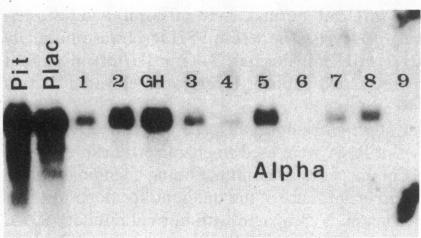
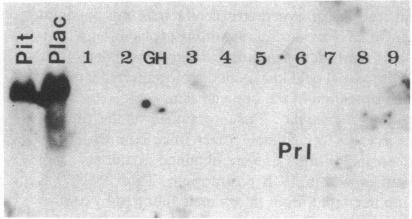
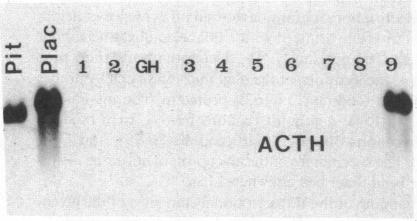
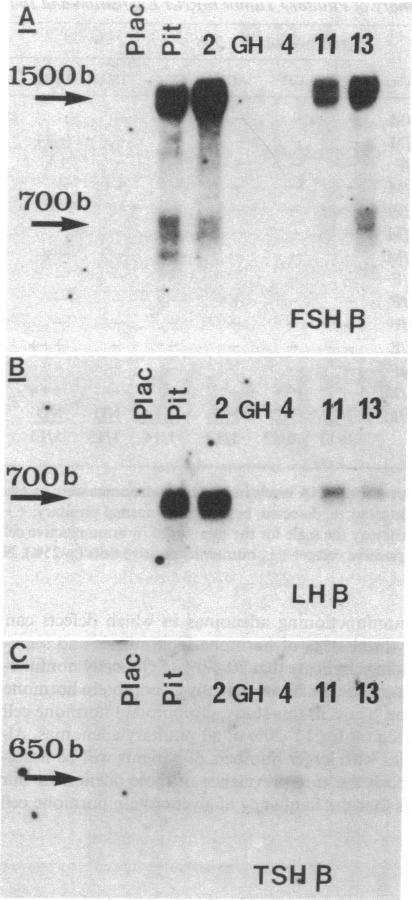
Approximately 25% of patients with pituitary adenomas have no clinical or biochemical evidence for excess hormone secretion and are classified as having null cell or nonfunctioning adenomas. To characterize the cell type of these tumors, we analyzed pituitary hormone gene expression in clinically nonfunctioning pituitary adenomas using specific oligonucleotide probes for the messenger (m)RNAs encoding growth hormone, prolactin, ACTH, and the glycoprotein hormone subunits, alpha, luteinizing hormone (LH)beta, follicle-stimulating hormone (FSH)beta, and thyroid-stimulating hormone (TSH)beta. Expression of one or more of the anterior pituitary hormone genes was found in 12/14 (86%) of the patients with clinically classified nonfunctioning adenomas. Expression of one or more of the glycoprotein hormone genes (alpha, LH beta, FSH beta, TSH beta) was identified most commonly (79%) with expression of multiple beta-subunit genes in many cases. Expression of alpha-subunit mRNA was found in each of the adenomas from patients expressing one of the beta-subunit mRNAs and in three patients with no detectable beta-subunit mRNA. Although FSH beta and LH beta mRNAs were found with similar frequencies in nonfunctioning adenomas, expression of FSH beta mRNA was generally much more abundant. TSH beta mRNA was detected in only one adenoma. The levels of glycoprotein hormone subunit mRNAs were variable in different adenomas, but the lengths of the mRNAs and transcriptional start sites for the alpha- and beta-subunit genes were the same in the pituitary adenomas and in normal pituitary. Growth hormone and prolactin gene expression were not observed in the nonfunctioning adenomas, but ACTH mRNA was found in a single case. Immunohistochemistry of the adenomas confirmed production of one or more pituitary hormones in 13/14 (93%) nonfunctioning tumors, with a distribution of hormone production similar to that of the hormone mRNAs. These data indicate that pituitary adenomas originating from cells producing glycoprotein hormones are common, but are difficult to recognize clinically because of the absence of characteristic endocrine syndromes and defective hormone biosynthesis and secretion.
约25%的垂体腺瘤患者没有激素分泌过多的临床或生化证据,被归类为无功能腺瘤或无分泌功能腺瘤。为了明确这些肿瘤的细胞类型,我们使用针对编码生长激素、催乳素、促肾上腺皮质激素(ACTH)以及糖蛋白激素亚基α、促黄体生成素(LH)β、促卵泡激素(FSH)β和促甲状腺激素(TSH)β的信使核糖核酸(mRNA)的特异性寡核苷酸探针,分析了临床无功能垂体腺瘤中垂体激素基因的表达情况。在临床分类为无功能腺瘤的患者中,14例中有12例(86%)发现一种或多种垂体前叶激素基因有表达。糖蛋白激素基因(α、LHβ、FSHβ、TSHβ)中一种或多种的表达最为常见(79%),在许多病例中存在多种β亚基基因的表达。在表达β亚基mRNA之一的患者的每例腺瘤中以及在3例未检测到β亚基mRNA的患者中均发现了α亚基mRNA的表达。虽然在无功能腺瘤中FSHβ和LHβmRNA的发现频率相似,但FSHβmRNA的表达通常更为丰富。仅在1例腺瘤中检测到TSHβmRNA。不同腺瘤中糖蛋白激素亚基mRNA的水平各不相同,但垂体腺瘤和正常垂体中α和β亚基基因的mRNA长度及转录起始位点相同。在无功能腺瘤中未观察到生长激素和催乳素基因的表达,但在1例中发现了ACTH mRNA。腺瘤的免疫组织化学证实,14例无功能肿瘤中有13例(93%)产生一种或多种垂体激素,激素产生的分布与激素mRNA的分布相似。这些数据表明,起源于产生糖蛋白激素细胞群体的垂体腺瘤很常见,但由于缺乏特征性内分泌综合征以及激素生物合成和分泌缺陷,在临床上难以识别。