Institute of Applied Optics and Research Center SCoPE, University of Stuttgart, 70569 Stuttgart, Germany.
4th Physics Institute and Research Center SCoPE, University of Stuttgart, 70569 Stuttgart, Germany.
Sci Adv. 2017 Feb 15;3(2):e1602655. doi: 10.1126/sciadv.1602655. eCollection 2017 Feb.
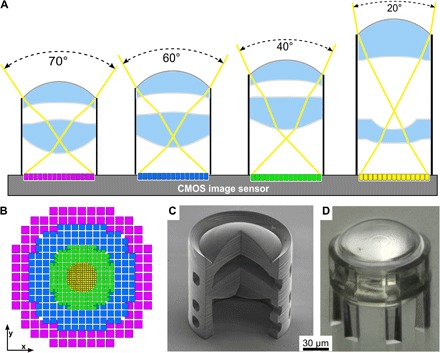
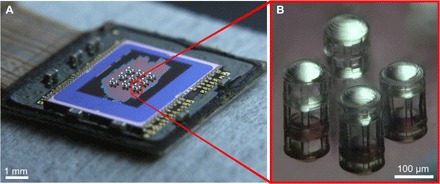
We present a highly miniaturized camera, mimicking the natural vision of predators, by 3D-printing different multilens objectives directly onto a complementary metal-oxide semiconductor (CMOS) image sensor. Our system combines four printed doublet lenses with different focal lengths (equivalent to = 31 to 123 mm for a 35-mm film) in a 2 × 2 arrangement to achieve a full field of view of 70° with an increasing angular resolution of up to 2 cycles/deg field of view in the center of the image. The footprint of the optics on the chip is below 300 μm × 300 μm, whereas their height is <200 μm. Because the four lenses are printed in one single step without the necessity for any further assembling or alignment, this approach allows for fast design iterations and can lead to a plethora of different miniaturized multiaperture imaging systems with applications in fields such as endoscopy, optical metrology, optical sensing, surveillance drones, or security.
我们通过 3D 打印不同的多透镜物镜直接在互补金属氧化物半导体(CMOS)图像传感器上,制作出一种高度微型化的相机,模拟出捕食者的自然视觉。我们的系统将四个具有不同焦距的打印双凸透镜(对于 35 毫米胶片,相当于 = 31 到 123 毫米)以 2×2 的排列组合在一起,在 70°的全视场范围内实现了高达 2 个周期/度的角分辨率,在图像中心的角分辨率更高。芯片上光学器件的占地面积小于 300 μm×300 μm,而其高度小于 200 μm。由于这四个透镜可以在一个单一的步骤中打印出来,无需任何进一步的组装或对准,因此这种方法可以实现快速的设计迭代,并可以制作出许多不同的微型多孔径成像系统,应用于内窥镜、光学计量学、光学传感、监控无人机或安全等领域。