Park Sangbum, Gonzalez David G, Guirao Boris, Boucher Jonathan D, Cockburn Katie, Marsh Edward D, Mesa Kailin R, Brown Samara, Rompolas Panteleimon, Haberman Ann M, Bellaïche Yohanns, Greco Valentina
Department of Genetics, Yale School of Medicine, New Haven, Connecticut 06510, USA.
Department of Laboratory Medicine, Department of Immunobiology, Yale School of Medicine, New Haven, Connecticut 06510, USA.
Nat Cell Biol. 2017 Mar 1;19(2):155-163. doi: 10.1038/ncb3472.
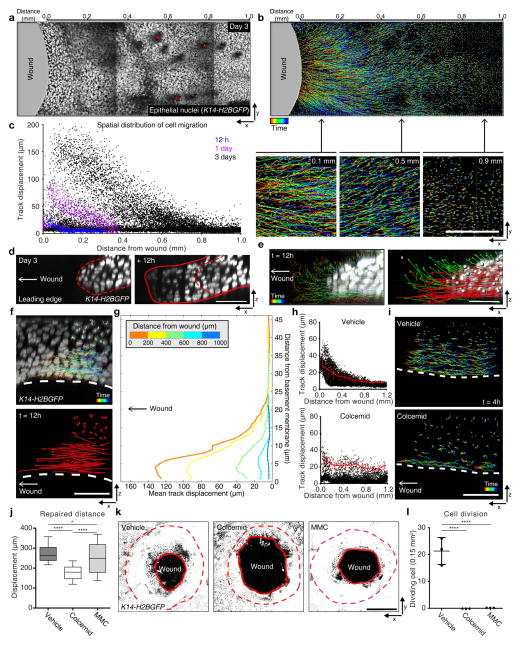
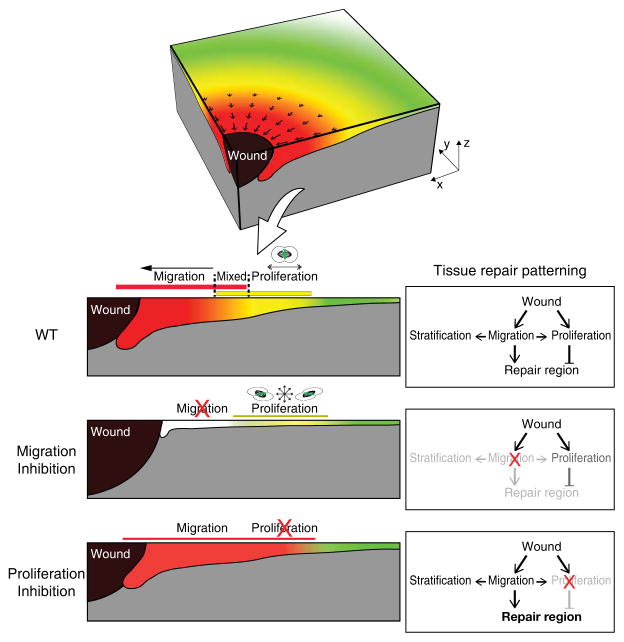
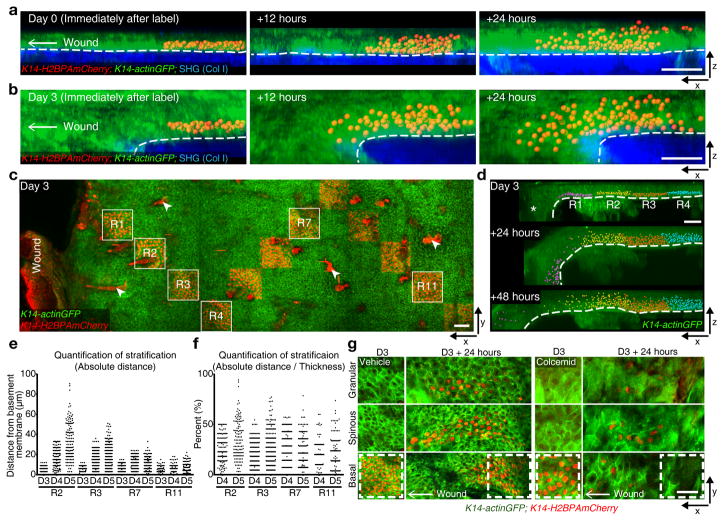
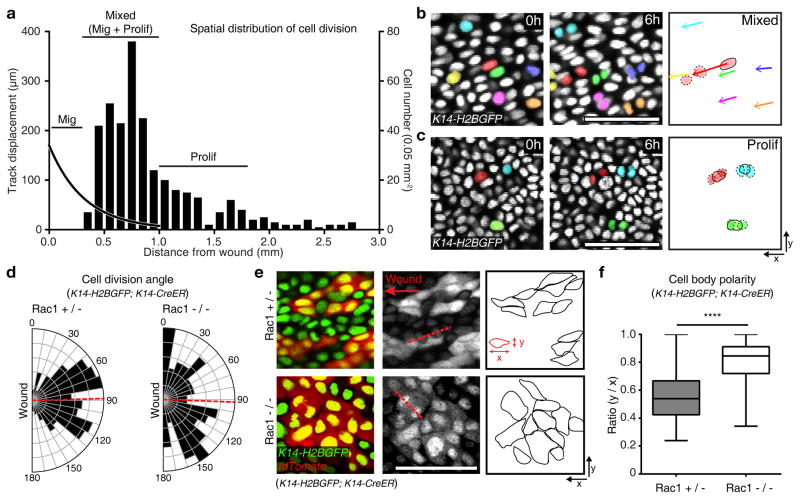
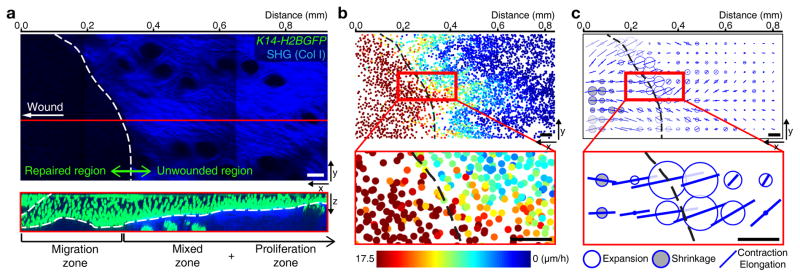
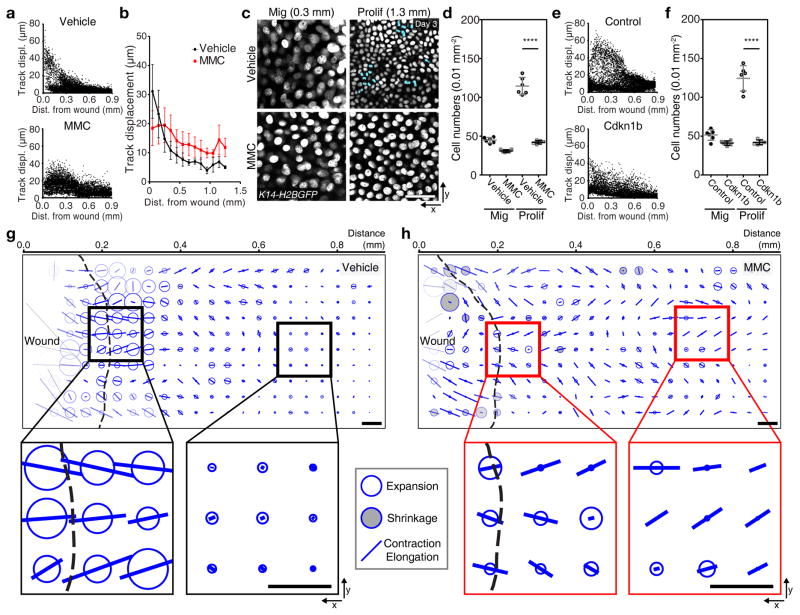
Tissue repair is fundamental to our survival as tissues are challenged by recurrent damage. During mammalian skin repair, cells respond by migrating and proliferating to close the wound. However, the coordination of cellular repair behaviours and their effects on homeostatic functions in a live mammal remains unclear. Here we capture the spatiotemporal dynamics of individual epithelial behaviours by imaging wound re-epithelialization in live mice. Differentiated cells migrate while the rate of differentiation changes depending on local rate of migration and tissue architecture. Cells depart from a highly proliferative zone by directionally dividing towards the wound while collectively migrating. This regional coexistence of proliferation and migration leads to local expansion and elongation of the repairing epithelium. Finally, proliferation functions to pattern and restrict the recruitment of undamaged cells. This study elucidates the interplay of cellular repair behaviours and consequent changes in homeostatic behaviours that support tissue-scale organization of wound re-epithelialization.
组织修复对我们的生存至关重要,因为组织会受到反复损伤的挑战。在哺乳动物皮肤修复过程中,细胞通过迁移和增殖做出反应以闭合伤口。然而,在活体哺乳动物中,细胞修复行为的协调及其对稳态功能的影响仍不清楚。在这里,我们通过对活体小鼠伤口再上皮化进行成像,捕捉了单个上皮行为的时空动态。分化细胞迁移,而分化速率根据局部迁移速率和组织结构而变化。细胞在集体迁移时通过向伤口定向分裂,从一个高度增殖区离开。增殖和迁移的这种区域共存导致修复上皮的局部扩张和伸长。最后,增殖起到塑造和限制未受损细胞募集的作用。这项研究阐明了细胞修复行为之间的相互作用以及随之而来的稳态行为变化,这些变化支持伤口再上皮化的组织尺度组织。