Arain Sadia Qamar, Talpur Farah Naz, Channa Naseem Aslam, Ali Muhammad Shahbaz, Afridi Hassan Imran
National Centre of Excellence in Analytical Chemistry, University of Sindh, Jamshoro, 76080, Pakistan.
Institute of Biochemistry University of Sindh, Jamshoro, Pakistan.
Lipids Health Dis. 2017 Mar 1;16(1):51. doi: 10.1186/s12944-017-0437-2.
Chronic HBV infection is a major cause of Cirrhosis and an important risk factor to develop hepatocellular carcinoma. The study is conducted to find out the changes in the lipid metabolism of HBV-cirrhosis patients.
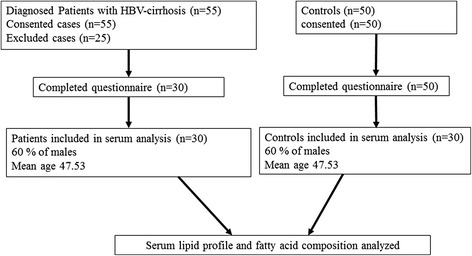
In the present study, serum lipid profiles of patients with HBV-cirrhosis were assessed by utilizing micro-lab and gas chromatography, while risk factors for transmission of HBV-cirrhosis studied through the standard questionnaire.
The epidemiological and etiological risk factors strongly associated with HBV-cirrhosis patients compared to controls, included as family history, shave from the barber, blood transfusion (without proper screening), mutual sharing of household contents, positive surgery history, and dental treatment. The HBV-cirrhosis patients have significantly lower level (p < 0.001) of lipid profile including total cholesterol (96.65 mg/dl), TAG (82.85 mg/dl), VLDL-C (16.57 mg/dl), LDL-C (68.27 mg/dl), HDL-C (27 mg/dl) and total lipid (424.76 mg/dl) in comparison to controls, indicating hypolipidemia in patients. The MELD score indicated mild prognostic values of the hepatic function for the study group. The result of total fatty acid composition of HBV-cirrhotic patients with comparison of control subjects reveals that palmitic (24.54 g/100 g) and palmitoleic acid (4.65 g/100 g) were significantly (p < 0.05) higher whereas eicosatrienoic (0.09 g/100 g), arachidonic (3.57 g/100 g), linoleic (22.75 g/100 g) and α-linolenic acid (0.12 g/100 g) were significantly lower. Marker for stearoyl-CoA desaturase (SCD = ∆9-desaturase) activity i.e. palmitoleic: palmitic (0.2) and oleic: stearic acid (1.5) ratios, originated higher in HBV-cirrhotic patients, while PUFA: SFA (0.6) was lower in HBV-cirrhosis patients as compared with control subjects. The serum SFA and MUFA were increased while PUFA were reduced in both total and free form.
Present study concluded that hypolipidemia observed in HBV-cirrhosis patients, MELD were found to be independent predictors of survival and alteration in fatty acid composition, possibly due to impairment in fatty acid metabolism by enzymatic elongation and desaturation.
慢性乙型肝炎病毒(HBV)感染是肝硬化的主要病因,也是发生肝细胞癌的重要危险因素。本研究旨在了解HBV肝硬化患者脂质代谢的变化。
在本研究中,利用微量实验室和气相色谱法评估HBV肝硬化患者的血清脂质谱,同时通过标准问卷研究HBV肝硬化的传播危险因素。
与对照组相比,与HBV肝硬化患者密切相关的流行病学和病因学危险因素包括家族史、理发店剃须、输血(未进行适当筛查)、共用家庭用品、阳性手术史和牙科治疗。与对照组相比,HBV肝硬化患者的脂质谱水平显著降低(p < 0.001),包括总胆固醇(96.65mg/dl)、甘油三酯(82.85mg/dl)、极低密度脂蛋白胆固醇(VLDL-C,16.57mg/dl)、低密度脂蛋白胆固醇(LDL-C,68.27mg/dl)、高密度脂蛋白胆固醇(HDL-C,27mg/dl)和总脂质(424.76mg/dl),表明患者存在低脂血症。终末期肝病模型(MELD)评分表明研究组肝功能的预后价值为轻度。HBV肝硬化患者与对照组总脂肪酸组成的比较结果显示,棕榈酸(24.54g/100g)和棕榈油酸(4.65g/100g)显著升高(p < 0.05),而二十碳三烯酸(0.09g/100g)、花生四烯酸(3.57g/100g)、亚油酸(22.75g/100g)和α-亚麻酸(0.12g/100g)显著降低。硬脂酰辅酶A去饱和酶(SCD = ∆9-去饱和酶)活性标志物,即棕榈油酸:棕榈酸(0.2)和油酸:硬脂酸(1.5)比值,在HBV肝硬化患者中较高,而HBV肝硬化患者的多不饱和脂肪酸:饱和脂肪酸(PUFA:SFA,0.6)低于对照组。血清饱和脂肪酸(SFA)和单不饱和脂肪酸(MUFA)在总量和游离形式上均增加,而多不饱和脂肪酸(PUFA)减少。
本研究得出结论,HBV肝硬化患者存在低脂血症,MELD被发现是生存和脂肪酸组成改变的独立预测因素,这可能是由于脂肪酸代谢中酶促延长和去饱和受损所致。