Westin Andreas Austgulen, Brekke Malin, Molden Espen, Skogvoll Eirik, Aadal Marianne, Spigset Olav
Department of Clinical Pharmacology, St Olav University Hospital, Trondheim, Norway.
Center for Psychopharmacology, Diakonhjemmet Hospital, Oslo, Norway.
BMJ Open. 2017 Mar 1;7(3):e015738. doi: 10.1136/bmjopen-2016-015738.
Pregnancy may cause changes in drug disposition, dose requirements and clinical response. For lithium, changes in disposition during pregnancy have so far been explored in a single-dose study on 4 participants only. The aim of this study was to determine the effect of pregnancy on serum levels of lithium in a larger patient material in a naturalistic setting.
A retrospective observational study of patient data from 2 routine therapeutic drug monitoring services in Norway, linked to the Medical Birth Registry of Norway.
Norway, October 1999 to December 2011.
Dose-adjusted drug concentrations of lithium during pregnancy were compared with the women's own baseline (non-pregnant) values, using a linear mixed model.
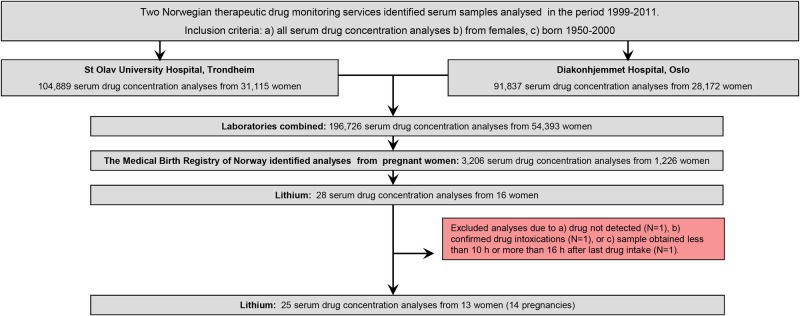
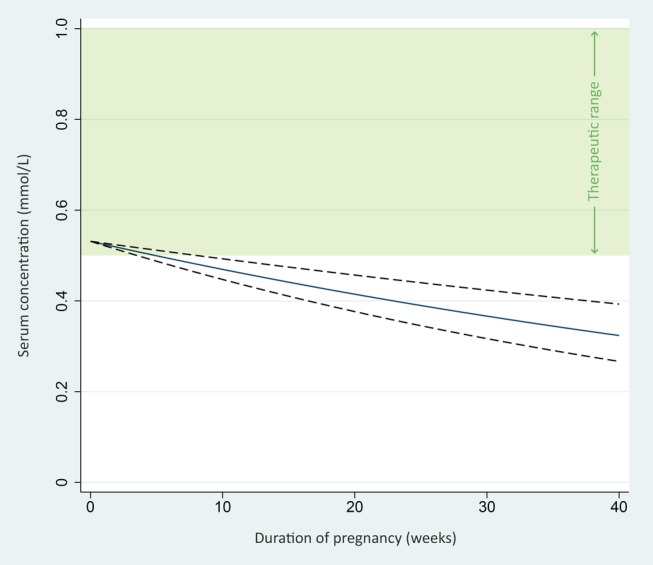
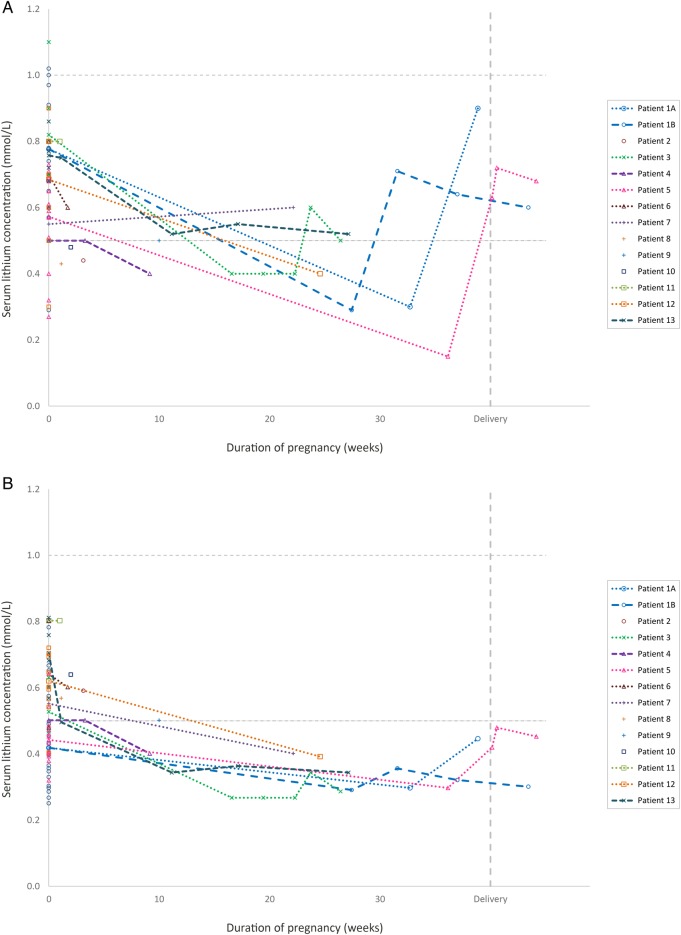
Overall, coupling 196 726 serum concentration measurements from 54 393 women to the national birth registry identified 25 serum lithium concentration analyses obtained from a total of 14 pregnancies in 13 women, and 63 baseline analyses from the same women. Dose-adjusted serum concentrations in the third trimester were significantly lower than baseline (-34%; CI -44% to -23%, p<0.001).
Pregnancy causes a clinically relevant decline in maternal lithium serum concentrations. In order to maintain stable lithium concentrations during the third trimester of pregnancy, doses generally need to be increased by 50%. Individual variability in decline implies that lithium levels should be even more closely monitored throughout pregnancy and in the puerperium than in non-pregnant women to ensure adequate dosing.
妊娠可能会导致药物处置、剂量需求及临床反应发生变化。就锂盐而言,迄今为止仅在一项针对4名参与者的单剂量研究中探讨过孕期的处置变化情况。本研究的目的是在更大量的患者群体及自然状态下,确定妊娠对锂盐血清水平的影响。
对来自挪威两项常规治疗药物监测服务的患者数据进行回顾性观察研究,并与挪威医疗出生登记处相链接。
挪威,1999年10月至2011年12月。
采用线性混合模型,将孕期锂盐的剂量调整药物浓度与其自身基线(非孕期)值进行比较。
总体而言,将54393名女性的196726次血清浓度测量结果与国家出生登记处相匹配,确定了13名女性共14次妊娠的25次血清锂浓度分析结果,以及同一批女性的63次基线分析结果。孕晚期的剂量调整血清浓度显著低于基线水平(-34%;可信区间-44%至-23%,p<0.001)。
妊娠会导致母体锂盐血清浓度出现具有临床意义的下降。为了在妊娠晚期维持稳定的锂盐浓度,通常需要将剂量增加50%。下降的个体差异意味着,与非孕期女性相比,在整个孕期及产褥期应更密切地监测锂盐水平,以确保给药剂量合适。