Tsai Hsin-Yuan, Matika Oswald, Edwards Stefan McKinnon, Antolín-Sánchez Roberto, Hamilton Alastair, Guy Derrick R, Tinch Alan E, Gharbi Karim, Stear Michael J, Taggart John B, Bron James E, Hickey John M, Houston Ross D
The Roslin Institute and Royal (Dick) School of Veterinary Studies, University of Edinburgh, Midlothian EH25 9RG, United Kingdom.
Hendrix Genetics Aquaculture BV/ NetherlandsVilla 'de Körver', Spoorstraat 695831 CK BoxmeerThe Netherlands.
G3 (Bethesda). 2017 Apr 3;7(4):1377-1383. doi: 10.1534/g3.117.040717.
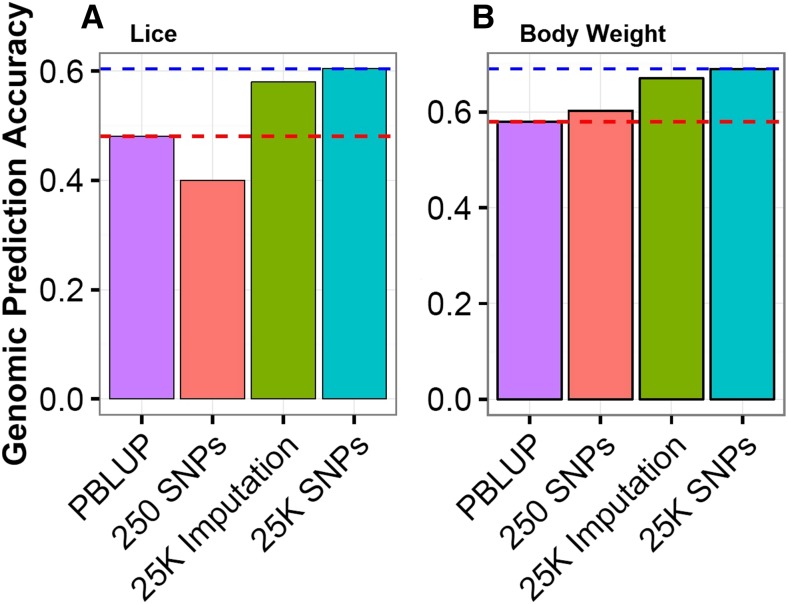
Genomic selection uses genome-wide marker information to predict breeding values for traits of economic interest, and is more accurate than pedigree-based methods. The development of high density SNP arrays for Atlantic salmon has enabled genomic selection in selective breeding programs, alongside high-resolution association mapping of the genetic basis of complex traits. However, in sibling testing schemes typical of salmon breeding programs, trait records are available on many thousands of fish with close relationships to the selection candidates. Therefore, routine high density SNP genotyping may be prohibitively expensive. One means to reducing genotyping cost is the use of genotype imputation, where selected key animals (, breeding program parents) are genotyped at high density, and the majority of individuals (, performance tested fish and selection candidates) are genotyped at much lower density, followed by imputation to high density. The main objectives of the current study were to assess the feasibility and accuracy of genotype imputation in the context of a salmon breeding program. The specific aims were: (i) to measure the accuracy of genotype imputation using medium (25 K) and high (78 K) density mapped SNP panels, by masking varying proportions of the genotypes and assessing the correlation between the imputed genotypes and the true genotypes; and (ii) to assess the efficacy of imputed genotype data in genomic prediction of key performance traits (sea lice resistance and body weight). Imputation accuracies of up to 0.90 were observed using the simple two-generation pedigree dataset, and moderately high accuracy (0.83) was possible even with very low density SNP data (∼250 SNPs). The performance of genomic prediction using imputed genotype data was comparable to using true genotype data, and both were superior to pedigree-based prediction. These results demonstrate that the genotype imputation approach used in this study can provide a cost-effective method for generating robust genome-wide SNP data for genomic prediction in Atlantic salmon. Genotype imputation approaches are likely to form a critical component of cost-efficient genomic selection programs to improve economically important traits in aquaculture.
基因组选择利用全基因组标记信息来预测经济性状的育种值,比基于系谱的方法更准确。用于大西洋鲑鱼的高密度SNP阵列的开发,使得在选择性育种计划中能够进行基因组选择,同时也能对复杂性状的遗传基础进行高分辨率关联图谱分析。然而,在鲑鱼育种计划典型的同胞测试方案中,有成千上万与选择候选个体关系密切的鱼有性状记录。因此,常规的高密度SNP基因分型可能成本过高。降低基因分型成本的一种方法是使用基因型填充,即对选定的关键动物(如育种计划的亲本)进行高密度基因分型,而大多数个体(如性能测试鱼和选择候选个体)进行低密度基因分型,然后填充到高密度。本研究的主要目的是评估在鲑鱼育种计划背景下基因型填充的可行性和准确性。具体目标是:(i)通过掩盖不同比例的基因型,并评估填充基因型与真实基因型之间的相关性,来测量使用中等密度(25K)和高密度(78K)映射SNP面板进行基因型填充的准确性;(ii)评估填充基因型数据在关键性能性状(抗海虱能力和体重)基因组预测中的有效性。使用简单的两代系谱数据集观察到填充准确率高达0.90,即使使用非常低密度的SNP数据(约250个SNP)也能达到中等较高的准确率(0.83)。使用填充基因型数据进行基因组预测的性能与使用真实基因型数据相当,且两者均优于基于系谱的预测。这些结果表明,本研究中使用的基因型填充方法可以提供一种经济有效的方法,用于生成用于大西洋鲑鱼基因组预测的可靠全基因组SNP数据。基因型填充方法可能会成为经济高效的基因组选择计划的关键组成部分,以改善水产养殖中的重要经济性状。