Department of Laboratory Medicine and Pathology, Mayo Clinic, Rochester, MN, USA.
Department of Ophthalmology, Mayo Clinic, Rochester, MN, USA.
Mod Pathol. 2017 Jun;30(6):788-796. doi: 10.1038/modpathol.2017.10. Epub 2017 Mar 3.
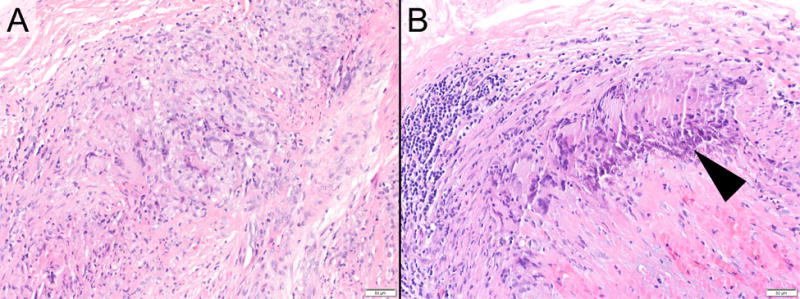
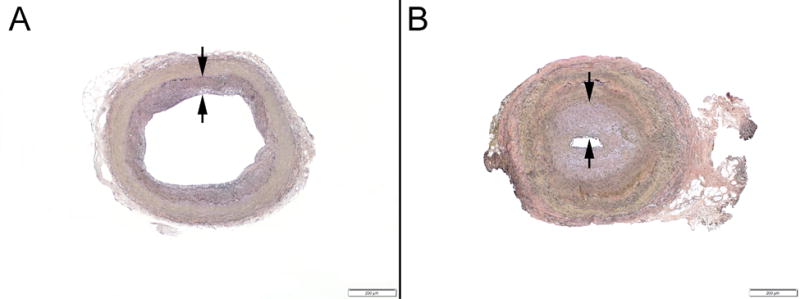
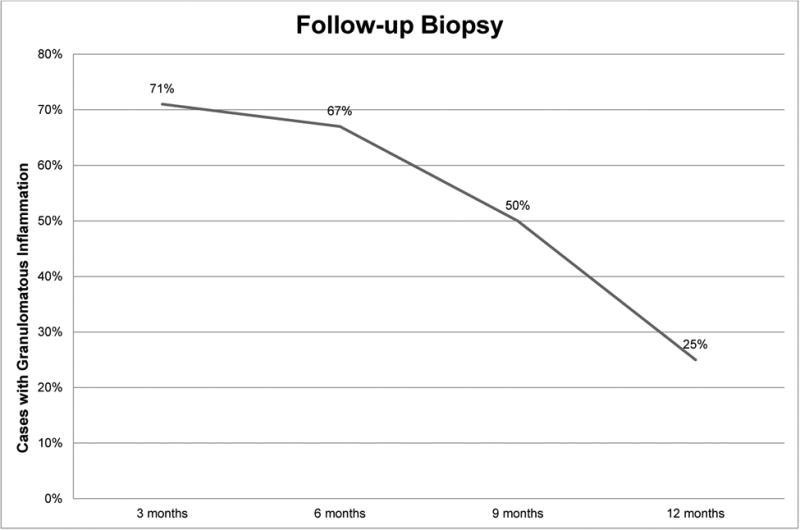
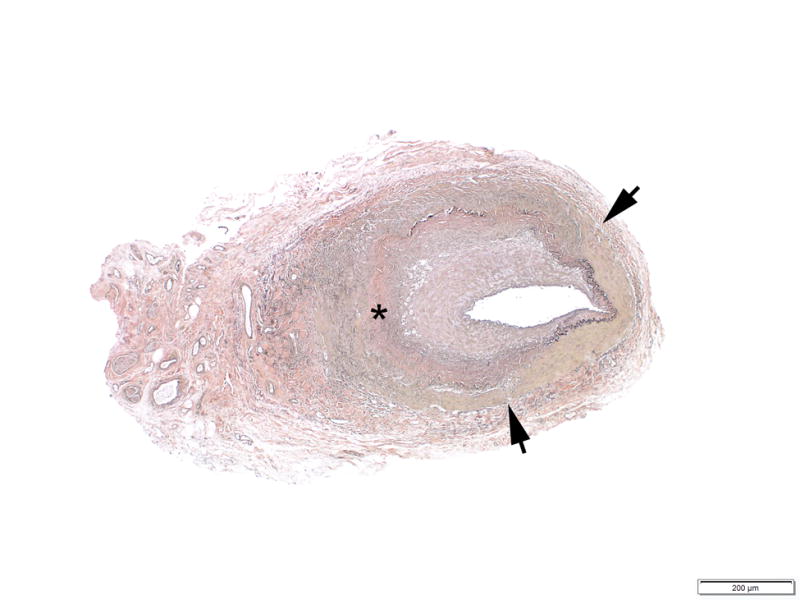
Although clinical signs and symptoms of giant cell arteritis improve promptly after starting glucocorticoid therapy, reports have suggested that the vascular inflammation may persist. To assess the duration and quality of histopathologic changes in treated patients, we prospectively obtained second temporal artery biopsies in patients treated for 3 to 12 months after their first diagnostic biopsy. Forty patients (28 women, 12 men, median age 77 years) agreed to have a second temporal artery biopsy randomly assigned to 3, 6, 9, or 12 months subsequent to the first. Clinical and laboratory evaluation of the patient cohort revealed a typical rapid response and continued suppression of clinical manifestations as a result of glucocorticoid treatment. Histopathologic findings, evaluated in a blinded manner by a cardiovascular pathologist, showed unequivocal findings of vasculitis in 7/10 patients with second temporal artery biopsy at 3 months, 9/12 at 6 months, 4/9 at 9 months, and 4/9 at 12 months. Lymphocytes were present in all positive initial biopsies and remained the dominant cell population in chronically treated patients. Granulomatous inflammation decreased in a time-dependent manner from 78 to 100% at initial biopsy to 50% at 9 months and 25% at 12 months. The increased medial fibrosis noted in the second biopsies (60 vs 33% in primary temporal artery biopsies) suggested that the finding may represent a chronic finding in arteritis. In summary, the response to glucocorticoids in giant cell arteritis was frequently discordant. Clinical manifestations were readily suppressed, but vascular changes were gradual and often incomplete.
虽然巨细胞动脉炎患者在开始糖皮质激素治疗后,其临床症状和体征会迅速改善,但有报道称血管炎症可能持续存在。为了评估治疗患者的组织病理学变化的持续时间和质量,我们前瞻性地在接受治疗的患者中获得了首次诊断性活检后 3 至 12 个月的第二次颞动脉活检。40 名患者(28 名女性,12 名男性,中位年龄 77 岁)同意随机分配至首次活检后 3、6、9 或 12 个月进行第二次颞动脉活检。对患者队列进行的临床和实验室评估显示出典型的快速反应,并且糖皮质激素治疗持续抑制临床表现。由心血管病理学家进行的盲法组织病理学评估显示,在首次活检后 3 个月的 10 名患者中有 7 名、6 个月时有 12 名、9 个月时有 4 名和 12 个月时有 4 名患者的第二次颞动脉活检存在明确的血管炎表现。淋巴细胞存在于所有阳性初始活检中,并且在接受慢性治疗的患者中仍然是主要细胞群。肉芽肿性炎症从初始活检的 78%至 100%逐渐减少,9 个月时降至 50%,12 个月时降至 25%。第二次活检中观察到的中层纤维化增加(60%比原发性颞动脉活检中的 33%)表明该发现可能代表动脉炎的慢性表现。总之,巨细胞动脉炎对糖皮质激素的反应经常不一致。临床表现容易得到抑制,但血管变化是渐进的,而且常常不完全。