Forzati Floriana, De Martino Marco, Esposito Francesco, Sepe Romina, Pellecchia Simona, Malapelle Umberto, Pellino Gianluca, Arra Claudio, Fusco Alfredo
Istituto di Endocrinologia ed Oncologia Sperimentale "G. Salvatore" - CNR c/o Dipartimento di Medicina Molecolare e Biotecnologie Mediche, Università degli Studi di Napoli "Federico II", Naples, Italy.
Dipartimento di Sanità Pubblica, Università degli Studi di Napoli "Federico II", Naples, Italy.
BMC Cancer. 2017 Mar 4;17(1):170. doi: 10.1186/s12885-017-3158-z.
Loss of CBX7 expression has been described in several malignant neoplasias, including human colon and thyroid carcinomas proposing CBX7 as a tumor suppressor gene with a key role in cancer progression. This role is supported from the development of benign and malignant neoplasias in Cbx7 null mice. The aim of our work has been to investigate the mechanisms underlying the CBX7 oncosuppressor activity by analyzing the microRNAs (miRNAs) regulated by CBX7.
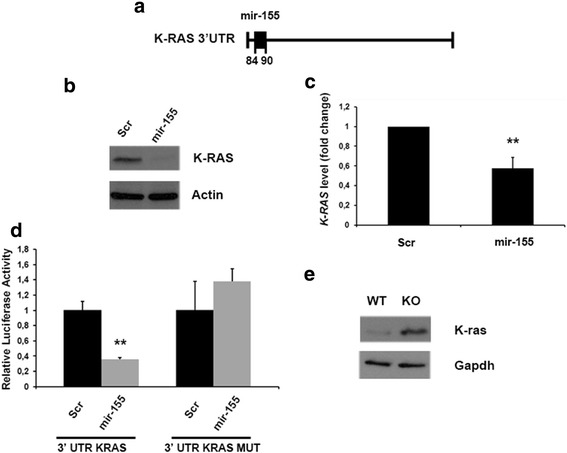
The miRNA expression profiles of the mouse embryonic fibroblasts (MEFs) null for Cbx7 and the wild-type counterpart were analyzed by the miRNACHIP microarray and then validated by qRT-PCR. To asses KRAS as target of miR-155 we evaluated the protein levels after transfection of the synthetic miR-155. Human colon carcinoma samples have been investigated for the expression of CBX7 and miR-155.
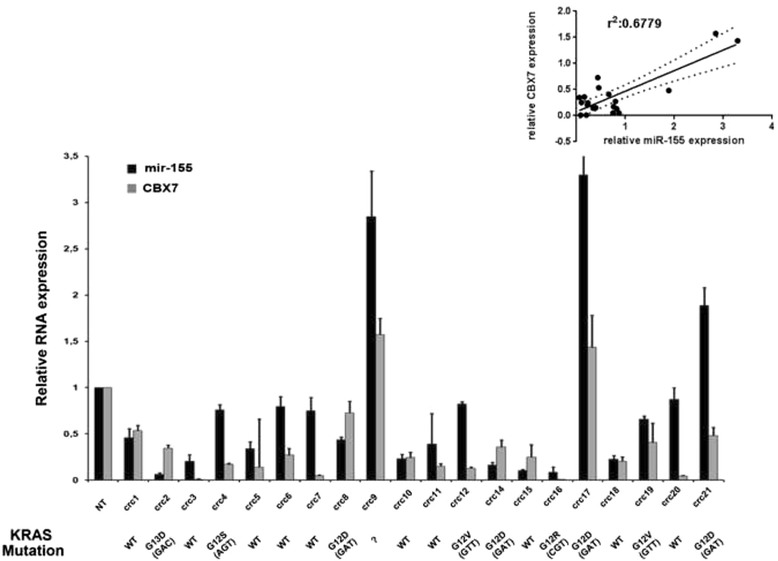
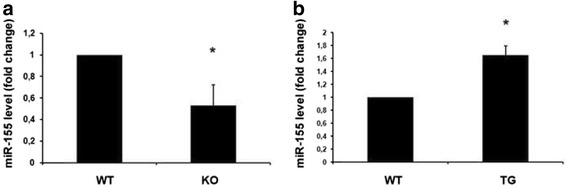
Twenty miRNAs were found upregulated and nine, including miR-155, downregulated in cbx7-null MEFS in comparison with the wild-type ones. Then, we focused on miR-155 since several studies have shown its deregulated expression in several human malignancies and, moreover, was the most downregulated miRNA. Subsequently, we searched for miR-155 target genes demonstrating that KRAS protein levels are directly modulated by miR-155. A direct significant correlation (r = 0.6779) between CBX7 and miR-155 expression levels was found in a set of human colon carcinoma tissue samples.
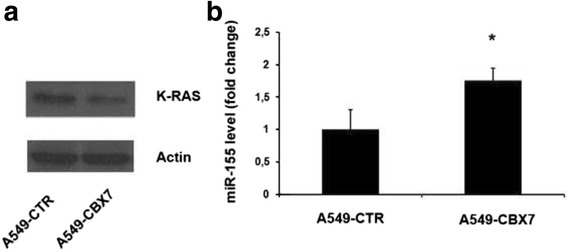
miR-155 is positively regulated by CBX7 in MEFs and colon carcinomas, and has KRAS as one of the target genes likely accounting for the anti-apoptotic activity ascribed to miR-155 in some tissue contexts.
在包括人类结肠癌和甲状腺癌在内的多种恶性肿瘤中,已发现CBX7表达缺失,这表明CBX7作为一种肿瘤抑制基因,在癌症进展中起关键作用。Cbx7基因敲除小鼠中良性和恶性肿瘤的发生支持了这一作用。我们研究的目的是通过分析受CBX7调控的微小RNA(miRNA),来探究CBX7抑癌活性的潜在机制。
通过miRNACHIP微阵列分析Cbx7基因敲除的小鼠胚胎成纤维细胞(MEF)和野生型对照的miRNA表达谱,然后通过qRT-PCR进行验证。为了评估KRAS是否为miR-155的靶标,我们在转染合成的miR-155后评估了蛋白质水平。对人类结肠癌样本进行了CBX7和miR-155表达的研究。
与野生型相比,在Cbx7基因敲除的MEF中发现20种miRNA上调,9种miRNA下调,其中包括miR-155。然后,我们聚焦于miR-155,因为多项研究表明其在多种人类恶性肿瘤中表达失调,而且它是下调最明显的miRNA。随后,我们寻找miR-155的靶基因,结果表明KRAS蛋白水平直接受miR-155调控。在一组人类结肠癌组织样本中,发现CBX7和miR-155表达水平之间存在直接显著相关性(r = 0.6779)。
在MEF和结肠癌中,miR-155受CBX7正向调控,并且KRAS是其靶基因之一,这可能解释了在某些组织环境中miR-155具有的抗凋亡活性。