Gornowicz-Porowska Justyna, Seraszek-Jaros Agnieszka, Bowszyc-Dmochowska Monika, Kaczmarek Elżbieta, Pietkiewicz Paweł, Bartkiewicz Paweł, Dmochowski Marian
Autoimmune Blistering Dermatoses Section, Department of Dermatology, Poznan University of Medical Sciences, Poznan, Poland.
Department of Bioinformatics and Computational Biology, Poznan University of Medical Sciences, Poznan, Poland.
Postepy Dermatol Alergol. 2017 Feb;34(1):21-27. doi: 10.5114/ada.2017.65617. Epub 2017 Feb 7.
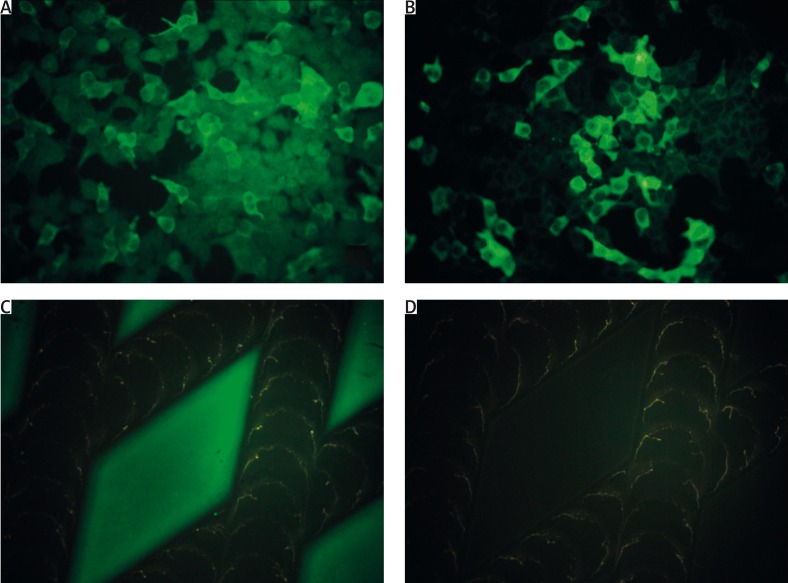
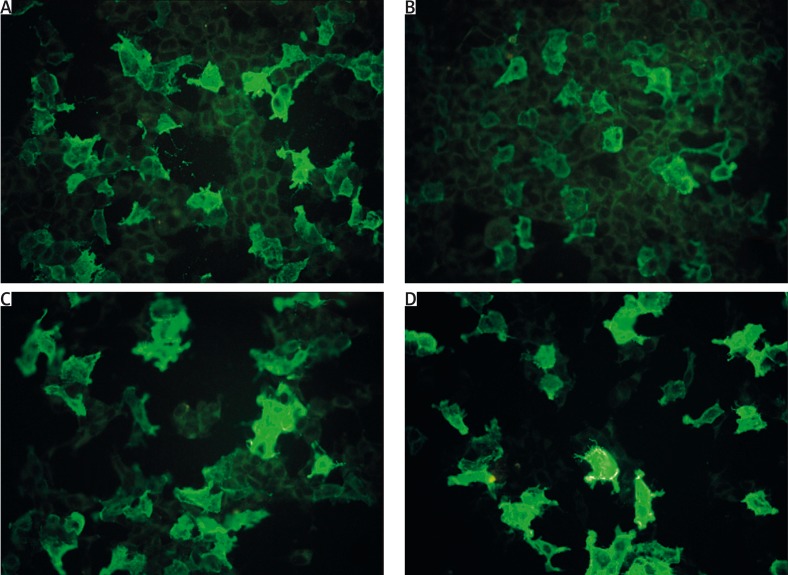
Pemphigus and bullous pemphigoid (BP) are identified by autoantibodies (abs) against desmoglein 1, 3 (DSG1/3) and BP180/BP230, respectively. A novel mosaic to indirect immunofluorescence (IIF) using purified BP180 recombinant proteins spotted on slide and transfected cells expressing BP230, DSG1, DSG3 is available. The commercial (IgG detection) and modified (IgG4 detection) mosaic for indirect immunofluorescence (IIFc - IIF commercial, IIFm - IIF modified) and IgG ELISAs were evaluated in pemphigus and bullous pemphigoid (BP) molecular diagnostics.
To compare diagnostic accuracy of commercial (IgG detection) and modified (IgG4 detection) mosaic IIF assay and to examine the diagnostic value of ELISAs in relation to mosaic IIF in routine laboratory diagnostics of pemphigus and BP.
Sera from 37 BP and 19 pemphigus patients were studied. Associations between tests were assessed using Fisher's exact test.
There are associations between the positive/negative samples detected by IIFc with desmoglein1 (DSG1)/desmoglein3 (DSG3)/BP230 transfected cells and ELISAs and no association between anti-BP180 IgG detection by IIFc and ELISA. IIFm with DSG1 and DSG3 showed both 100% sensitivity and 100% and 78% specificity, respectively, and 100% and 83% positive predictive value in relation to IIFc. IIFm with BP230 had 87% specificity, 55% sensitivity, whereas IIFm with BP180 had a 100% sensitivity and 13% specificity in relation to IIFc.
The IIFc with DSG1/DSG3/BP230 transfected cells, excluding BP180 spots, is an alternative method to ELISA in pemphigus/BP diagnostics. IgG4 antibodies, both pathogenically and diagnostically important, are inconsistently detectable with IIFm.
天疱疮和大疱性类天疱疮(BP)分别由针对桥粒芯糖蛋白1、3(DSG1/3)和BP180/BP230的自身抗体(Abs)所识别。一种新型的间接免疫荧光(IIF)方法问世,该方法使用点样于载玻片上的纯化BP180重组蛋白以及表达BP230、DSG1、DSG3的转染细胞。对用于间接免疫荧光的商业化(IgG检测)和改良型(IgG4检测)嵌合体(IIFc - 商业化IIF,IIFm - 改良型IIF)以及IgG酶联免疫吸附测定(ELISA)在天疱疮和大疱性类天疱疮(BP)的分子诊断中进行了评估。
比较商业化(IgG检测)和改良型(IgG4检测)嵌合体IIF检测的诊断准确性,并在天疱疮和BP的常规实验室诊断中检验ELISA相对于嵌合体IIF的诊断价值。
研究了37例BP患者和19例天疱疮患者的血清。使用Fisher精确检验评估检测之间的相关性。
IIFc检测的抗桥粒芯糖蛋白1(DSG1)/桥粒芯糖蛋白3(DSG3)/BP230转染细胞的阳性/阴性样本与ELISA检测结果之间存在相关性,而IIFc检测抗BP180 IgG与ELISA检测结果之间无相关性。检测DSG1和DSG3的IIFm分别显示出100%的敏感性以及100%和78%的特异性,相对于IIFc的阳性预测值分别为100%和83%。检测BP230的IIFm特异性为87%,敏感性为55%,而检测BP180的IIFm相对于IIFc敏感性为100%,特异性为13%。
使用DSG1/DSG3/BP230转染细胞(不包括BP180点样)的IIFc是天疱疮/BP诊断中ELISA的替代方法。致病性和诊断上均重要的IgG4抗体,用IIFm检测时结果不一致。