Eliasson Pernilla, Svensson Rene B, Giannopoulos Antonis, Eismark Christian, Kjær Michael, Schjerling Peter, Heinemeier Katja M
Institute of Sports Medicine Copenhagen, Dept of Orthopedic Surgery M, Bispebjerg Hospital and Center for Healthy Aging, Faculty of Health and Medical Sciences, University of Copenhagen, Copenhagen, Denmark.
Department of Clinical and Experimental Medicine, Linköping University, Linköping, Sweden.
PLoS One. 2017 Mar 6;12(3):e0172797. doi: 10.1371/journal.pone.0172797. eCollection 2017.
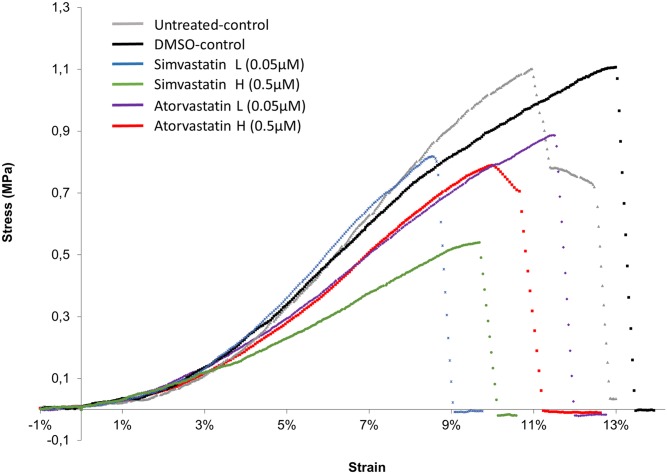
Treatment with lipid-lowering drugs, statins, is common all over the world. Lately, the occurrence of spontaneous tendon ruptures or tendinosis have suggested a negative influence of statins upon tendon tissue. But how statins might influence tendons is not clear. In the present study, we investigated the effect of statin treatment on mechanical strength, cell proliferation, collagen content and gene expression pattern in a tendon-like tissue made from human tenocytes in vitro. Human tendon fibroblasts were grown in a 3D tissue culture model (tendon constructs), and treated with either simvastatin or atorvastatin, low or high dose, respectively, for up to seven days. After seven days of treatment, mechanical testing of the constructs was performed. Collagen content and cell proliferation were also determined. mRNA levels of several target genes were measured after one or seven days. The maximum force and stiffness were reduced by both statins after 7 days (p<0.05), while the cross sectional area was unaffected. Further, the collagen content was reduced by atorvastatin (p = 0.01) and the cell proliferation rate was decreased by both types of statins (p<0.05). Statin treatment also introduced increased mRNA levels of MMP-1, MMP-3, MMP-13, TIMP-1 and decreased levels of collagen type 1 and 3. In conclusion, statin treatment appears to have a negative effect on tendon matrix quality as seen by a reduced strength of the tendon constructs. Further, activated catabolic changes in the gene expression pattern and a reduced collagen content indicated a disturbed balance in matrix production of tendon due to statin administration.
使用降脂药物他汀类进行治疗在全球都很常见。最近,自发性肌腱断裂或肌腱病的出现提示了他汀类药物对肌腱组织有负面影响。但他汀类药物如何影响肌腱尚不清楚。在本研究中,我们在体外研究了他汀类药物治疗对由人肌腱细胞制成的类肌腱组织的机械强度、细胞增殖、胶原蛋白含量和基因表达模式的影响。人肌腱成纤维细胞在三维组织培养模型(肌腱构建体)中生长,分别用低剂量或高剂量的辛伐他汀或阿托伐他汀处理长达7天。治疗7天后,对构建体进行力学测试并测定胶原蛋白含量和细胞增殖情况。在1天或7天后测量几个靶基因的mRNA水平。7天后,两种他汀类药物均降低了最大力和刚度(p<0.05),而横截面积未受影响。此外,阿托伐他汀降低了胶原蛋白含量(p = 0.01),两种他汀类药物均降低了细胞增殖率(p<0.05)。他汀类药物治疗还使MMP-1、MMP-3、MMP-13、TIMP-1的mRNA水平升高,I型和III型胶原蛋白水平降低。总之,从肌腱构建体强度降低可以看出,他汀类药物治疗似乎对肌腱基质质量有负面影响。此外,基因表达模式中分解代谢的激活变化和胶原蛋白含量的降低表明,他汀类药物给药导致肌腱基质产生的平衡受到干扰。