Frondelius Kasper, Borg Madelene, Ericson Ulrika, Borné Yan, Melander Olle, Sonestedt Emily
Diabetes and Cardiovascular Disease-Genetic Epidemiology, Department of Clinical Sciences Malmö, Lund University, Jan Waldenströms gata 35, SE-20502 Malmö, Sweden.
Cardiovascular Epidemiology, Department of Clinical Sciences Malmö, Lund University, Jan Waldenströms gata 35, SE-20502 Malmö, Sweden.
Nutrients. 2017 Feb 28;9(3):211. doi: 10.3390/nu9030211.
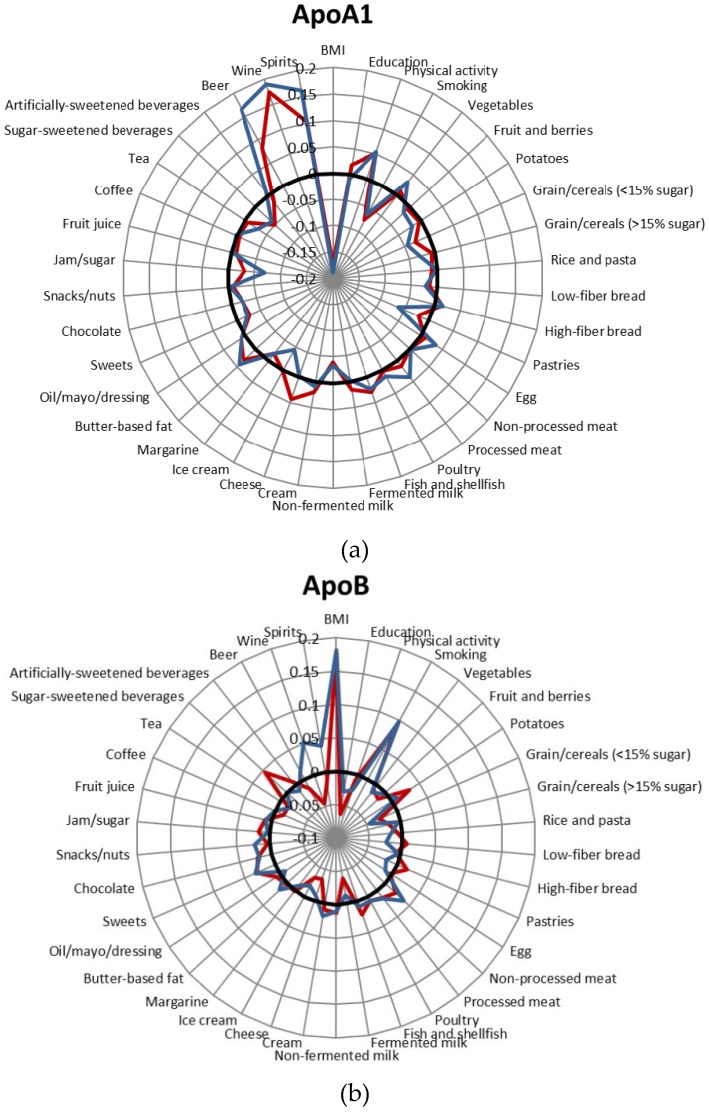
Low serum apolipoprotein (Apo) A1 concentrations and high serum ApoB concentrations may be better markers of the risk of cardiovascular disease than high-density lipoprotein (HDL) and low-density lipoprotein (LDL). However, the associations between modifiable lifestyle factors and Apo concentrations have not been investigated in detail. Therefore, this study investigated the associations between Apo concentrations and education, lifestyle factors and dietary intake (macronutrients and 34 food groups). These cross-sectional associations were examined among 24,984 individuals in a Swedish population-based cohort. Baseline examinations of the cohort were conducted between 1991 and 1996. Dietary intake was assessed using a modified diet history method. The main determinants of high ApoA1 concentrations ( between 0.05 and 0.25) were high alcohol consumption, high physical activity, non-smoking, and a low body mass index (BMI), and the main determinants of high ApoB concentrations were smoking and a high BMI. The intake of sucrose and food products containing added sugar (such as pastries, sweets, chocolate, jam/sugar and sugar-sweetened beverages) was negatively correlated with ApoA1 concentrations and positively correlated with ApoB concentrations and the ApoB/ApoA1 ratio, whereas the intake of fermented dairy products, such as fermented milk and cheese, was positively correlated with ApoA1 concentrations and negatively correlated with the ApoB/ApoA1 ratio. These results indicate that smoking, obesity, low physical activity, low alcohol consumption and a diet high in sugar and low in fermented dairy products are correlated with an unfavorable Apo profile.
低血清载脂蛋白(Apo)A1浓度和高血清ApoB浓度可能比高密度脂蛋白(HDL)和低密度脂蛋白(LDL)更能作为心血管疾病风险的标志物。然而,可改变的生活方式因素与Apo浓度之间的关联尚未得到详细研究。因此,本研究调查了Apo浓度与教育程度、生活方式因素和饮食摄入(常量营养素和34个食物组)之间的关联。在瑞典一个基于人群的队列中的24984名个体中对这些横断面关联进行了研究。该队列的基线检查在1991年至1996年期间进行。饮食摄入采用改良的饮食史方法进行评估。高ApoA1浓度(0.05至0.25之间)的主要决定因素是高酒精摄入量、高体力活动、不吸烟和低体重指数(BMI),而高ApoB浓度的主要决定因素是吸烟和高BMI。蔗糖和含添加糖的食品(如糕点、糖果、巧克力、果酱/糖和含糖饮料)的摄入量与ApoA1浓度呈负相关,与ApoB浓度和ApoB/ApoA1比值呈正相关,而发酵乳制品(如发酵乳和奶酪)的摄入量与ApoA1浓度呈正相关,与ApoB/ApoA1比值呈负相关。这些结果表明,吸烟、肥胖、低体力活动、低酒精摄入量以及高糖和低发酵乳制品的饮食与不良的Apo谱相关。