• 文献检索
  • 文档翻译
  • 深度研究
  • 学术资讯
  • Suppr Zotero 插件Zotero 插件
  • 邀请有礼
  • 套餐&价格
  • 历史记录
应用&插件
Suppr Zotero 插件Zotero 插件浏览器插件Mac 客户端Windows 客户端微信小程序
定价
高级版会员购买积分包购买API积分包
服务
文献检索文档翻译深度研究API 文档MCP 服务
关于我们
关于 Suppr公司介绍联系我们用户协议隐私条款
关注我们

Suppr 超能文献

核心技术专利:CN118964589B侵权必究
粤ICP备2023148730 号-1Suppr @ 2026

文献检索

告别复杂PubMed语法,用中文像聊天一样搜索,搜遍4000万医学文献。AI智能推荐,让科研检索更轻松。

立即免费搜索

文件翻译

保留排版,准确专业,支持PDF/Word/PPT等文件格式,支持 12+语言互译。

免费翻译文档

深度研究

AI帮你快速写综述,25分钟生成高质量综述,智能提取关键信息,辅助科研写作。

立即免费体验

在腊塔纳基里省(柬埔寨)进行疟疾被动病例检测,以发现疟疾风险较高的村庄。

Passive case detection of malaria in Ratanakiri Province (Cambodia) to detect villages at higher risk for malaria.

作者信息

Heng Somony, Durnez Lies, Mao Sokny, Siv Sovannaroth, Tho Sochantha, Mean Vanna, Sluydts Vincent, Coosemans Marc

机构信息

National Center for Parasitology, Entomology and Malaria Control, Phnom Penh, Cambodia.

Department of Biomedical Sciences, Institute of Tropical Medicine, Antwerp, Belgium.

出版信息

Malar J. 2017 Mar 6;16(1):104. doi: 10.1186/s12936-017-1758-3.

DOI:10.1186/s12936-017-1758-3
PMID:28264678
原文链接:https://pmc.ncbi.nlm.nih.gov/articles/PMC5340042/
Abstract

BACKGROUND

Cambodia reduced malaria incidence by more than 75% between 2000 and 2015, a target of the Millennium Development Goal 6. The Cambodian Government aims to eliminate all forms of malaria by 2025. The country's malaria incidence is highly variable at provincial level, but less is known at village level. This study used passive case detection (PCD) data at village level in Ratanakiri Province from 2010 to 2014 to describe incidence trends and identify high-risk areas of malaria to be primarily targeted towards malaria elimination.

METHODS

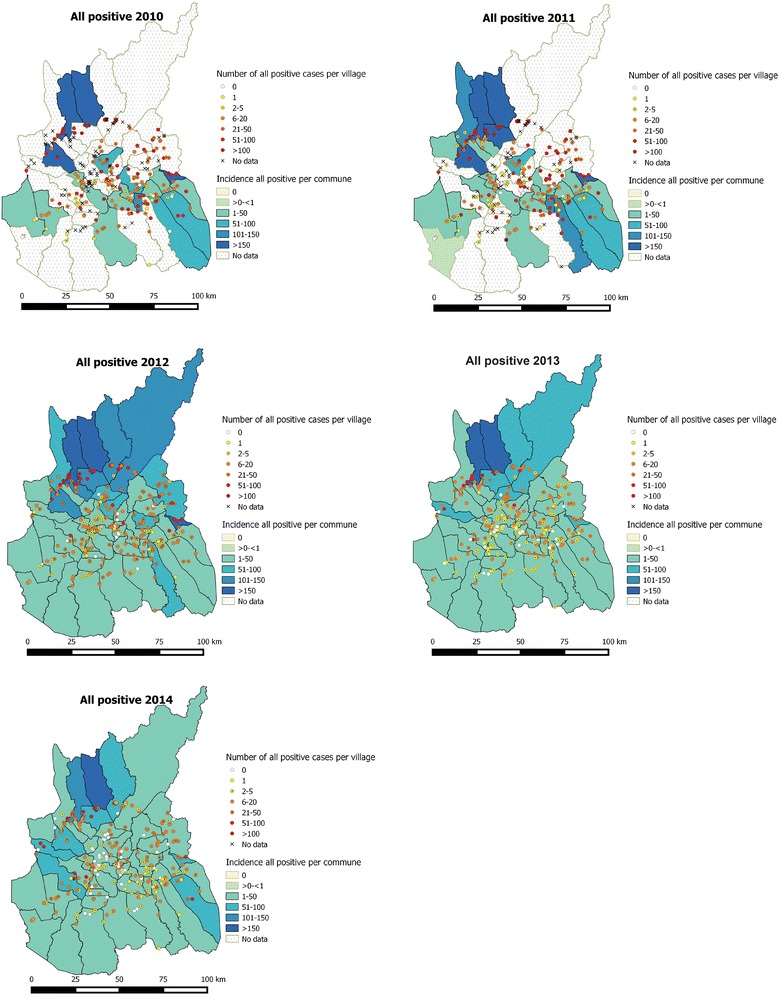
In 2010, the Cambodian malaria programme created a Malaria Information System (MIS) to capture malaria information at village level through PCD by village malaria workers and health facilities. The MIS data of Ratanakiri Province 2010-2014 were used to calculate annual incidence rates by Plasmodium species at province and commune levels. For estimating the trend at provincial level only villages reporting each year were selected. The communal incidences and the number of cases per village were visualized on a map per Plasmodium species and per year. Analysis of spatial clustering of village malaria cases by Plasmodium species was performed by year.

RESULTS

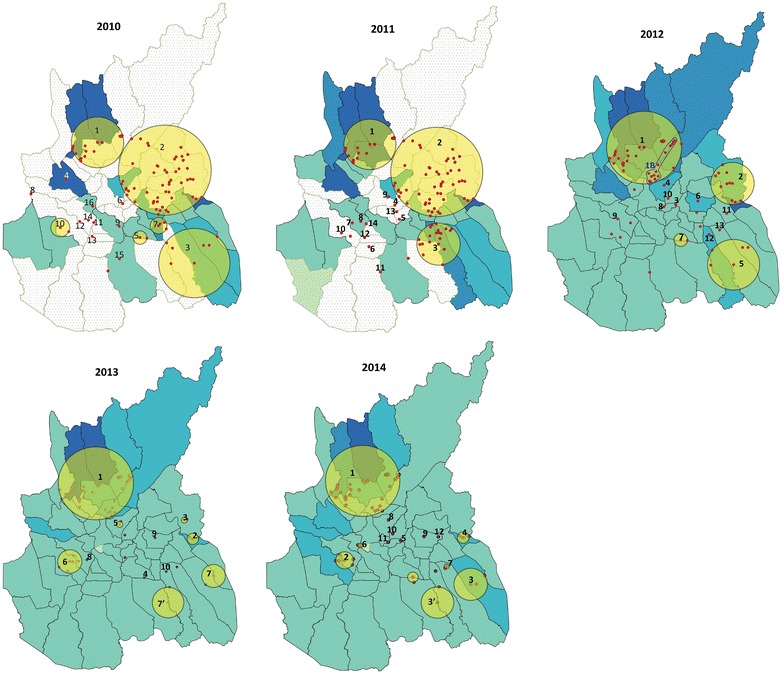
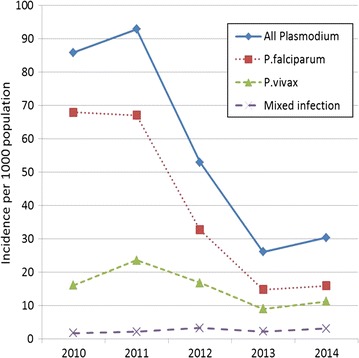
Overall, malaria annual incidence rates per 1000 inhabitants decreased from 86 (2010) to 30 (2014). Falciparum incidence decreased (by 79% in 2014 compared to 2010; CI 95% 76-82%) more rapidly than vivax incidence (by 19% in 2014 compared to 2010; CI 95% 5-32%). There were ten to 16 significant spatial clusters each year. Big clusters tended to extend along the Cambodian-Vietnamese border and along the Sesan River. Three clusters appeared throughout all years (2010-2014): one with 21 villages appeared each year, the second shrunk progressively from 2012 to 2014 and the third was split into two smaller clusters in 2013 and 2014.

CONCLUSION

The decline of malaria burden can be attributed to intensive malaria control activities implemented in the areas: distribution of a long-lasting insecticidal net per person and early diagnosis and prompt treatment. Dihydro-artemisinin piperaquine was the only first-line treatment for all malaria cases. No radical treatment with primaquine was provided for Plasmodium vivax cases, which could explain the slow decrease of P. vivax due to relapses. To achieve malaria elimination by 2025, priority should be given to the control of stable malaria clusters appearing over time.

摘要

背景

柬埔寨在2000年至2015年间将疟疾发病率降低了75%以上,这是千年发展目标6的一项指标。柬埔寨政府旨在到2025年消除所有形式的疟疾。该国省级层面的疟疾发病率差异很大,但村级层面的情况了解较少。本研究利用2010年至2014年腊塔纳基里省村级层面的被动病例检测(PCD)数据来描述发病率趋势,并确定疟疾的高风险地区,以便主要针对这些地区开展疟疾消除工作。

方法

2010年,柬埔寨疟疾项目创建了疟疾信息系统(MIS),通过村级疟疾防治人员和卫生设施的被动病例检测来收集村级层面的疟疾信息。利用腊塔纳基里省2010 - 2014年的MIS数据,按疟原虫种类计算省和公社层面的年发病率。仅为估算省级层面的趋势,选取了每年上报的村庄。按疟原虫种类和年份,将各公社的发病率及每个村庄的病例数绘制成地图。每年对按疟原虫种类划分的村级疟疾病例进行空间聚集性分析。

结果

总体而言,每1000名居民的疟疾年发病率从2010年的86例降至2014年的30例。恶性疟发病率下降(2014年相较于2010年下降了79%;95%置信区间76 - 82%)比间日疟发病率下降(2014年相较于2010年下降了19%;95%置信区间5 - 32%)更为迅速。每年有10至16个显著的空间聚集区。大的聚集区往往沿着柬埔寨与越南边境以及塞桑河延伸。有三个聚集区在2010 - 2014年期间一直存在:一个每年有21个村庄,第二个从2012年到2014年逐渐缩小,第三个在2013年和2014年分裂成两个较小的聚集区。

结论

疟疾负担的下降可归因于在这些地区开展的强化疟疾防控活动:每人分发长效驱虫蚊帐以及早期诊断和及时治疗。双氢青蒿素哌喹是所有疟疾病例的唯一一线治疗药物。间日疟病例未提供伯氨喹进行根治治疗,这可能解释了间日疟因复发导致下降缓慢的原因。为在2025年实现疟疾消除,应优先控制长期存在的稳定疟疾聚集区。
https://cdn.ncbi.nlm.nih.gov/pmc/blobs/dd17/5340042/074cc4956f02/12936_2017_1758_Fig4_HTML.jpg
https://cdn.ncbi.nlm.nih.gov/pmc/blobs/dd17/5340042/f55ccc73124d/12936_2017_1758_Fig1_HTML.jpg
https://cdn.ncbi.nlm.nih.gov/pmc/blobs/dd17/5340042/6e67531253a4/12936_2017_1758_Fig2_HTML.jpg
https://cdn.ncbi.nlm.nih.gov/pmc/blobs/dd17/5340042/9cc645d5c474/12936_2017_1758_Fig3_HTML.jpg
https://cdn.ncbi.nlm.nih.gov/pmc/blobs/dd17/5340042/074cc4956f02/12936_2017_1758_Fig4_HTML.jpg
https://cdn.ncbi.nlm.nih.gov/pmc/blobs/dd17/5340042/f55ccc73124d/12936_2017_1758_Fig1_HTML.jpg
https://cdn.ncbi.nlm.nih.gov/pmc/blobs/dd17/5340042/6e67531253a4/12936_2017_1758_Fig2_HTML.jpg
https://cdn.ncbi.nlm.nih.gov/pmc/blobs/dd17/5340042/9cc645d5c474/12936_2017_1758_Fig3_HTML.jpg
https://cdn.ncbi.nlm.nih.gov/pmc/blobs/dd17/5340042/074cc4956f02/12936_2017_1758_Fig4_HTML.jpg

相似文献

1
Passive case detection of malaria in Ratanakiri Province (Cambodia) to detect villages at higher risk for malaria.在腊塔纳基里省(柬埔寨)进行疟疾被动病例检测,以发现疟疾风险较高的村庄。
Malar J. 2017 Mar 6;16(1):104. doi: 10.1186/s12936-017-1758-3.
2
Submicroscopic Plasmodium prevalence in relation to malaria incidence in 20 villages in western Cambodia.柬埔寨西部20个村庄中与疟疾发病率相关的亚显微疟原虫流行情况。
Malar J. 2017 Jan 31;16(1):56. doi: 10.1186/s12936-017-1703-5.
3
Forest malaria in Cambodia: the occupational and spatial clustering of Plasmodium vivax and Plasmodium falciparum infection risk in a cross-sectional survey in Mondulkiri province, Cambodia.柬埔寨森林地区疟疾:柬埔寨蒙多基里省横断面调查中间日疟原虫和恶性疟原虫感染风险的职业及空间聚集情况
Malar J. 2020 Nov 19;19(1):413. doi: 10.1186/s12936-020-03482-4.
4
Geographical patterns of malaria transmission based on serological markers for falciparum and vivax malaria in Ratanakiri, Cambodia.基于柬埔寨腊塔纳基里省恶性疟和间日疟血清学标志物的疟疾传播地理模式。
Malar J. 2016 Oct 19;15(1):510. doi: 10.1186/s12936-016-1558-1.
5
History of malaria treatment as a predictor of subsequent subclinical parasitaemia: a cross-sectional survey and malaria case records from three villages in Pailin, western Cambodia.疟疾治疗史作为后续亚临床寄生虫血症预测指标的研究:柬埔寨西部拜林三个村庄的横断面调查及疟疾病例记录
Malar J. 2016 Apr 26;15:240. doi: 10.1186/s12936-016-1284-8.
6
Household level spatio-temporal analysis of Plasmodium falciparum and Plasmodium vivax malaria in Ethiopia.埃塞俄比亚恶性疟原虫和间日疟原虫疟疾的家庭层面时空分析
Parasit Vectors. 2017 Apr 20;10(1):196. doi: 10.1186/s13071-017-2124-6.
7
Efficacy of topical mosquito repellent (picaridin) plus long-lasting insecticidal nets versus long-lasting insecticidal nets alone for control of malaria: a cluster randomised controlled trial.局部驱蚊剂(派卡瑞丁)加长效驱虫蚊帐与单独使用长效驱虫蚊帐控制疟疾的效果:一项群组随机对照试验。
Lancet Infect Dis. 2016 Oct;16(10):1169-1177. doi: 10.1016/S1473-3099(16)30148-7. Epub 2016 Jun 29.
8
Identification and characterization of areas of high and low risk for asymptomatic malaria infections at sub-village level in Ratanakiri, Cambodia.在柬埔寨腊塔纳基里省,以村庄为单位鉴定和描述无症状疟疾病例的高、低风险区域。
Malar J. 2018 Jan 15;17(1):27. doi: 10.1186/s12936-017-2169-1.
9
Declining malaria transmission in rural Amazon: changing epidemiology and challenges to achieve elimination.亚马逊农村地区疟疾传播的下降:流行病学的变化及实现消除疟疾的挑战
Malar J. 2016 May 10;15(1):266. doi: 10.1186/s12936-016-1326-2.
10
Persistent Plasmodium falciparum and Plasmodium vivax infections in a western Cambodian population: implications for prevention, treatment and elimination strategies.柬埔寨西部人群中恶性疟原虫和间日疟原虫的持续感染:对预防、治疗及消除策略的启示
Malar J. 2016 Mar 24;15:181. doi: 10.1186/s12936-016-1224-7.

引用本文的文献

1
Evaluating malaria reactive surveillance and response strategies in northeast Cambodia: a mixed-methods study.柬埔寨东北部疟疾反应性监测与应对策略评估:一项混合方法研究。
Malar J. 2025 Jul 13;24(1):229. doi: 10.1186/s12936-025-05475-7.
2
Clinical malaria incidence and health seeking pattern in geographically heterogeneous landscape of western Kenya.肯尼亚西部地理景观差异大,疟疾临床发病率和求医行为。
BMC Infect Dis. 2022 Oct 3;22(1):768. doi: 10.1186/s12879-022-07757-w.
3
Households or Hotspots? Defining Intervention Targets for Malaria Elimination in Ratanakiri Province, Eastern Cambodia.

本文引用的文献

1
Geographical patterns of malaria transmission based on serological markers for falciparum and vivax malaria in Ratanakiri, Cambodia.基于柬埔寨腊塔纳基里省恶性疟和间日疟血清学标志物的疟疾传播地理模式。
Malar J. 2016 Oct 19;15(1):510. doi: 10.1186/s12936-016-1558-1.
2
Plasmodium vivax Malaria in Cambodia.柬埔寨的间日疟原虫疟疾
Am J Trop Med Hyg. 2016 Dec 28;95(6 Suppl):97-107. doi: 10.4269/ajtmh.16-0208. Epub 2016 Oct 5.
3
Efficacy of topical mosquito repellent (picaridin) plus long-lasting insecticidal nets versus long-lasting insecticidal nets alone for control of malaria: a cluster randomised controlled trial.
家庭还是疫点?柬埔寨东部腊塔纳基里省消除疟疾的干预目标界定。
J Infect Dis. 2019 Aug 9;220(6):1034-1043. doi: 10.1093/infdis/jiz211.
4
A Critical Enquiry into Variability of Insecticidal Net Use in Cambodia: Implications for Assessing Appropriateness of Malaria Elimination Interventions.柬埔寨杀虫剂使用的变异性的批判性探究:对评估消除疟疾干预措施的适宜性的影响。
Am J Trop Med Hyg. 2019 Jun;100(6):1424-1432. doi: 10.4269/ajtmh.18-0730.
5
Spatiotemporal patterns of malaria at cross-boundaries area in Menoreh Hills, Java, Indonesia.印度尼西亚爪哇门罗埃丘陵跨界地区疟疾的时空格局。
Malar J. 2019 Mar 15;18(1):80. doi: 10.1186/s12936-019-2717-y.
6
The tolerability of single low dose primaquine in glucose-6-phosphate deficient and normal falciparum-infected Cambodians.葡萄糖-6-磷酸脱氢酶缺乏和正常的恶性疟原虫感染的柬埔寨人中单次低剂量磷酸萘酚喹的耐受性。
BMC Infect Dis. 2019 Mar 12;19(1):250. doi: 10.1186/s12879-019-3862-1.
7
Malaria knowledge, preventive actions, and treatment-seeking behavior among ethnic minorities in Ratanakiri Province, Cambodia: a community-based cross-sectional survey.柬埔寨腊塔纳基里省少数民族的疟疾知识、预防措施和求医行为:基于社区的横断面调查。
BMC Public Health. 2018 Oct 26;18(1):1206. doi: 10.1186/s12889-018-6123-0.
8
Analysis of clinical malaria disease patterns and trends in Vietnam 2009-2015.2009-2015 年越南临床疟疾疾病模式和趋势分析。
Malar J. 2018 Sep 17;17(1):332. doi: 10.1186/s12936-018-2478-z.
9
Importance of household-level risk factors in explaining micro-epidemiology of asymptomatic malaria infections in Ratanakiri Province, Cambodia.家庭层面风险因素对柬埔寨腊塔纳基里省无症状疟疾病例微流行病学的解释作用。
Sci Rep. 2018 Aug 3;8(1):11643. doi: 10.1038/s41598-018-30193-3.
局部驱蚊剂(派卡瑞丁)加长效驱虫蚊帐与单独使用长效驱虫蚊帐控制疟疾的效果:一项群组随机对照试验。
Lancet Infect Dis. 2016 Oct;16(10):1169-1177. doi: 10.1016/S1473-3099(16)30148-7. Epub 2016 Jun 29.
4
Mapping Malaria Risk in Low Transmission Settings: Challenges and Opportunities.绘制低传播环境中的疟疾风险图:挑战与机遇。
Trends Parasitol. 2016 Aug;32(8):635-645. doi: 10.1016/j.pt.2016.05.001. Epub 2016 May 26.
5
Assuring access to topical mosquito repellents within an intensive distribution scheme: a case study in a remote province of Cambodia.在密集分发计划中确保获得局部用驱蚊剂:柬埔寨一个偏远省份的案例研究
Malar J. 2015 Nov 24;14:468. doi: 10.1186/s12936-015-0960-4.
6
The effect of malaria control on Plasmodium falciparum in Africa between 2000 and 2015.2000年至2015年期间疟疾控制对非洲恶性疟原虫的影响。
Nature. 2015 Oct 8;526(7572):207-211. doi: 10.1038/nature15535. Epub 2015 Sep 16.
7
High Mobility and Low Use of Malaria Preventive Measures Among the Jarai Male Youth Along the Cambodia-Vietnam Border.柬埔寨-越南边境地区贾莱族青年男性的疟疾预防措施使用情况及流动性分析
Am J Trop Med Hyg. 2015 Oct;93(4):810-818. doi: 10.4269/ajtmh.15-0259. Epub 2015 Aug 17.
8
Socio-economic, epidemiological and geographic features based on GIS-integrated mapping to identify malarial hotspots.基于地理信息系统集成绘图的社会经济、流行病学和地理特征,以识别疟疾热点地区。
Malar J. 2015 May 7;14:192. doi: 10.1186/s12936-015-0685-4.
9
Plasmodium vivax malaria at households: spatial clustering and risk factors in a low endemicity urban area of the northwestern Peruvian coast.秘鲁西北海岸低流行率城市地区家庭间的间日疟原虫疟疾:空间聚集性及危险因素
Malar J. 2015 Apr 24;14:176. doi: 10.1186/s12936-015-0670-y.
10
Spatial, temporal, and spatiotemporal analysis of malaria in Hubei Province, China from 2004-2011.2004年至2011年中国湖北省疟疾的空间、时间及时空分析
Malar J. 2015 Apr 8;14:145. doi: 10.1186/s12936-015-0650-2.