Institute of Tropical Medicine, Antwerp, Belgium.
National Center for Parasitology Entomology and Malaria Control, Phnom Penh, Cambodia.
Am J Trop Med Hyg. 2019 Jun;100(6):1424-1432. doi: 10.4269/ajtmh.18-0730.
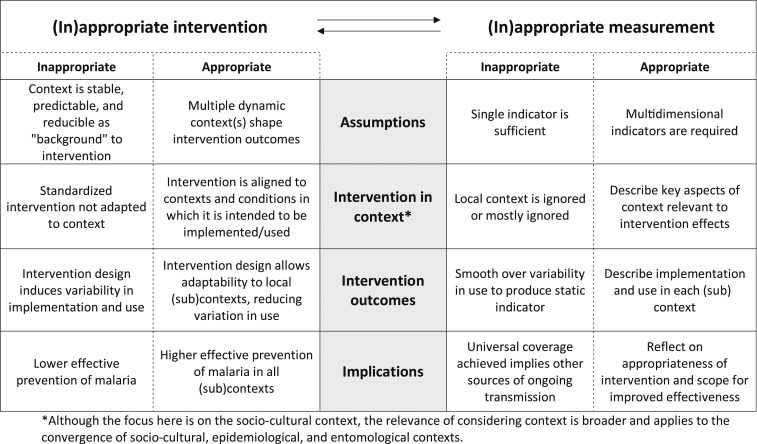
Distributing long-lasting insecticidal nets (LLINs) to individuals living in malaria-endemic regions is a cornerstone of global malaria control. National malaria control programs aim to achieve "universal coverage" of at-risk populations to reach LLINs' full potential to reduce malaria, progress of which is then measured by indicators constructed from standardized questionnaires. Through an exploration of variability in LLIN use in Cambodia, we argue that indicators of universal coverage of LLINs are not sufficiently commensurate with the realities they are intended to measure, limiting the suitability of the data to serve program and policy purposes in a malaria elimination era. Reflecting on the various sources of variability in LLIN use, we apply and extend the concept of "appropriateness" as a third prong to the widely used "efficacy" and "effectiveness" criteria for evaluating LLINs as a tool for malaria prevention. Describing first the different dimensions of the intervention and the sociocultural context separately, we will further show how the variability underlying both is affected and induced by inappropriate aspects of the intervention and the measurements of its impact. We consider the gap between "net use" and the numerical representations of such local net use justifies further exploration of potential strategies to improve LLIN use in subgroups where persisting malaria transmission clusters.
在疟疾流行地区向个人分发长效驱虫蚊帐(LLINs)是全球疟疾控制的基石。国家疟疾控制规划旨在实现高危人群的“普遍覆盖”,以充分发挥 LLIN 减少疟疾的潜力,然后通过来自标准化问卷的指标来衡量进展。通过探索柬埔寨长效驱虫蚊帐使用的变异性,我们认为 LLIN 普遍覆盖的指标与它们旨在衡量的实际情况不够一致,这限制了数据在疟疾消除时代为规划和政策目的服务的适用性。考虑到长效驱虫蚊帐使用变异性的各种来源,我们将“适当性”概念应用和扩展为评估长效驱虫蚊帐作为疟疾预防工具的广泛使用的“功效”和“有效性”标准的第三个方面。首先分别描述干预措施的不同维度和社会文化背景,我们将进一步展示基础干预措施和其影响测量的不适当方面如何影响和引发变异性。我们认为“蚊帐使用”和此类当地蚊帐使用的数字表示之间的差距证明了进一步探索改善持续疟疾传播群集中的亚组中长效驱虫蚊帐使用的潜在策略是合理的。